
 13 Oct 2026









'Turkey to continue protecting its right in East Med.'
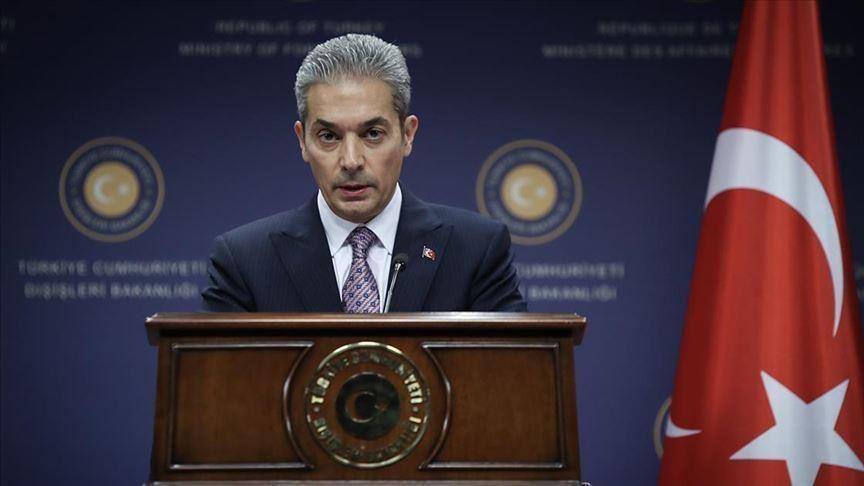
Foreign Ministry spokesman says new license for additional oil exploration is in line with UN continental shelf, according to Anadolu Agency.
Turkey's Foreign Ministry spokesman on Tuesday said the country is determined to "protect the rights of Turkey and Turkish Cypriots in the Eastern Mediterranean".
In a statement, Hami Aksoy said Turkish Petroleum Corporation's recent application for a permit for additional oil exploration and drilling activities in the East Mediterranean is within the boundaries of UN's continental shelf for Turkey.
Underlining that Turkey "will resolutely continue to exercise its sovereign rights in this area", Aksoy said the country's "seismic research and drilling activities are carried out according to the previously determined program."
Aksoy's remarks came shortly after Greek Foreign Minister Nikos Dendias claimed Turkey was deploying "illegal" means in the Eastern Mediterranean.
Moreover, Turkish Ambassador in Athens Burak Ozugergin said on Tuesday that Ankara's call for dialogue with Athens has gone unanswered.
According to diplomatic sources, Ozugergin attended a meeting at the Greek Foreign Ministry and said Turkey's position is known and transparent on various issues including hydrocarbon exploration and extraction.
Turkey has several times sought dialogue with Greece on these issues, but Athens failed to make any response, he added.
In 1974, following a coup aiming at Cyprus’ annexation by Greece, Ankara had to intervene as a guarantor power. In 1983, the Turkish Republic of Northern Cyprus was founded.
The decades since have seen several attempts to resolve the Cyprus dispute, all ending in failure. The latest one, held with the participation of the guarantor countries – Turkey, Greece, and the UK – ended in 2017 in Switzerland.
Turkey has consistently contested the Greek Cypriot administration’s unilateral drilling in the Eastern Mediterranean, asserting that the Turkish Republic of Northern Cyprus (TRNC) also has rights to the resources in the area.
Since last year, Ankara has sent drilling vessels to the Eastern Mediterranean, asserting the right of Turkey and the TRNC to the resources of the region.
Athens and Greek Cypriots have opposed the move, threatening to arrest the ships’ crews and enlisting EU leaders to join their criticism.
02.06.2020 12:59


 Latest news
Latest news
Latest newsGeorgia’s Constitutional Court Continues Case on Banning Opposition Parties: Political Pluralism at Stake
12.Oct.2026
Azerbaijan and Iran Step Up Security Contacts Amid Hijab Protests
12.Oct.2026
Personnel Shortages Complicate Ukrainian Forces’ Rotation: Ukraine Faces Long-Term Challenges on the Front Line
11.Oct.2026
Trump Eases Sanctions on Russian Fuel After Talks with Putin: Kyiv Fears Boost to Moscow’s War Revenues
10.Oct.2026
Putin Seeks to Strengthen Russia’s Influence in the Post-Soviet Space Through the CIS
10.Oct.2026
Russia and the South Caucasus: External Pressure, Political Competition and a Crisis of Trust
10.Oct.2026
Peaceful Settlement Between Armenia and Azerbaijan: Moving from Declarations to Implementation
10.Oct.2026
Moldova Ready to Accept as Many Ukrainians as Necessary if Situation Worsens This Winter
09.Oct.2026
Turkmenistan Turns Avaza into a Regional Diplomatic Hub as Caspian, Central Asian and CIS Agendas Converge
08.Oct.2026
Romania Scrambles Spanish F-18s After Aerial Targets Detected Near Ukrainian Border
07.Oct.2026
Berlin Deepens Defence Partnership with Kyiv: Germany to Provide Ukraine with €1 Billion in Military Aid
07.Oct.2026
European Parliament Against Georgian Dream: EU Prepares New Response to Tbilisi
06.Oct.2026
Bulgarian Foreign Minister to Discuss European Security and International Law in the Netherlands
05.Oct.2026
Rheinmetall in Bulgaria: Sofia Emerges as a New NATO Defence-Industrial Hub in the Balkans
05.Oct.2026
The Cost of a Long War: Moscow Expands Spending Plans Through 2029
05.Oct.2026