
 13 Oct 2026









Bulgaria: Raids on president's office draw large protests
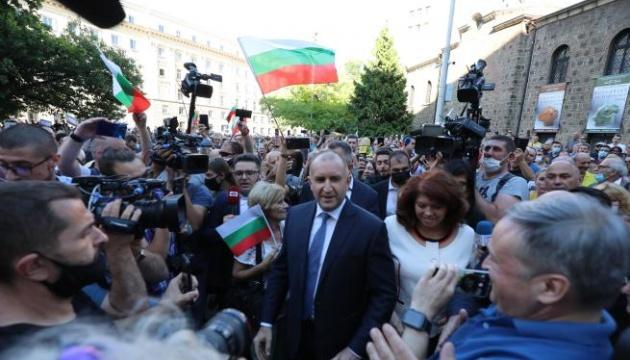
Demonstrators think the searches of the offices of Bulgarian President Rumen Radev are an effort by the conservative prime minister to protect the country's oligarchy from graft investigations, Deutsche Welle reports.
Heavily armed police raided the offices of Bulgarian President Rumen Radev Thursday, in a move that has exposed political rifts between the president and the country's parliament and oligarchy.
The raids targeted Radev's legal affairs and anti-corruption secretary, along with his security and defense minister. The officials were detained for questioning and their offices searched.
Prosecutors said the raids were part of two separate probes into influence-peddling and disclosure of state secrets.
Protecting the oligarchy?
However, Radev's supporters said the raids targeted the president in order to deliberately delay corruption investigations into Bulgaria's political elite and oligarch class.
Thursday's raids were followed by thousands of people taking to the streets of the capital, Sofia, to denounce the raids and chief prosecutor Ivan Geshev.
In a short speech in front of demonstrators, Radev called for a "purge" of the "mafia" within the government and the prosecutor's office.
Protesters responded with chants of "Geshev is a disgrace!" and "Out with the mafia!"
Geshev said ahead of the protests that the raids were not part of "political games."
"It does not matter if it is the president or the premier, the prosecution acts on the basis of evidence and does not care about political consequences," he said.
Corruption widespread in Bulgaria
Radev, who was elected in 2015 with the backing of the Bulgarian Socialist Party, is a harsh critic of the Cabinet of conservative Bulgarian Prime Minister Boyko Borisov, accusing him of having "links with the oligarchs."
Last year, Radev tried to block the appointment of chief prosecutor Ivan Geshev amid public outcry that Geshev would do little to tackle widespread, high-level corruption in Bulgaria.
Radev has also pursued constitutional changes on power limits and improved accountability for the chief prosecutor's office.
Bulgaria is ranked as the most corrupt member state in the European Union by governance watchdog Transparency International.


 Latest news
Latest news
Latest newsGeorgia’s Constitutional Court Continues Case on Banning Opposition Parties: Political Pluralism at Stake
12.Oct.2026
Azerbaijan and Iran Step Up Security Contacts Amid Hijab Protests
12.Oct.2026
Personnel Shortages Complicate Ukrainian Forces’ Rotation: Ukraine Faces Long-Term Challenges on the Front Line
11.Oct.2026
Trump Eases Sanctions on Russian Fuel After Talks with Putin: Kyiv Fears Boost to Moscow’s War Revenues
10.Oct.2026
Putin Seeks to Strengthen Russia’s Influence in the Post-Soviet Space Through the CIS
10.Oct.2026
Russia and the South Caucasus: External Pressure, Political Competition and a Crisis of Trust
10.Oct.2026
Peaceful Settlement Between Armenia and Azerbaijan: Moving from Declarations to Implementation
10.Oct.2026
Moldova Ready to Accept as Many Ukrainians as Necessary if Situation Worsens This Winter
09.Oct.2026
Turkmenistan Turns Avaza into a Regional Diplomatic Hub as Caspian, Central Asian and CIS Agendas Converge
08.Oct.2026
Romania Scrambles Spanish F-18s After Aerial Targets Detected Near Ukrainian Border
07.Oct.2026
Berlin Deepens Defence Partnership with Kyiv: Germany to Provide Ukraine with €1 Billion in Military Aid
07.Oct.2026
European Parliament Against Georgian Dream: EU Prepares New Response to Tbilisi
06.Oct.2026
Bulgarian Foreign Minister to Discuss European Security and International Law in the Netherlands
05.Oct.2026
Rheinmetall in Bulgaria: Sofia Emerges as a New NATO Defence-Industrial Hub in the Balkans
05.Oct.2026
The Cost of a Long War: Moscow Expands Spending Plans Through 2029
05.Oct.2026