
 24 Aug 2026









FM Aivazian: The trilateral statement on Nagorno-Karabakh does not address the key elements of the conflict settlement
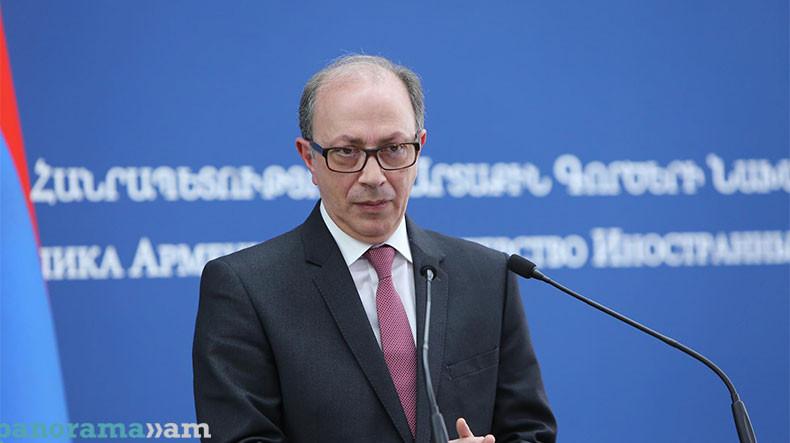
"The use of force by Azerbaijan is a gross violation of the OSCE commitments, including the Helsinki Final Act," Armenian Foreign Minister Ara Aivazian stated on Tuesday at a press conference with OSCE Chairperson-in-Office, Sweden’s Minister for Foreign Affairs Ann Linde.
"During the course of the war, the Azerbaijani forces with active support from Turkey carried out mass crimes, including ethnic cleanings and war crimes against the Artsakh Armenians in explicit violation of international humanitarian law," the minister said, adding four months after the end of military actions Azerbaijan continues violating the international humanitarian law, keeping war prisoners and civilians in captivity. Aivazian reminded of Turkey's direct involvement in transferring thousands of mercenaries and militants to the Nagorno-Karabakh conflict zone which was not only a violation of international law but also the OSCE commitments.
"This established two dangerous precedents - an attempt to solve a conflict through mass crimes and use of force and mass transfer of armed mercenaries and terrorists to OSCE region." Minister Aivazian said, noting with the trilateral statement signed on November 9 to end the Azerbaijani-Turkish aggression and deployment of Russian peacekeepers the Nagorno-Karabakh conflict entered a new stage.
"We consider the trilateral statement as a document aimed at restoring the ceasefire and establishing security. Although it contains some provisions aimed at peaceful settlement of the conflict, the document does not address the key elements of the settlement. The Artsakh status remains the main one based on the self-determination of Artsakh Armenians. The final political solution to the conflict is possible exclusively within the frameworks of the OSCE Minsk Group. The recent developments in the region showed that we need a strong Co-Chairmanship of the OSCE Minsk group that can lead the peace process based on principles worked out throughout the years," stressed Aivazian.


 Latest news
Latest news
Latest newsPutin Authorizes Temporary State Management of Critical Infrastructure Vulnerable to Drone Attacks
24.Aug.2026
The United States Rapidly Expands Missile Production: Pentagon Accelerates Output of Tomahawks and Other Critical Weapons
24.Aug.2026
Record Supplies: Armenia Boosts Fish Exports to Georgia
23.Aug.2026
Political Battle During Wartime: Zelensky Opposes Elections
23.Aug.2026
Romania Approves Construction of One of the Largest Solar Power Plants in Europe
23.Aug.2026
Ex-Ukrainian Defence Minister Fails in Bid to Pressure Zelenskiy
22.Aug.2026
Upper Lars: Why Border Queues Have Become a Political Signal for Georgia and Russia
22.Aug.2026
Russia-Ukraine War: No Decisive Breakthrough on the Front and Intensifying Ukrainian Deep Strikes on Russia
21.Aug.2026
TRIPP, Peace, and a New Geopolitical Crossroads: How Armenia Has Changed One Year After Washington
20.Aug.2026
Tokayev Updates Kazakhstan Foreign Policy Concept: Astana Strengthens Its Strategic Multi Vector Approach
19.Aug.2026
Ukraine Turns Ground Robots into a New Tool in the Fight Against Russia
19.Aug.2026
Tehran Threatens a New Round of War After Talks With the US Collapse
18.Aug.2026
Drones Over Moldova: Accident or a New Threat to National Security?
17.Aug.2026
Spanish F-18 Fighter Jet Shoots Down Drone That Violated Romanian Airspace
17.Aug.2026
The Black Sea Becomes a Risk Zone: Can Turkiye Protect Key Trade Routes?
16.Aug.2026