
 25 Aug 2026









Is there space for the Organization of Turkic States at the Arctic Council?
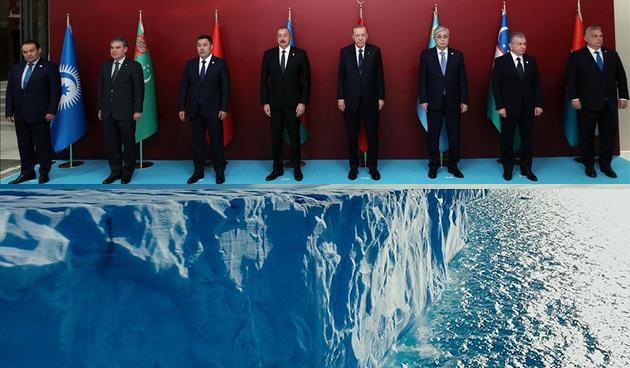
At the recent meeting in Istanbul of the Organization of Turkic States the group’s leaders adopted the “Turkic World 2040 Vision". This vision will serve as the strategic document to guide future cooperation between Turkic states and peoples, TRT World writes.
Of course, as the Organization of Turkic States realises the goals in its 2040 Vision, it will be focusing on regions across the Eurasian landmass with large Turkic populations—namely the South Caucasus and Central Asia. However, if the Organization of Turkic States wants to play a global role while recognising the importance of Turkic culture, language, and shared history one region that the organisation cannot ignore is the Arctic.
Melting ice in the region means new economic opportunities but also new security challenges. According to some estimates, up to 13 percent of undiscovered oil reserves and almost one-third of undiscovered natural gas reserves are in the Arctic. In recent years there has been an increase of shipping, trade, tourism, and energy exploration in the region.
The emerging geopolitical situation in the Arctic has caught the attention of policymakers around the world. Even though there are only eight actual Arctic countries (The US, Canada, Russia, Iceland, Denmark [because of Greenland], Norway, Finland, and Sweden), more countries and international organisations are getting involved in the region. There are good reasons for The Organization of Turkic States to keep an eye on the Arctic region too.
Approximately 500,000 ethnic Turkic people called the Yakuts live in the Russia’s Republic of Sakha (Yakutia) in the Arctic region. The Republic of Sakha is in Siberia and accounts for one-fifth of the Russian Federation’s total landmass. Sixty percent of Sakha is above the Arctic Circle and the region is rich in minerals and other natural resources. Sakha also includes a sizable chunk of Russia’s Arctic coastline where new shipping lanes are connecting European and Asian markets. The Dolgans are another Turkic group in the Arctic. They number around 8,000 and live in the northern parts of Russia’s Krasnoyarsk Krai.
One of the stated aims of the Organization of Turkic States is “promoting the values and interests of the Turkic World in the regional and international arena.” Much of what the organisation does is promote a common heritage and culture between Turkic states and people. Therefore, the Organization of Turkic States should consider applying for Observer status in the Arctic Council.
The Arctic Council is the world’s main multilateral forum concerned with the Arctic region, and focuses on all Arctic policy issues other than defence and security. It was established in 1996 as a way for the eight Arctic countries to coordinate and work together on mutually important issues in the region.
Reflecting the fact that there are many countries, organisations, and indigenous groups that have legitimate interests in the Arctic region, the Arctic Council has three categories of membership: Member States, which include the eight Arctic states; Permanent Participants, which is a category reserved for the six organisations representing indigenous groups that live above the Arctic Circle; and Observers. This category is open to non-Arctic states, intergovernmental and inter-parliamentary organisations, and global and regional nongovernmental organisations.
There are currently 38 Observers including countries like China, Italy, Singapore and various international organisations. Observers are allowed to attend meetings, make oral statements, present written statements, participate in and fund working groups (less than 50 percent of the working group’s budget), and provide views on the issues under discussion.
It should be stressed that if the Organization of Turkic States gets Observer status in the Arctic Council it would not undermine Russia’s sovereignty. Instead, it would merely be one way of many that the organisation will help promote and preserve the Turkic identity of the Yakut and Dolgan people. Afterall, a shared culture is the social fabric of the Organization of Turkic States.
Perhaps Turkey would want to consider applying for Observer status too. Currently, 13 non-Arctic countries have Observer status in the Arctic Council. They cannot vote but can help shape the agenda behind the scenes. Geography is not a factor in obtaining Observer status. For example, Singapore became an Observer in 2013. Geographically, Turkey is much closer to the Arctic Circle than Singapore.
The influence of the Turkic World is on the ascendancy. Notwithstanding some of the tensions in the US-Turkish bilateral relationship, which when placed into its historical context are an anomaly, Turkey remains an important member of NATO and US ally. Hungary, an Observer in the Organization of Turkic States is also a NATO member and US ally. Other countries in the Organization of Turkic States such as Azerbaijan and Kazakhstan are becoming increasingly important for the US on energy security issues, for example.
As an intergovernmental organisation with an interest in the cultural wellbeing and preservation of Turkic people (in this case living above the Arctic Circle) the Organization of Turkic States meets the criteria to become an Observer in the Arctic Council. As it strives towards the goals in the “Turkic World 2040 Vision" it should not ignore the Arctic.


 Latest news
Latest news
Latest newsPutin Authorizes Temporary State Management of Critical Infrastructure Vulnerable to Drone Attacks
24.Aug.2026
The United States Rapidly Expands Missile Production: Pentagon Accelerates Output of Tomahawks and Other Critical Weapons
24.Aug.2026
Record Supplies: Armenia Boosts Fish Exports to Georgia
23.Aug.2026
Political Battle During Wartime: Zelensky Opposes Elections
23.Aug.2026
Romania Approves Construction of One of the Largest Solar Power Plants in Europe
23.Aug.2026
Ex-Ukrainian Defence Minister Fails in Bid to Pressure Zelenskiy
22.Aug.2026
Upper Lars: Why Border Queues Have Become a Political Signal for Georgia and Russia
22.Aug.2026
Russia-Ukraine War: No Decisive Breakthrough on the Front and Intensifying Ukrainian Deep Strikes on Russia
21.Aug.2026
TRIPP, Peace, and a New Geopolitical Crossroads: How Armenia Has Changed One Year After Washington
20.Aug.2026
Tokayev Updates Kazakhstan Foreign Policy Concept: Astana Strengthens Its Strategic Multi Vector Approach
19.Aug.2026
Ukraine Turns Ground Robots into a New Tool in the Fight Against Russia
19.Aug.2026
Tehran Threatens a New Round of War After Talks With the US Collapse
18.Aug.2026
Drones Over Moldova: Accident or a New Threat to National Security?
17.Aug.2026
Spanish F-18 Fighter Jet Shoots Down Drone That Violated Romanian Airspace
17.Aug.2026
The Black Sea Becomes a Risk Zone: Can Turkiye Protect Key Trade Routes?
16.Aug.2026