
 20 Sep 2026









Turkey's National Security Council on March 30 called on Greece to act in line with good neighborly relations and abide by international law, instead of stepping up its policies against Ankara.
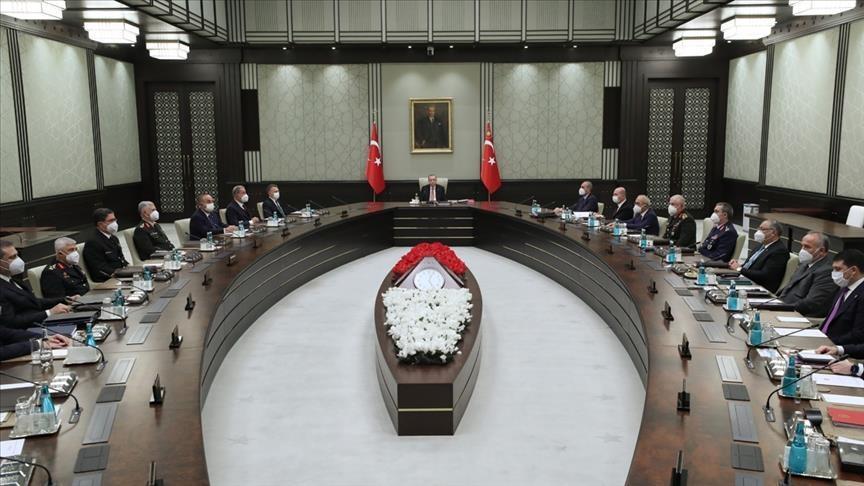
In a three-hour meeting chaired by President Recep Tayyip Erdoğan in the capital Ankara, senior Turkish officials discussed foreign policy, terrorism, and regional developments, said a council statement.
Greek human rights violations against its Turkish minority and irregular migrants were among issues tackled at the meeting, according to the statement following the meeting held in the presidential complex.
On the crisis in the Eastern Mediterranean, it said countries from outside the region should take a neutral position and a common approach protecting mutual rights and benefits.
Turkey, which has the longest continental coastline in the Eastern Mediterranean, has rejected the maritime boundary claims by Greece and the Greek Cypriot administration, stressing that those excessive claims violate the sovereign rights of Turkey and the Turkish Cypriots.
Ankara last year sent several drillships to explore for energy in the Eastern Mediterranean, asserting its rights in the region, as well as those of the Turkish Republic of Northern Cyprus (TRNC).
Turkish leaders have repeatedly stressed that Ankara is in favor of resolving outstanding problems in the region through international law, good neighborly relations, dialogue, and negotiations.
On the issue of Cyprus, the security council underlined the indispensable need for a permanent and fair resolution based on two independent states to be put on the agenda, adding that the present nearly-half-a-century-old approach that ignored the existence of Turkish Cypriots on the island had been fruitless.
National Security Council calls on Greece to abide by int'l law


 Latest news
Latest news
Latest newsUS Sanctions Target Russias Main Pillar as Moscow Faces New Pressure on Oil Revenues
19.Sep.2026
Russia Begins State Duma Elections Amid War in Ukraine
18.Sep.2026
Bulgaria Strengthens Protection of Strategic Infrastructure Against Drones and Other Threats
18.Sep.2026
Georgia and Enka: How the Namakhvani Dispute Could Affect the Investment Climate
17.Sep.2026
Una Aleksandra Bērziņa-Čerenkova: After Russia’s Invasion, Latvia Began Banning Russian-Language Media
17.Sep.2026
Rainer Saks: Russia сould lose its influence in Armenia, just as it did in the Baltics
16.Sep.2026
Russian Drones Violated Moldovan Airspace Twice During Zelenskys Trips
16.Sep.2026
Operation Vivaldi: Ukraine Reports Advances Near Lyman as Fighting Intensifies
16.Sep.2026
Kazakhstan and South Korea Elevate Ties to Comprehensive Strategic Partnership
16.Sep.2026
Armenia Energy Diversification: Testing the Limits of Dependence on Russian Gas
15.Sep.2026
Tbilisi Distances Itself from Brussels as Kobakhidze Intensifies Criticism of European Policy
14.Sep.2026
Russia Fuel Crisis Gives the US a New Diplomatic Leverage Tool
14.Sep.2026
Trump Calls on Zelenskyy to Stop Strikes on Russian Oil Infrastructure
13.Sep.2026
Ukraine Expands Pressure on Russia’s Shadow Fleet: Moscow’s Oil Logistics Under Threat
13.Sep.2026
The Riga Conference: Europe Prepares for Long-Term Confrontation with Russia and Reshapes Its Security Architecture
12.Sep.2026