
 13 Oct 2026









Armenia FM on Karabakh conflict: If someone is allowed to resolve matters by force, then everyone is allowed
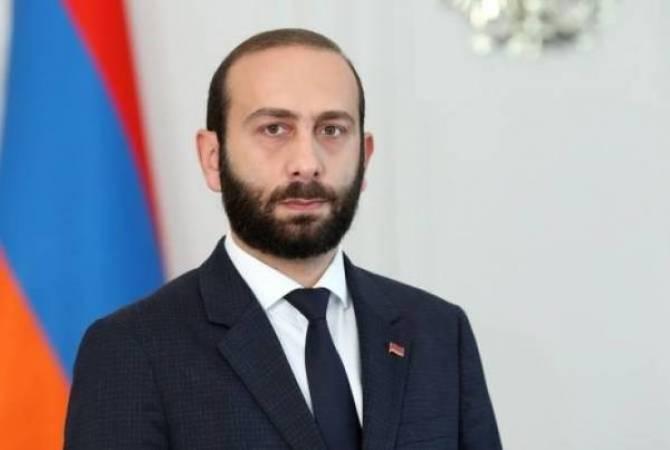
The international community must decide on the matter of the activity of the principle of non-use of force. Armenian Foreign Minister Ararat Mirzoyan stated this at Wednesday’s joint news conference with Alexander Schallenberg, the visiting Austrian Minister for European and International Affairs.
Answering the question about the possibility of signing a peace agreement with Azerbaijan and the respective "red lines" of Armenia, the FM noted that the answers are more than obvious.
"I have already said that the OSCE Minsk Group co-chairing is the only international format endowed with a mandate to find ways to resolve the Karabakh conflict. The solution has not been found yet, and the negotiations in that format must continue," Mirzoyan stressed.
The Armenian Foreign Minister noted that one of the results of this work should be the clarification of the parameters of the universal peace agreement and, in fact, its signing.
"One of the principles is the right of peoples to self-determination. The other principle, the principle of non-use of force, was grossly violated [by Azerbaijan] in 2020. Not only Armenia and Artsakh [(Nagorno-Karabakh)], the whole world must decide whether this principle remains on the agenda, or the states can resolve the fates of the peoples by force. If the rule is violated for one, then such a ‘door’ is opened for the others, too," Ararat Mirzoyan warned.


 Latest news
Latest news
Latest newsGeorgia’s Constitutional Court Continues Case on Banning Opposition Parties: Political Pluralism at Stake
12.Oct.2026
Azerbaijan and Iran Step Up Security Contacts Amid Hijab Protests
12.Oct.2026
Personnel Shortages Complicate Ukrainian Forces’ Rotation: Ukraine Faces Long-Term Challenges on the Front Line
11.Oct.2026
Trump Eases Sanctions on Russian Fuel After Talks with Putin: Kyiv Fears Boost to Moscow’s War Revenues
10.Oct.2026
Putin Seeks to Strengthen Russia’s Influence in the Post-Soviet Space Through the CIS
10.Oct.2026
Russia and the South Caucasus: External Pressure, Political Competition and a Crisis of Trust
10.Oct.2026
Peaceful Settlement Between Armenia and Azerbaijan: Moving from Declarations to Implementation
10.Oct.2026
Moldova Ready to Accept as Many Ukrainians as Necessary if Situation Worsens This Winter
09.Oct.2026
Turkmenistan Turns Avaza into a Regional Diplomatic Hub as Caspian, Central Asian and CIS Agendas Converge
08.Oct.2026
Romania Scrambles Spanish F-18s After Aerial Targets Detected Near Ukrainian Border
07.Oct.2026
Berlin Deepens Defence Partnership with Kyiv: Germany to Provide Ukraine with €1 Billion in Military Aid
07.Oct.2026
European Parliament Against Georgian Dream: EU Prepares New Response to Tbilisi
06.Oct.2026
Bulgarian Foreign Minister to Discuss European Security and International Law in the Netherlands
05.Oct.2026
Rheinmetall in Bulgaria: Sofia Emerges as a New NATO Defence-Industrial Hub in the Balkans
05.Oct.2026
The Cost of a Long War: Moscow Expands Spending Plans Through 2029
05.Oct.2026