
 13 Oct 2026









State Department refers to significant human rights issues in Armenia
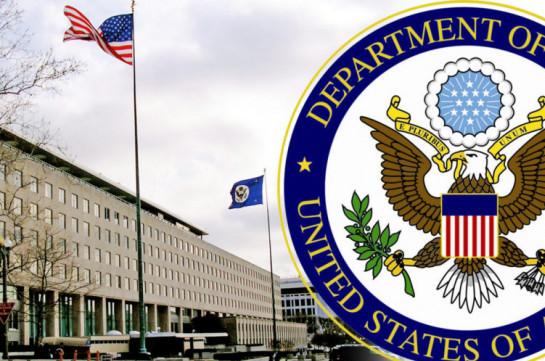
The US Department of State published its annual 2021 Country Reports on Human Rights Practices, in which the authors pointed to some human rights problems in Armenia.
In the report, the authors touched upon snap parliamentary elections, during which Prime Minister Nikol Pashinyan's Civil Contract party received 54 percent of the vote and an overwhelming majority of seats in parliament.
According to the final assessment of October 27 by an international election observation mission under the auspices of the Organization for Security and Cooperation in Europe, voters were given a wide choice of options, the elections were generally well organized, and candidates were able to campaign freely, the report said.
However, the authors say that the elections in Armenia were also highly polarized and marred by increasingly inflammatory rhetoric.
Cases of coercion to participate in campaign events, allegations of vote-buying, blurring of lines between the ruling party and the state, alleged misuse of administrative resources, inadequate campaign finance regulations, and limited opportunities for filing electoral complaints have been documented, the report notes.
The authors also touched upon the war in Nagorno-Karabakh in 2020.
It notes that isolated incidents of violence along the border between the two countries and in some other areas during the year resulted in casualties and detentions.
There were credible reports that ethnic Armenian and Azerbaijani forces resorted to unlawful killings, torture, and other cruel, inhuman, or degrading treatment during, and in some cases after, fighting in November 2020, the authors noted.
The report also touched upon serious human rights issues that had been recorded.
Credible reports include torture by members of the security forces, harsh prison conditions, serious problems with judicial independence along with arbitrary or selective detentions; arbitrary or unlawful interference with privacy; serious violations in the context of the conflict, including torture and other forms of physical violence; severe restrictions on freedom of speech and the media, including criminalization of insults; human trafficking; crimes involving violence or the threat of violence against civil society actors and lesbian, gay, bisexual, transgender, homosexual or intersex people; and the worst forms of child labor.
According to the report, the government has taken only limited steps to investigate and punish alleged abuses by former and current government officials and law enforcement.
Pointing to the unsolved March 1 case, the authors note that the trial of the guilt of former high-ranking government officials in connection with the events that led to the deaths of eight civilians and two policemen during post-election protests in 2008 failed after how the Constitutional Court invalidated the article of the Criminal Code underlying the case.
As of the end of the year, the Armenian parliament had not passed a law establishing a commission of inquiry into human rights violations. The government has taken steps to create new mechanisms for investigating and punishing corruption crimes, the report says.


 Latest news
Latest news
Latest newsGeorgia’s Constitutional Court Continues Case on Banning Opposition Parties: Political Pluralism at Stake
12.Oct.2026
Azerbaijan and Iran Step Up Security Contacts Amid Hijab Protests
12.Oct.2026
Personnel Shortages Complicate Ukrainian Forces’ Rotation: Ukraine Faces Long-Term Challenges on the Front Line
11.Oct.2026
Trump Eases Sanctions on Russian Fuel After Talks with Putin: Kyiv Fears Boost to Moscow’s War Revenues
10.Oct.2026
Putin Seeks to Strengthen Russia’s Influence in the Post-Soviet Space Through the CIS
10.Oct.2026
Russia and the South Caucasus: External Pressure, Political Competition and a Crisis of Trust
10.Oct.2026
Peaceful Settlement Between Armenia and Azerbaijan: Moving from Declarations to Implementation
10.Oct.2026
Moldova Ready to Accept as Many Ukrainians as Necessary if Situation Worsens This Winter
09.Oct.2026
Turkmenistan Turns Avaza into a Regional Diplomatic Hub as Caspian, Central Asian and CIS Agendas Converge
08.Oct.2026
Romania Scrambles Spanish F-18s After Aerial Targets Detected Near Ukrainian Border
07.Oct.2026
Berlin Deepens Defence Partnership with Kyiv: Germany to Provide Ukraine with €1 Billion in Military Aid
07.Oct.2026
European Parliament Against Georgian Dream: EU Prepares New Response to Tbilisi
06.Oct.2026
Bulgarian Foreign Minister to Discuss European Security and International Law in the Netherlands
05.Oct.2026
Rheinmetall in Bulgaria: Sofia Emerges as a New NATO Defence-Industrial Hub in the Balkans
05.Oct.2026
The Cost of a Long War: Moscow Expands Spending Plans Through 2029
05.Oct.2026