
 13 Oct 2026









Iran Slams UN Watchdog Censure Motion In New Blow To Nuclear Talks
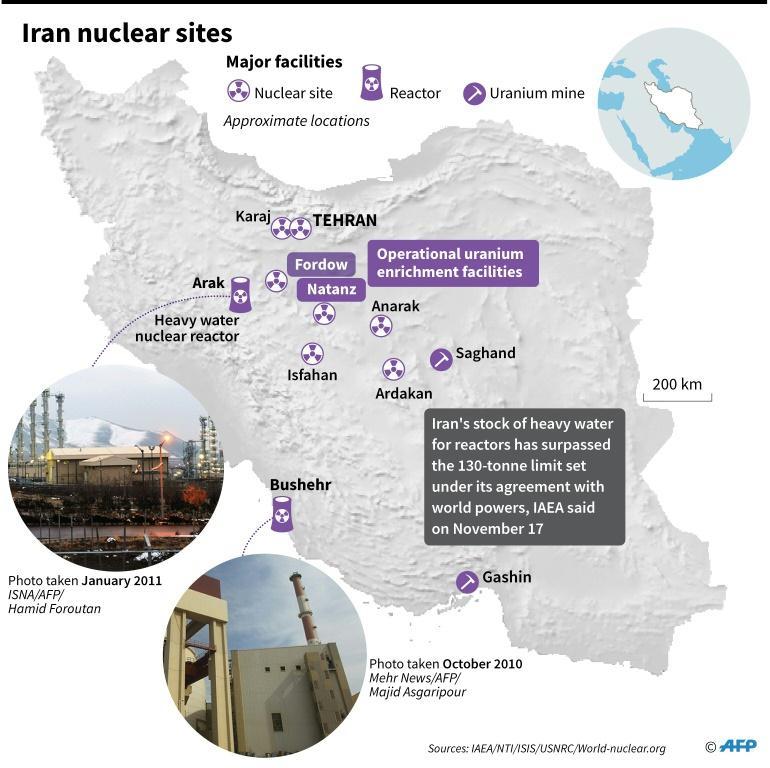
btimes.com: Iran condemned as "unconstructive" Thursday the UN atomic energy watchdog's adoption of a resolution censuring it for non-cooperation, in a new spat that clouded efforts to revive a deal limiting its nuclear activities.
Iran already announced it had disconnected some International Atomic Energy Agency cameras monitoring its nuclear sites in anticipation of the watchdog's adoption of the Western-drafted censure motion Wednesday.
The motion -- approved by 30 members of the IAEA board of governors, with only Russia and China voting against -- was the first to criticise Iran since June 2020.
"Iran condemns the adoption of the resolution presented by the United States, Britain, France and Germany at the Board of Governors meeting of the International Atomic Energy Agency as a political, unconstructive and incorrect action," a foreign ministry statement said.
The resolution came after the IAEA raised concerns about traces of enriched uranium previously found at three sites Tehran had not declared as having hosted nuclear activities.
The agency has said its questions about the three sites of Marivan, Varamin and Turquzabad were "not clarified" in its meetings with Iranian authorities.
Iran, which had already responded angrily to IAEA chief Rafael Grossi's decision to visit Israel ahead of the board of governors meeting, accused the watchdog of relying too much on "fabricated" Israeli intelligence reports.
"The adoption of the resolution, which is based on the hasty and unbalanced report of the director general of the IAEA and on false and fabricated information from the Zionist regime (Israel), will only weaken the process of cooperation and interaction between the Islamic Republic of Iran and the agency," the foreign ministry said.
Iran said it had already taken steps in response to the IAEA censure motion, but gave few new details.
"Iran has taken reciprocal practical steps due to the non-constructive approach of the agency and the adoption of the resolution, including the installation of advanced centrifuges and the deactivation of cameras," the ministry said.
In a statement on Wednesday, Iran's Atomic Energy Organisation stressed that the cameras it had disconnected were not part of its safeguard agreement with the UN watchdog.
The statement did not specify how many cameras had been turned off, but said "more than 80 percent of the agency's existing cameras are operating according to the safeguard agreement and will continue to operate just as before".
After the adoption of the resolution, the US, Britain, France and Germany urged Iran "to fulfil its legal obligations, and cooperate with the IAEA".
"The overwhelming majority vote at the IAEA Board of Governors today sends an unambiguous message to Iran that it must meet its safeguards obligations and provide technically credible clarifications on outstanding safeguards issues," the four governments said in a joint statement.
The US State Department said that if confirmed, Iran's reported reprisals were "extremely regrettable" and "counterproductive" to attempts to revive the 2015 nuclear deal.
The landmark agreement set limits to Iran's nuclear activities in return for relief from international sanctions -- but it has been in disarray since then US president Donald Trump unilaterally withdrew from it in 2018 and reimposed crippling sanctions.
In response, Iran, which has repeatedly denied any ambition to develop a nuclear weapons capability, began rolling back on its own commitments under the deal.
Talks began in April last year on reviving the agreement through the lifting of US sanctions and Iran's return to full compliance but they have stalled in recent months.
The European Union's top diplomat Josep Borrell warned last weekend that the possibility of returning to the accord was "shrinking".
European capitals have expressed mounting concern over how far Iran has gone in resuming nuclear activities since the US began reimposing sanctions.
Iran has built up large stockpiles of enriched uranium, some of it enriched to levels far higher than those needed for nuclear power generation.
The IAEA chief said Monday that it would be "a matter of just a few weeks" before Iran could get sufficient material needed for a nuclear weapon if it continues to develop its programme.


 Latest news
Latest news
Latest newsGeorgia’s Constitutional Court Continues Case on Banning Opposition Parties: Political Pluralism at Stake
12.Oct.2026
Azerbaijan and Iran Step Up Security Contacts Amid Hijab Protests
12.Oct.2026
Personnel Shortages Complicate Ukrainian Forces’ Rotation: Ukraine Faces Long-Term Challenges on the Front Line
11.Oct.2026
Trump Eases Sanctions on Russian Fuel After Talks with Putin: Kyiv Fears Boost to Moscow’s War Revenues
10.Oct.2026
Putin Seeks to Strengthen Russia’s Influence in the Post-Soviet Space Through the CIS
10.Oct.2026
Russia and the South Caucasus: External Pressure, Political Competition and a Crisis of Trust
10.Oct.2026
Peaceful Settlement Between Armenia and Azerbaijan: Moving from Declarations to Implementation
10.Oct.2026
Moldova Ready to Accept as Many Ukrainians as Necessary if Situation Worsens This Winter
09.Oct.2026
Turkmenistan Turns Avaza into a Regional Diplomatic Hub as Caspian, Central Asian and CIS Agendas Converge
08.Oct.2026
Romania Scrambles Spanish F-18s After Aerial Targets Detected Near Ukrainian Border
07.Oct.2026
Berlin Deepens Defence Partnership with Kyiv: Germany to Provide Ukraine with €1 Billion in Military Aid
07.Oct.2026
European Parliament Against Georgian Dream: EU Prepares New Response to Tbilisi
06.Oct.2026
Bulgarian Foreign Minister to Discuss European Security and International Law in the Netherlands
05.Oct.2026
Rheinmetall in Bulgaria: Sofia Emerges as a New NATO Defence-Industrial Hub in the Balkans
05.Oct.2026
The Cost of a Long War: Moscow Expands Spending Plans Through 2029
05.Oct.2026