
 13 Oct 2026









Everyone Associated With Putin Is At Risk Of Being Sanctioned — State Department
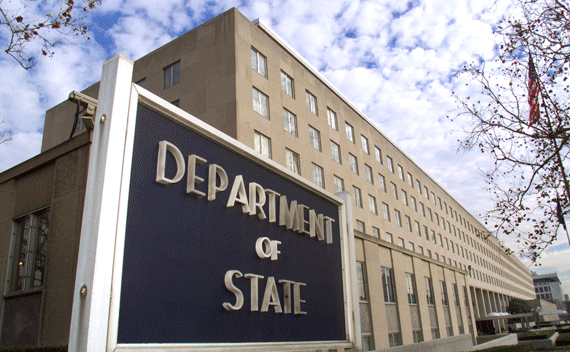
Senior State Department officials on Wednesday commented on the sanctions the U.S. and its allies have imposed on Putin's Russia on account of the Kremlin's war on Ukraine, making it clear that "all those associated with Putin and Russia's leadership are at risk of being sanctioned," TURAN's U.S. correspondent reports.
Washington doesn't preview future sanctions actions, but it has already targeted Putin's associates and oligarchs financing the war, and as the diplomats put it, “we will continue to act with our allies and partners around the world in imposing costs on the Kremlin as the conflict continues."
Three senior officials - Molly Montgomery, deputy assistant secretary of state (DAS) for European and Eurasian Affairs, Erik Woodhouse, DAS for Economic and Business Affairs, and Gonzalo Suarez, acting DAS for International Security and Nonproliferation, were speaking to reporters during a briefing organized by the State Department's Washington Foreign Press Center.
"Our goal is straightforward: we want to see a democratic, independent, sovereign, and prosperous Ukraine with the means to deter and defend itself against Russian aggression. If Russia does not pay a heavy price for its actions, it will send a message to other would-be aggressors that they too can seize territory and subjugate other countries with a little or no consequences," DAS Montgomery explained.
"Broadly speaking, we do take evasion very seriously," she told TURAN's correspondent when asked about claims suggesting that Moscow could potentially influence its immediate neighbors, such as Azerbaijan, Georgia, Armenia, to get their help to skirt sanctions.
It remained unclear, though, whether the topic has been discussed between Washington and the South Caucasian countries during their recent communications: "We generally don't provide the details of diplomatic conversations."
In the meantime, Montgomery added speaking generally, evasion is a topic that Washington is following "very closely" around the world. "Certainly, it's really an area where we're focusing a lot of attention."
When asked by TURAN about the difference in the lists of targets between the U.S. and European countries — unlike Europe, Washington is yet to sanction Putin's alleged lover Alina Kabayeva, and several others — DAS Eric Woodhouse explained that, while sometimes the allies and partners can move with "a perfectly synchronized targets list", other times, the lists can be different due to variety of reasons, including how the authorities work in the way that they make designations, different policy calculations etc.
"We do pay attention to where there are gaps, and over time, I think, you'll see those gaps narrow," he added. "...Most importantly, in terms of the direction and intend in the objective of these programs we are very usified with our partners - not only in Europe but all around the world"
Washington and allies and partners are "standing together" in imposing severe costs for Russia's unacceptable behavior and aggression in Ukraine, the speakers emphasized.
As for countries such as China and India, two main patrons of Russian oil, they may "very well be part of" the proposed oil value cap. “Obviously, China and India are vital purchasers of Russian oil. I can say that we are engaged most intensively with partners and allies to help design a proposal for how this can work," Woodhouse said.
Montgomery also stated that the primary intent of the Russian oil value cap is to pay less for energy imports, and to have stabler global oil market.
Alex Raufoglu
Washington D.C.


 Latest news
Latest news
Latest newsGeorgia’s Constitutional Court Continues Case on Banning Opposition Parties: Political Pluralism at Stake
12.Oct.2026
Azerbaijan and Iran Step Up Security Contacts Amid Hijab Protests
12.Oct.2026
Personnel Shortages Complicate Ukrainian Forces’ Rotation: Ukraine Faces Long-Term Challenges on the Front Line
11.Oct.2026
Trump Eases Sanctions on Russian Fuel After Talks with Putin: Kyiv Fears Boost to Moscow’s War Revenues
10.Oct.2026
Putin Seeks to Strengthen Russia’s Influence in the Post-Soviet Space Through the CIS
10.Oct.2026
Russia and the South Caucasus: External Pressure, Political Competition and a Crisis of Trust
10.Oct.2026
Peaceful Settlement Between Armenia and Azerbaijan: Moving from Declarations to Implementation
10.Oct.2026
Moldova Ready to Accept as Many Ukrainians as Necessary if Situation Worsens This Winter
09.Oct.2026
Turkmenistan Turns Avaza into a Regional Diplomatic Hub as Caspian, Central Asian and CIS Agendas Converge
08.Oct.2026
Romania Scrambles Spanish F-18s After Aerial Targets Detected Near Ukrainian Border
07.Oct.2026
Berlin Deepens Defence Partnership with Kyiv: Germany to Provide Ukraine with €1 Billion in Military Aid
07.Oct.2026
European Parliament Against Georgian Dream: EU Prepares New Response to Tbilisi
06.Oct.2026
Bulgarian Foreign Minister to Discuss European Security and International Law in the Netherlands
05.Oct.2026
Rheinmetall in Bulgaria: Sofia Emerges as a New NATO Defence-Industrial Hub in the Balkans
05.Oct.2026
The Cost of a Long War: Moscow Expands Spending Plans Through 2029
05.Oct.2026