
 13 Oct 2026









Bellingcat: Key MH17 figure identified as senior FSB official
Burlaka was in a crucial role supervising militant activities in Donbas and authorizing the flow of weapons across the border, the investigation says.
The Bellingcat investigation team, in cooperation with Russian colleagues from The Insider, and with additional reporting from Kevin Hall from McClatchy Newspapers (DC), has been able to identify the person of "Vladimir Ivanovich" as one of the top officials within Russia's FSB security service, namely Colonel General Andrey Ivanovich Burlaka, who is a person of interest in the criminal investigation into the downing of MH17. It is noted Bellingcat has identified "Vladimir Ivanovich" as Col. General Andrey Ivanovich Burlaka, who serves as Chief of the Operational Staff of the FSB's Border Service, and is the first deputy to the head of the Border Service of FSB, who in turn is first deputy to the head of the FSB, Alexander Bortnikov. This makes Andrey Burlaka one of the senior-most officers in the FSB, two positions removed from the director, via his direct boss, army general Vladimir Kulishov. He held this same position at the time of the MH17 shoot-down. The phone intercepts published by JIT make frequent references to a certain "Vladimir Ivanovich"; a shadowy figure who, by the start of July 2014, was already in a crucial role supervising militant activities in Donbas and authorizing the flow of weapons across the border. In one intercept from the morning of July 16, 2014, the day before MH17 was shot down, Borodai asks "Vladimir Ivanovich" if it is possible that Russian helicopters were attacking, or could engage, Ukrainian positions near Maryinka:
(…) Borodai: Vladimir Ivanovich?
V.I.: Speaking.
Borodai: Tell me, is it possible that our helicopters could be carrying out some raids? Good morning. I beg your pardon.
V.I: Good morning Borodai: So, is it possible that our helicopters are carrying out raids near Maryinka? Ours?
V.I: [speaking to the side] Turn on the encryption!. (…)
Maryinka is a village that was, at the time, a frontline village near Donetsk, and although Russian Armed Forces were by then frequently conducting cross-border artillery strikes on Ukrainian positions, it seems unrealistic that Borodai believed that Russian helicopters would venture that deep into Ukrainian airspace. As such, it seems possible that he actually meant the similar-sounding village of Marinovka (Marynivka in Ukrainian) which marked the frontline south of Snizhne near the border with Russia. In fact, on that same morning, Borodai was captured in a video broadcast on a Russian TV channel while talking on the phone behind Igor Girkin, who was giving an interview from the battlefield near Marinovka (several hours later the town fell to separatist forces).
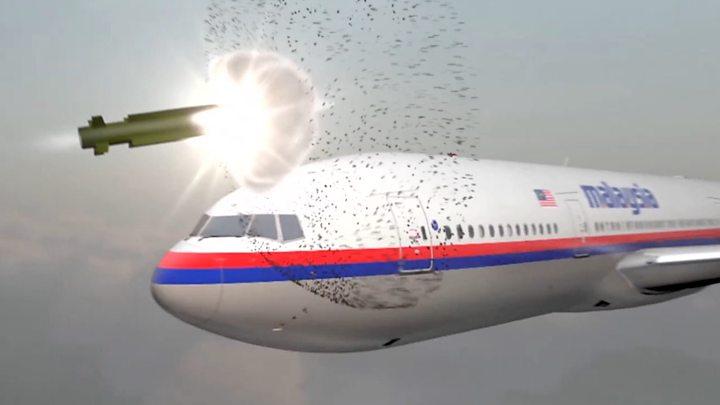
Due to the encryption being turned on at the start of the call, it is not clear what "Vladimir Ivanovich" then said to Borodai, and if helicopter support was provided. While there is no publicly available official information of Gen. Andrey Burlaka's involvement in the Donbas war, travel data obtained by Bellingcat and a review of previously leaked or hacked correspondence corroborates the evidence from the intercepts published by JIT. A review of Burlaka's airplane travel in 2014 and 2015 shows that he frequently flew from Moscow to Rostov, to Crimea, and to Krasnodar – the three control centers for military operations against Ukraine. UNIAN memo. Malaysia Airlines' MH17 Boeing 777 heading from Amsterdam for Kuala Lumpur was shot down on July 17, 2014, over Russia-occupied territory in Donetsk region. All 298 people on board who were citizens of 10 countries were killed in the crash. The majority of the victims, 196, were citizens of the Netherlands. The Dutch Safety Board October 13, 2015, issued a report on the causes of the accident. It was revealed that the plane had been shot down by a Buk anti-aircraft missile system. The Joint Investigation Team in its report published on September 28, 2016, confirmed that the plane had been downed by a Russian-made Buk brought to Ukraine from Russia.
Russia-controlled military intelligence officers of involvement in a missile attack that shot down MH17. The first four suspects in the MH17 case are Russian terrorist Igor Girkin (AKA "Strelkov"), who in the summer of 2014 was the so-called "Minister of Defense of the Donetsk People's Republic" ("DPR"); Russian General Sergei Dubinsky (nom de guerre "Khmuryi"), who led the "DPR intelligence;" Oleg Pulatov (nom de guerre "Gyurza"), who in 2014 headed of "the 2nd division of the GRU of the DPR;" as well as Leonid Kharchenko (nom de guerre "Krot"), who was a leader of the "reconnaissance battalion" of Russia-led forces. The trial in the Netherlands started on March 9.


 Latest news
Latest news
Latest newsGeorgia’s Constitutional Court Continues Case on Banning Opposition Parties: Political Pluralism at Stake
12.Oct.2026
Azerbaijan and Iran Step Up Security Contacts Amid Hijab Protests
12.Oct.2026
Personnel Shortages Complicate Ukrainian Forces’ Rotation: Ukraine Faces Long-Term Challenges on the Front Line
11.Oct.2026
Trump Eases Sanctions on Russian Fuel After Talks with Putin: Kyiv Fears Boost to Moscow’s War Revenues
10.Oct.2026
Putin Seeks to Strengthen Russia’s Influence in the Post-Soviet Space Through the CIS
10.Oct.2026
Russia and the South Caucasus: External Pressure, Political Competition and a Crisis of Trust
10.Oct.2026
Peaceful Settlement Between Armenia and Azerbaijan: Moving from Declarations to Implementation
10.Oct.2026
Moldova Ready to Accept as Many Ukrainians as Necessary if Situation Worsens This Winter
09.Oct.2026
Turkmenistan Turns Avaza into a Regional Diplomatic Hub as Caspian, Central Asian and CIS Agendas Converge
08.Oct.2026
Romania Scrambles Spanish F-18s After Aerial Targets Detected Near Ukrainian Border
07.Oct.2026
Berlin Deepens Defence Partnership with Kyiv: Germany to Provide Ukraine with €1 Billion in Military Aid
07.Oct.2026
European Parliament Against Georgian Dream: EU Prepares New Response to Tbilisi
06.Oct.2026
Bulgarian Foreign Minister to Discuss European Security and International Law in the Netherlands
05.Oct.2026
Rheinmetall in Bulgaria: Sofia Emerges as a New NATO Defence-Industrial Hub in the Balkans
05.Oct.2026
The Cost of a Long War: Moscow Expands Spending Plans Through 2029
05.Oct.2026