
 13 Oct 2026









Russia again reminded Armenia that it is against the presence of Washington and Brussels in the Caucasus
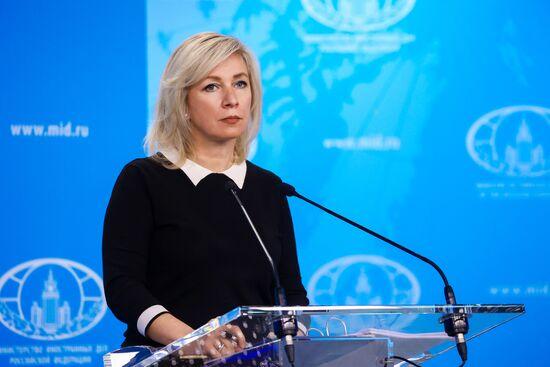
Russia can welcome a trilateral dialogue with the participation of Armenia, Azerbaijan and Georgia if it contributes to the settlement of contradictions in the Caucasus, strengthening stability and security in the region, the Russian Foreign Ministry spokeswoman Maria Zakharova told at the briefing on Friday.
Moscow recognizes the right of each country to participate in those international formats that meet its interests and are not directed against third countries, and also take into account the existing balance of power, she noted.
"If, behind this initiative, the contours of Washington and Brussels are visible, which seek to undermine the implementation of the trilateral agreements between the leaders of Armenia, Azerbaijan and Russia, then this is a completely different story," "RIA Novosti" quoted Zakharova as saying.
She noted that it is the trilateral agreements that are the basis for the normalization of relations between Yerevan and Baku. Within this format, since 2020, key processes have been launched to unblock communications, delimit the Armenian-Azerbaijani border, develop a peace treaty, as well as establish contacts between representatives of public, expert and parliamentary circles.
As for the formats in the Transcaucasus, she pointed to the 3+3 consultative-regional platform, which just covers the three states of the Transcaucasus, as well as Russia, Turkey and Iran.
Moscow is confident that Brussels aims to change the security system in the region and hopes that Yerevan understands and takes this into account, Zakharova continued. She did not agree with Pashinyan's opinion that the EU monitoring mission on the border with Azerbaijan would contribute to stability.
According to her, Russian peacekeepers ensure peace in Nagorno-Karabakh, Russian border guards work on the territory of Armenia, including on the Armenian-Azerbaijani border. Brussels aims to change the security system that has developed in the region. Its cornerstone is the presence of Russian military and border guards, as well as Armenia's membership in the CSTO.
"We are open to dialogue with Armenian partners on improving measures to maintain stability in the Transcaucasus, both in bilateral and multilateral formats, including relevant developments within the framework of the CSTO," Zakharova said.
It should be reminded that on January 23, the Foreign Ministers of the EU countries approved the formation of a new civilian mission to be sent to Armenia with a two-year mandate. The EU long-term civilian mission in Armenia will include about 100 people, including experts and European observers. The purpose of the mission is to promote stability in the border areas of Armenia, build confidence on the ground and provide conditions conducive to efforts to normalize relations between Armenia and Azerbaijan.
13.02.2023 09:37


 Latest news
Latest news
Latest newsGeorgia’s Constitutional Court Continues Case on Banning Opposition Parties: Political Pluralism at Stake
12.Oct.2026
Azerbaijan and Iran Step Up Security Contacts Amid Hijab Protests
12.Oct.2026
Personnel Shortages Complicate Ukrainian Forces’ Rotation: Ukraine Faces Long-Term Challenges on the Front Line
11.Oct.2026
Trump Eases Sanctions on Russian Fuel After Talks with Putin: Kyiv Fears Boost to Moscow’s War Revenues
10.Oct.2026
Putin Seeks to Strengthen Russia’s Influence in the Post-Soviet Space Through the CIS
10.Oct.2026
Russia and the South Caucasus: External Pressure, Political Competition and a Crisis of Trust
10.Oct.2026
Peaceful Settlement Between Armenia and Azerbaijan: Moving from Declarations to Implementation
10.Oct.2026
Moldova Ready to Accept as Many Ukrainians as Necessary if Situation Worsens This Winter
09.Oct.2026
Turkmenistan Turns Avaza into a Regional Diplomatic Hub as Caspian, Central Asian and CIS Agendas Converge
08.Oct.2026
Romania Scrambles Spanish F-18s After Aerial Targets Detected Near Ukrainian Border
07.Oct.2026
Berlin Deepens Defence Partnership with Kyiv: Germany to Provide Ukraine with €1 Billion in Military Aid
07.Oct.2026
European Parliament Against Georgian Dream: EU Prepares New Response to Tbilisi
06.Oct.2026
Bulgarian Foreign Minister to Discuss European Security and International Law in the Netherlands
05.Oct.2026
Rheinmetall in Bulgaria: Sofia Emerges as a New NATO Defence-Industrial Hub in the Balkans
05.Oct.2026
The Cost of a Long War: Moscow Expands Spending Plans Through 2029
05.Oct.2026