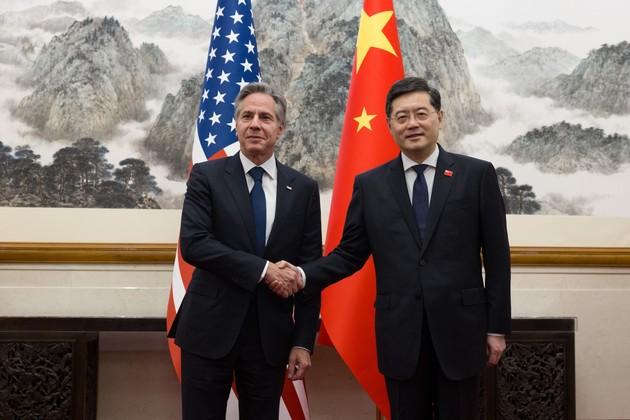
U.S. and China say their relations at the lowest point

    The United States and China have failed to overcome their most serious disagreements but were able to discuss them in a potentially constructive way and have agreed to continue talks, U.S. and Chinese officials said.

    The China-U.S. relationship is at the lowest point since its establishment, Chinese Foreign Minister Qin Gang said at the meeting with U.S. Secretary of State Antony Blinken.

    "The current state of relations “does not serve the fundamental interests of the two peoples or meet the shared expectations of the international community," the diplomat said.

    The Chinese foreign ministry countered in its statement that “China hopes that the U.S. will adopt an objective and rational perception of China, work with China in the same direction, uphold the political foundation of China-U.S. relations, and handle unexpected and sporadic events in a calm, professional and rational manner.”

    Blinken invites Qin Gang to U.S.

    Blinken, in turn, invited Qin to the U.S. to continue discussions, and the spokesperson said the pair agreed to schedule a visit at a “mutually suitable time,” but no date was set.

    According to the State Department, Blinken held candid, substantive, and constructive talks with the Chinese FM.

    "The Secretary emphasized the importance of diplomacy and maintaining open channels of communication across the full range of issues to reduce the risk of misperception and miscalculation," the State Department said.

    Blinken “made clear that the United States will always stand up for the interests and values of the American people and work with its allies and partners to advance our vision for a world that is free, open, and upholds the international rules-based order,” the State Department said.


    © Photo : the U.S. State Department


    #POLITICS
    #SECURITY
    #USA
    #CHINA
    #DIPLOMACY
    #BIDEN
    #BLINKEN

    19.06.2023 13:00


Latest news

    Georgia’s Constitutional Court Continues Case on Banning Opposition Parties: Political Pluralism at Stake

    12.Oct.2026

    Azerbaijan and Iran Step Up Security Contacts Amid Hijab Protests

    12.Oct.2026

    Personnel Shortages Complicate Ukrainian Forces’ Rotation: Ukraine Faces Long-Term Challenges on the Front Line

    11.Oct.2026

    Trump Eases Sanctions on Russian Fuel After Talks with Putin: Kyiv Fears Boost to Moscow’s War Revenues

    10.Oct.2026

    Putin Seeks to Strengthen Russia’s Influence in the Post-Soviet Space Through the CIS

    10.Oct.2026

    Russia and the South Caucasus: External Pressure, Political Competition and a Crisis of Trust

    10.Oct.2026

    Peaceful Settlement Between Armenia and Azerbaijan: Moving from Declarations to Implementation

    10.Oct.2026

    Moldova Ready to Accept as Many Ukrainians as Necessary if Situation Worsens This Winter

    09.Oct.2026

    Turkmenistan Turns Avaza into a Regional Diplomatic Hub as Caspian, Central Asian and CIS Agendas Converge

    08.Oct.2026

    Romania Scrambles Spanish F-18s After Aerial Targets Detected Near Ukrainian Border

    07.Oct.2026

    Berlin Deepens Defence Partnership with Kyiv: Germany to Provide Ukraine with €1 Billion in Military Aid

    07.Oct.2026

    European Parliament Against Georgian Dream: EU Prepares New Response to Tbilisi

    06.Oct.2026

    Bulgarian Foreign Minister to Discuss European Security and International Law in the Netherlands

    05.Oct.2026

    Rheinmetall in Bulgaria: Sofia Emerges as a New NATO Defence-Industrial Hub in the Balkans

    05.Oct.2026

    The Cost of a Long War: Moscow Expands Spending Plans Through 2029

    05.Oct.2026

All news