
 13 Oct 2026









'He is failing': Putin's approval rating slides as Covid-19 grips Russia
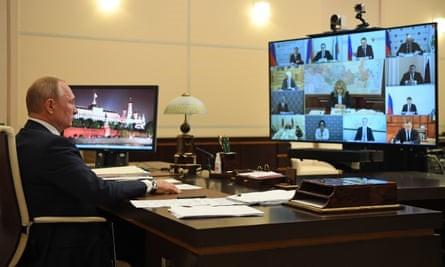
Backseat president announces easing of lockdown on day of record high infection numbers.
According to Guardian, a day of record high coronavirus infection numbers is an odd time to announce a route out of lockdown, but that is what Vladimir Putin did on Monday as he announced that the “non-working days” imposed by the Kremlin at the end of March would come to an end from Tuesday.
“We have a long and difficult process ahead of us with no room for mistakes,” said Putin by video link from his residence outside Moscow on a day when the country registered more than 11,000 new infections. Russia now has the second fastest rate of infections in the world after the US. The prime minister, Mikhail Mishustin, is among those in hospital with the virus.
Rather than an invitation to Russians to stream back into the streets, however, Monday’s announcement seemed to be the latest gambit in Putin’s plan to delegate responsibility for tackling the crisis to local leaders, who he said would make their own decisions on when to end lockdown.
Certainly, Russia’s vast size means there is little point in lockdown restrictions in Vladivostok being tied to the epidemic growth seven timezones away in Moscow. But the health minister, Tatiana Golikova, later clarified that so far only 11 of Russia’s 85 regions had an epidemiological situation that could allow for a loosening of restrictions, making Putin’s announcement look to some like passing the buck.
“This is abdication of responsibility, the architect of Russia’s hyper-presidential system suddenly discovering local authorities when it is convenient,” said Mark Galeotti, a Russia analyst and author of a book on Putin. “Putin is giving them the responsibility to fight the pandemic without the funds or the powers.”
Putin has rarely shone in crisis management, something noted as far back as the sinking of the Kursk submarine 20 years ago during his first months in office, and this one appears no different.
Since donning a yellow hazmat suit to visit coronavirus patients back in March, Putin has been largely confined to his residence, where he appears by video link to address the nation and cabinet. Russians who are used to seeing their president atop a horse or motorbike instead see a static-screen Putin who often seems bored.
Last week he was spotted distractedly playing with a pen as his health minister discussed the regional response with him. On Monday Putin again looked less than enthusiastic as he simultaneously addressed the nation and his government. On several occasions he let out audible sighs in mid-sentence.
The virus is asking hard questions of the Kremlin and the political system constructed by Putin over the past two decades.
“Putin’s detached initial response to the spread of the coronavirus outbreak was at least partly a result of his staff’s tendency to sanitise information and to portray events in the most optimistic light possible. Putin’s staff reports about its achievements, not problems,” wrote Tatiana Stanovaya in a recent report for the Carnegie Moscow Centre.
Coronavirus has also disrupted plans for a vote on constitutional amendments that would have paved the way for Putin to rule until 2036. That was set for April, but instead he has found himself up against a pernicious, frustrating and invisible foe, and seen his approval ratings slide.
“This is arguably the most serious challenge to Putin as national leader in the 20 years he has been in power, and he is failing it,” said Galeotti.


 Latest news
Latest news
Latest newsGeorgia’s Constitutional Court Continues Case on Banning Opposition Parties: Political Pluralism at Stake
12.Oct.2026
Azerbaijan and Iran Step Up Security Contacts Amid Hijab Protests
12.Oct.2026
Personnel Shortages Complicate Ukrainian Forces’ Rotation: Ukraine Faces Long-Term Challenges on the Front Line
11.Oct.2026
Trump Eases Sanctions on Russian Fuel After Talks with Putin: Kyiv Fears Boost to Moscow’s War Revenues
10.Oct.2026
Putin Seeks to Strengthen Russia’s Influence in the Post-Soviet Space Through the CIS
10.Oct.2026
Russia and the South Caucasus: External Pressure, Political Competition and a Crisis of Trust
10.Oct.2026
Peaceful Settlement Between Armenia and Azerbaijan: Moving from Declarations to Implementation
10.Oct.2026
Moldova Ready to Accept as Many Ukrainians as Necessary if Situation Worsens This Winter
09.Oct.2026
Turkmenistan Turns Avaza into a Regional Diplomatic Hub as Caspian, Central Asian and CIS Agendas Converge
08.Oct.2026
Romania Scrambles Spanish F-18s After Aerial Targets Detected Near Ukrainian Border
07.Oct.2026
Berlin Deepens Defence Partnership with Kyiv: Germany to Provide Ukraine with €1 Billion in Military Aid
07.Oct.2026
European Parliament Against Georgian Dream: EU Prepares New Response to Tbilisi
06.Oct.2026
Bulgarian Foreign Minister to Discuss European Security and International Law in the Netherlands
05.Oct.2026
Rheinmetall in Bulgaria: Sofia Emerges as a New NATO Defence-Industrial Hub in the Balkans
05.Oct.2026
The Cost of a Long War: Moscow Expands Spending Plans Through 2029
05.Oct.2026