
 13 Oct 2026









France envoy: We disagree with Iran on many issues but we agree on Armenia issue
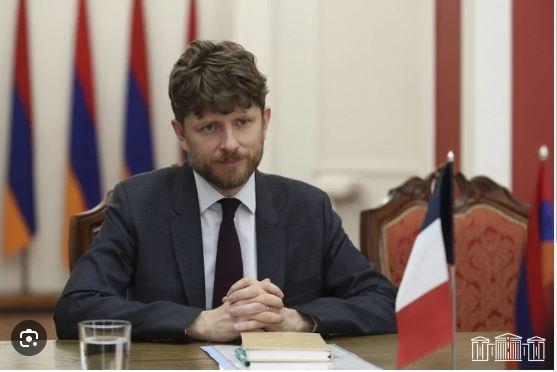
We do not think in terms of spheres of influence, we think in terms of the rights of each nation to defend its sovereignty and territorial integrity. French Ambassador to Armenia Olivier Decottignies stated this in an interview with Armenpress—and referring to the fact that Azerbaijan actively buys weapons from Turkey, Israel and other countries, while the president of Azerbaijan accuses France of arming Armenia and contributing to the escalation of tension in the South Caucasus, and certain cycles also express an opinion that the European Union—represented by France—wants to weaken Russia's influence in the South Caucasus..
"And it is actually not only a French concern. Many times the past few years, neighboring country of Armenia like Iran, have expressed concern about Armenia's sovereignty and territorial integrity.
We disagree with Iran on many issues, but this is one issue we agree on. And I think actually all UN member states should agree on that because under the UN Charter, all UN member states recognize and ought to support the integrity and sovereignty of other member states. That is a general obligation.
When it comes to the Azerbaijani stated concerns, they can be sure that the type of cooperation and the equipment that we are providing to Armenia are aimed at defending the country; it is purely defensive. Let me give you a good example: when we talk about air defense, if you don't enter the airspace of Armenia, you will never face the air defense of Armenia; it is a defensive capability," said the French ambassador to Armenia.
According to him, defense cooperation with Armenia is about the sovereignty of the country and the protection of its territory and people.
"It was clearly stated from the very beginning that all that we are providing—weapons, equipment, training—is consistent with that goal," Decottignies added.


 Latest news
Latest news
Latest newsGeorgia’s Constitutional Court Continues Case on Banning Opposition Parties: Political Pluralism at Stake
12.Oct.2026
Azerbaijan and Iran Step Up Security Contacts Amid Hijab Protests
12.Oct.2026
Personnel Shortages Complicate Ukrainian Forces’ Rotation: Ukraine Faces Long-Term Challenges on the Front Line
11.Oct.2026
Trump Eases Sanctions on Russian Fuel After Talks with Putin: Kyiv Fears Boost to Moscow’s War Revenues
10.Oct.2026
Putin Seeks to Strengthen Russia’s Influence in the Post-Soviet Space Through the CIS
10.Oct.2026
Russia and the South Caucasus: External Pressure, Political Competition and a Crisis of Trust
10.Oct.2026
Peaceful Settlement Between Armenia and Azerbaijan: Moving from Declarations to Implementation
10.Oct.2026
Moldova Ready to Accept as Many Ukrainians as Necessary if Situation Worsens This Winter
09.Oct.2026
Turkmenistan Turns Avaza into a Regional Diplomatic Hub as Caspian, Central Asian and CIS Agendas Converge
08.Oct.2026
Romania Scrambles Spanish F-18s After Aerial Targets Detected Near Ukrainian Border
07.Oct.2026
Berlin Deepens Defence Partnership with Kyiv: Germany to Provide Ukraine with €1 Billion in Military Aid
07.Oct.2026
European Parliament Against Georgian Dream: EU Prepares New Response to Tbilisi
06.Oct.2026
Bulgarian Foreign Minister to Discuss European Security and International Law in the Netherlands
05.Oct.2026
Rheinmetall in Bulgaria: Sofia Emerges as a New NATO Defence-Industrial Hub in the Balkans
05.Oct.2026
The Cost of a Long War: Moscow Expands Spending Plans Through 2029
05.Oct.2026