
 13 Oct 2026









- The territorial status of disputed regions and the
mechanism of control over them.
- Security guarantees for Ukraine, including its future
course and relations with NATO.
- Mechanisms for the reconstruction of destroyed territories
and the possible use of frozen Russian assets.
- The format and timing of the ceasefire, as well as control
over the implementation of the agreements.
- The
costs of supporting Ukraine are rising, and public opinion at home may change.
- Geopolitical risks: the conflict diverts resources from
other regions.
- The role of the US as a global leader: successfully ending
the conflict would enhance Washington’s status as a peacemaker.
Peace talks on Ukraine: leaders of Ukraine and the US meet on the sidelines of Davos
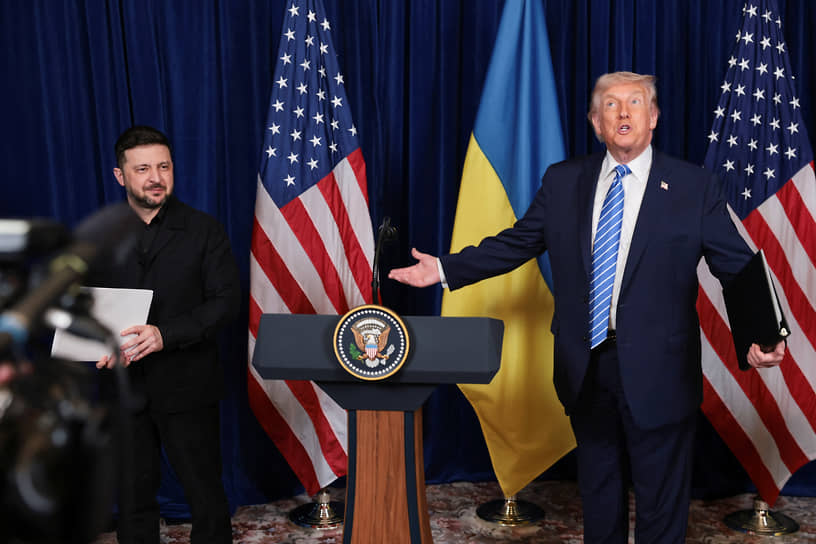
On
the sidelines of the World Economic Forum in Davos, Ukrainian President
Volodymyr Zelensky and US President Donald Trump held a meeting. The main topic
of discussion was the possibility of reaching a peace agreement between Ukraine
and Russia — an agreement that the international community has been discussing
for several years but has yet to be formalized in a document.
Donald Trump, speaking at the forum, stated that a peace
agreement between Kyiv and Moscow is “within reach”, and that the parties are
“quite close” to a deal. He emphasized that it would be “a disgrace” if an
agreement is not reached, given the scale of human losses and destruction.
Donald Trump: “If peace can be achieved, and the parties are close to an agreement, then not doing it would be a disgrace. People are dying, cities are collapsing, and the peace process must be completed”.
At the same time, US Special Envoy Steve Witkoff said that
the negotiations have “come down to one key issue” that remains unresolved.
According to him, he is heading to Moscow the same day to continue
consultations.
Steve Witkoff: “We have made significant progress, but there is one issue that we still cannot agree on. I am going to Moscow to continue negotiations and try to close this gap”.
It seems that this “final issue” is the point around which
the entire conflict potential accumulates. Experts name several most likely
problematic topics:
Volodymyr Zelensky: “We are ready for negotiations and compromises, but we are not ready for peace at any cost. Ukraine’s security is not a subject for bargaining”.
Davos is not just an economic forum, but a place where
leaders meet and decisions are made that subsequently affect world politics.
Against the backdrop of the war in Ukraine, Davos 2026 has become one of the
rare platforms where key players are present at the same time and scenarios for
ending the conflict are discussed.
In this process, the United States acts as a de facto
mediator, which not only exerts pressure on the parties but also tries to offer
a package of guarantees acceptable to all. At the same time, NATO and the EU
remain in a position where they must support Ukraine but avoid escalation.
Mark Rutte, Secretary General of NATO: “We must continue to support Ukraine and keep the focus on its security. Peace is important, but it must not be achieved at the cost of its future”.
For Kyiv, the main risk is that the “peace plan” may be
adopted without taking into account key national interests, particularly
security and territorial integrity. The Ukrainian leadership has repeatedly
stated that it is ready for compromises but not for a “peace agreement at any
cost”.
Volodymyr Zelensky: “We cannot sign an agreement that would threaten the future of our state. Peace is not only a cessation of hostilities but also a guarantee of security for decades”.
For Moscow, the prospect of a peace agreement may be beneficial as a way to legitimize the positions it has achieved and to secure the lifting of some sanctions, but it also carries the risk of political and economic isolation if the conditions are too harsh. Therefore, Russia is likely to seek an agreement that consolidates its gains without further pressure.

The United States is interested in ending the war for
several reasons:
Donald Trump: “America must be at the center of peace. We can help the parties reach an agreement, but for that, political will from all participants is needed”.
While diplomacy is intensifying, military actions continue.
Destruction and humanitarian problems persist in Ukraine, increasing pressure
on the country’s leadership and raising public demand for a swift end to the
war.
According to Witkoff, new negotiations in Moscow may take
place in the coming days and could be decisive. If the “final issue” can be
agreed upon, it could open the way to signing an agreement in the coming
months.
Alongside diplomacy, hostilities and the everyday consequences of war continue. In the Ukrainian capital, for example, utilities are restoring heating after shelling — earlier in the week, thousands of homes remained without heat. This serves as a reminder that any delay in negotiations means more human casualties and destruction. Today, additional meetings between US and Russian representatives are scheduled in Moscow, which could become a decisive stage. If the “final issue” is agreed upon, it will open the way to a full agreement.


 Latest news
Latest news
Latest newsGeorgia’s Constitutional Court Continues Case on Banning Opposition Parties: Political Pluralism at Stake
12.Oct.2026
Azerbaijan and Iran Step Up Security Contacts Amid Hijab Protests
12.Oct.2026
Personnel Shortages Complicate Ukrainian Forces’ Rotation: Ukraine Faces Long-Term Challenges on the Front Line
11.Oct.2026
Trump Eases Sanctions on Russian Fuel After Talks with Putin: Kyiv Fears Boost to Moscow’s War Revenues
10.Oct.2026
Putin Seeks to Strengthen Russia’s Influence in the Post-Soviet Space Through the CIS
10.Oct.2026
Russia and the South Caucasus: External Pressure, Political Competition and a Crisis of Trust
10.Oct.2026
Peaceful Settlement Between Armenia and Azerbaijan: Moving from Declarations to Implementation
10.Oct.2026
Moldova Ready to Accept as Many Ukrainians as Necessary if Situation Worsens This Winter
09.Oct.2026
Turkmenistan Turns Avaza into a Regional Diplomatic Hub as Caspian, Central Asian and CIS Agendas Converge
08.Oct.2026
Romania Scrambles Spanish F-18s After Aerial Targets Detected Near Ukrainian Border
07.Oct.2026
Berlin Deepens Defence Partnership with Kyiv: Germany to Provide Ukraine with €1 Billion in Military Aid
07.Oct.2026
European Parliament Against Georgian Dream: EU Prepares New Response to Tbilisi
06.Oct.2026
Bulgarian Foreign Minister to Discuss European Security and International Law in the Netherlands
05.Oct.2026
Rheinmetall in Bulgaria: Sofia Emerges as a New NATO Defence-Industrial Hub in the Balkans
05.Oct.2026
The Cost of a Long War: Moscow Expands Spending Plans Through 2029
05.Oct.2026