
 13 Oct 2026









Access to the Sea as Strategy: Why Kazakhstan Needs Pakistan
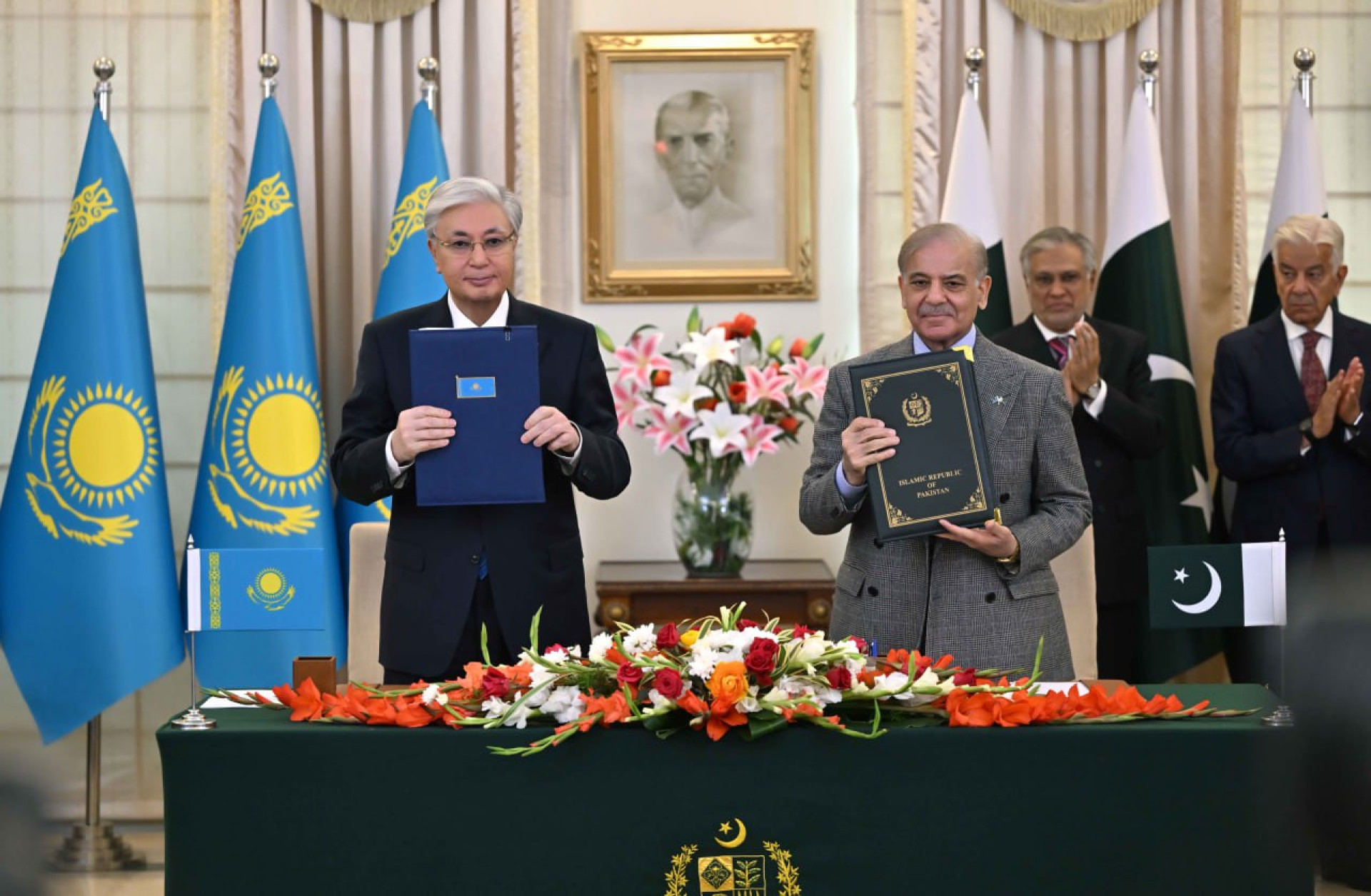
President Kassym-Jomart Tokayev’s visit to Pakistan in February 2026 was less a display of diplomatic rapprochement than an indicator of Astana’s reassessment of its regional priorities. Elevating bilateral relations to the level of a strategic partnership is a formula that conceals pragmatic economic and logistical calculations rather than symbolic politics.
Kazakhstan remains the world’s largest landlocked country, and amid growing geopolitical turbulence this structural constraint is increasingly turning into a source of vulnerability. Dependence on transit routes through a limited number of countries narrows the space for foreign policy maneuver. In this context, Pakistan — with its ports of Karachi and Gwadar — offers Astana not an alternative to existing routes, but an additional layer of insurance: direct access to the Indian Ocean.
The officially stated goal of increasing bilateral trade turnover to one billion dollars appears ambitious but is not decisive. Even if this threshold is reached, Pakistan will not become one of Kazakhstan’s major trading partners, remaining behind the European Union, China, and Russia in terms of economic interaction. Trade here plays a supporting role, creating an institutional framework for more consequential processes.
Kazakhstan’s real interest lies in investment, joint projects, and transit logistics. Pakistan matters not as a consumer market, but as a geographic hub. South Asia, with a population of nearly two billion, is viewed by Astana as a potential direction for expanding its economic presence, with Pakistan serving as the gateway to this macro-region.
The proposed transport routes through Turkmenistan and Afghanistan are objectively high-risk. Questions of security, political stability, and sustainable financing for infrastructure projects remain unresolved. Yet Kazakhstan has few simple options. Traditional transit routes are either congested, politically sensitive, or excessively dependent on the interests of external actors. Under these conditions, even partial implementation of the Pakistan-oriented route can alter Astana’s negotiating position with other transit countries. The corridor thus becomes not only an infrastructure project, but also a tool of political leverage.
In this sense, the context of Tokayev’s visit to Islamabad is more important than the memoranda signed. Kazakhstan continues to demonstrate its rejection of a hierarchical foreign policy and its commitment to expanding multi-vector engagement. Deepening ties with Pakistan proceeds in parallel with active dialogue with the European Union, China, Russia, and the countries of the Middle East, underscoring Astana’s determination not to anchor itself to any single center of power.
For Moscow, the visit signals a transformation in foreign policy thinking across Central Asia, where there is diminishing space for vertical models of influence. For Beijing, it is a reminder that the region’s transport architecture is not limited to Chinese initiatives. For Western partners, it confirms Kazakhstan’s pragmatic multi-vector policy, free of ideological declarations and political gestures.
Security cooperation was mentioned during the visit but deliberately not placed at the forefront. This reflects Astana’s strategic caution: Kazakhstan avoids being drawn into South Asian conflicts and has no interest in military alignment. The focus remains firmly on economics and logistics, with all other dimensions treated as secondary.
The choice of Pakistan is driven not by its economic strength, but by its geographic position. Islamabad’s macroeconomic difficulties are not a deterrent; spatial logic outweighs financial risk. At the same time, the visit does not signify a southward pivot. It represents an expansion of maneuvering corridors rather than a change in foreign policy direction.
Logistics in this case becomes an element of sovereignty. For Kazakhstan, transport routes are no longer merely an economic issue, but a tool of political autonomy. Even if certain projects are not fully implemented, they retain value as a source of negotiating power and as a means of reducing dependence on a narrow set of transit options.
Tokayev’s visit to Pakistan was neither a diplomatic gesture nor an attempt at a loud geopolitical breakthrough. It was a cold, calculated move by a state guided by a simple logic: in the modern world, it is not the richest or the most ideologically consistent who survive, but the most mobile.


 Latest news
Latest news
Latest newsGeorgia’s Constitutional Court Continues Case on Banning Opposition Parties: Political Pluralism at Stake
12.Oct.2026
Azerbaijan and Iran Step Up Security Contacts Amid Hijab Protests
12.Oct.2026
Personnel Shortages Complicate Ukrainian Forces’ Rotation: Ukraine Faces Long-Term Challenges on the Front Line
11.Oct.2026
Trump Eases Sanctions on Russian Fuel After Talks with Putin: Kyiv Fears Boost to Moscow’s War Revenues
10.Oct.2026
Putin Seeks to Strengthen Russia’s Influence in the Post-Soviet Space Through the CIS
10.Oct.2026
Russia and the South Caucasus: External Pressure, Political Competition and a Crisis of Trust
10.Oct.2026
Peaceful Settlement Between Armenia and Azerbaijan: Moving from Declarations to Implementation
10.Oct.2026
Moldova Ready to Accept as Many Ukrainians as Necessary if Situation Worsens This Winter
09.Oct.2026
Turkmenistan Turns Avaza into a Regional Diplomatic Hub as Caspian, Central Asian and CIS Agendas Converge
08.Oct.2026
Romania Scrambles Spanish F-18s After Aerial Targets Detected Near Ukrainian Border
07.Oct.2026
Berlin Deepens Defence Partnership with Kyiv: Germany to Provide Ukraine with €1 Billion in Military Aid
07.Oct.2026
European Parliament Against Georgian Dream: EU Prepares New Response to Tbilisi
06.Oct.2026
Bulgarian Foreign Minister to Discuss European Security and International Law in the Netherlands
05.Oct.2026
Rheinmetall in Bulgaria: Sofia Emerges as a New NATO Defence-Industrial Hub in the Balkans
05.Oct.2026
The Cost of a Long War: Moscow Expands Spending Plans Through 2029
05.Oct.2026