
 13 Oct 2026









Trump Supports Pashinyan’s Course Toward Stability and Armenia’s Development
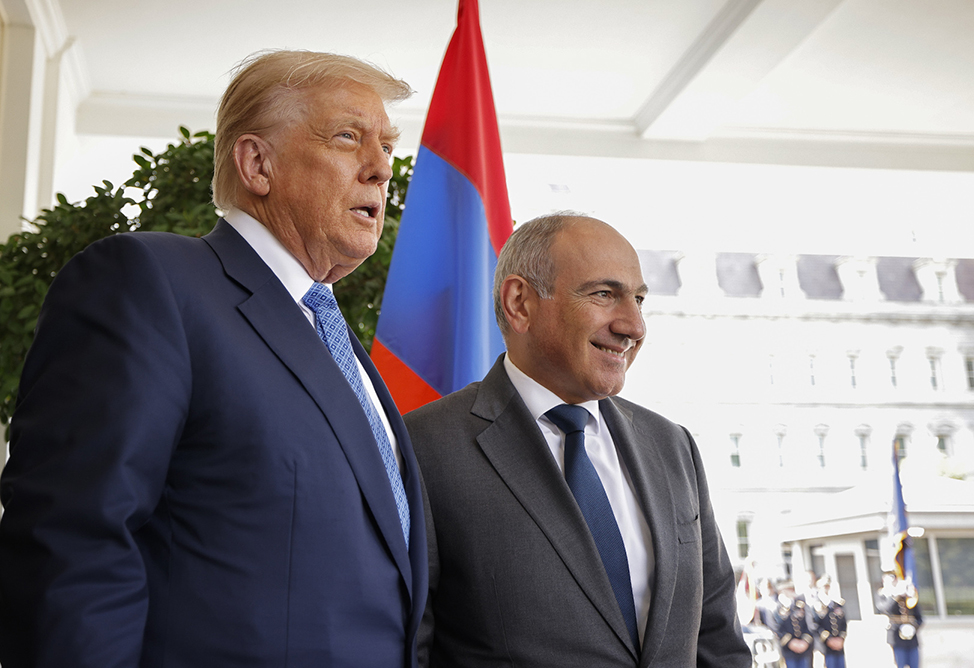
Support
for Armenian Prime Minister Nikol Pashinyan from U.S. President Donald Trump
has become an important political signal for Yerevan ahead of the parliamentary
elections. In his statement, the American leader highly praised the Armenian
prime minister’s policies, emphasizing his role in strengthening stability,
promoting reforms, and expanding cooperation with Western partners. Trump
described Pashinyan as a “strong leader” and noted that Armenia’s current
leadership plays an important role in shaping a more sustainable security
architecture in the South Caucasus.
Particular
attention in the U.S. president’s statement was drawn to the mention of the
so-called “Trump Route,” which, according to him, could open new economic
opportunities for the region. This refers to the prospects of developing
transport, energy, and investment projects that could strengthen Armenia’s role
as an important transit and political hub in the South Caucasus. The U.S.
administration believes that deeper economic cooperation will allow Yerevan to
diversify its foreign ties and attract additional international investment.
Trump’s
statement came shortly after U.S. Secretary of State Marco Rubio’s visit to
Yerevan, where the sides discussed security, economic issues, and the expansion
of bilateral cooperation. According to the American president, agreements on
several promising areas have already been reached between the two countries.
Against this backdrop, experts are increasingly speaking about
Armenian-American relations entering a qualitatively new stage.
Support
from Washington is also being viewed in Armenia as an important diplomatic
success for Pashinyan’s government. Amid a complicated regional environment and
ongoing geopolitical changes, Yerevan seeks to pursue a more multi-vector
foreign policy while maintaining a balance between traditional partners and the
development of relations with the United States and Europe.
An
additional significance of Trump’s statement is connected to the upcoming
parliamentary elections and discussions surrounding political reforms within
the country. In particular, Nikol Pashinyan has previously stated the need to
adopt a new Constitution after the elections, which the authorities believe
should become part of the further modernization of Armenia’s governance and
political system.
Trump’s support for Pashinyan demonstrates
that Armenia is gradually becoming, for the United States, not merely a
partner, but one of the key elements of the West’s new strategy in the South
Caucasus. Washington is effectively signaling its readiness to strengthen
Yerevan politically and economically amid the weakening of Russian influence in
the region and growing competition over transport and energy routes.


 Latest news
Latest news
Latest newsGeorgia’s Constitutional Court Continues Case on Banning Opposition Parties: Political Pluralism at Stake
12.Oct.2026
Azerbaijan and Iran Step Up Security Contacts Amid Hijab Protests
12.Oct.2026
Personnel Shortages Complicate Ukrainian Forces’ Rotation: Ukraine Faces Long-Term Challenges on the Front Line
11.Oct.2026
Trump Eases Sanctions on Russian Fuel After Talks with Putin: Kyiv Fears Boost to Moscow’s War Revenues
10.Oct.2026
Putin Seeks to Strengthen Russia’s Influence in the Post-Soviet Space Through the CIS
10.Oct.2026
Russia and the South Caucasus: External Pressure, Political Competition and a Crisis of Trust
10.Oct.2026
Peaceful Settlement Between Armenia and Azerbaijan: Moving from Declarations to Implementation
10.Oct.2026
Moldova Ready to Accept as Many Ukrainians as Necessary if Situation Worsens This Winter
09.Oct.2026
Turkmenistan Turns Avaza into a Regional Diplomatic Hub as Caspian, Central Asian and CIS Agendas Converge
08.Oct.2026
Romania Scrambles Spanish F-18s After Aerial Targets Detected Near Ukrainian Border
07.Oct.2026
Berlin Deepens Defence Partnership with Kyiv: Germany to Provide Ukraine with €1 Billion in Military Aid
07.Oct.2026
European Parliament Against Georgian Dream: EU Prepares New Response to Tbilisi
06.Oct.2026
Bulgarian Foreign Minister to Discuss European Security and International Law in the Netherlands
05.Oct.2026
Rheinmetall in Bulgaria: Sofia Emerges as a New NATO Defence-Industrial Hub in the Balkans
05.Oct.2026
The Cost of a Long War: Moscow Expands Spending Plans Through 2029
05.Oct.2026