
 13 Oct 2026









- maintaining working relations with Russia
without becoming excessively dependent on Moscow;
- expanding economic and technological
cooperation with China;
- using the EU as a source of investment,
technology and alternative transport routes;
- strengthening relations with Turkiye and
other Turkic states;
- developing cooperation with the United
States and the Gulf countries;
- strengthening its own role in Central
Asia;
- diversifying export and transit routes.
Tokayev Updates Kazakhstan Foreign Policy Concept: Astana Strengthens Its Strategic Multi Vector Approach
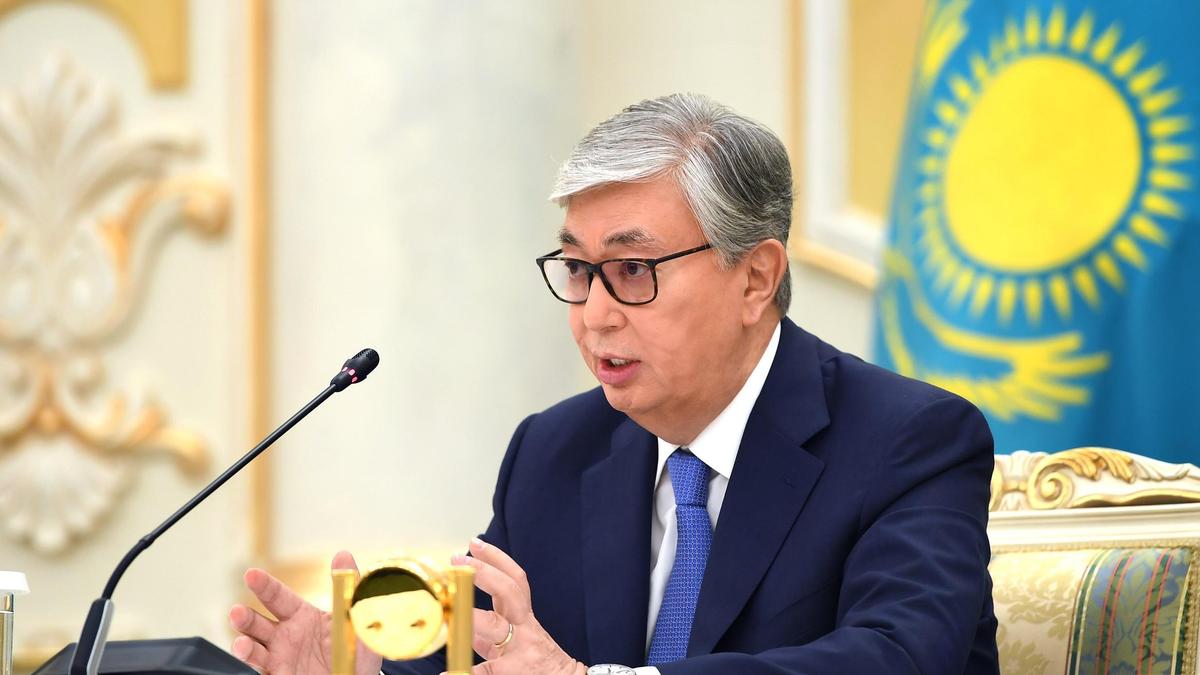
President of Kazakhstan
Kassym-Jomart Tokayev has introduced amendments to the existing Concept of the Foreign Policy of
the Republic of Kazakhstan for 2020–2030. The decision comes
amid a significant transformation of the international system, intensifying
competition among major powers, and growing geopolitical risks for Central
Asian states.
The
revision of the foreign policy document is particularly significant for
Kazakhstan, which maintains close ties with Russia, deepens cooperation with
China, expands relations with the European Union, the United States and Turkiye, and seeks to strengthen its own
role in Central Asia.
The
current concept was approved by a presidential decree signed by Tokayev on March 6, 2020. It
defines Kazakhstan as a state pursuing an independent, pragmatic and
multi-vector foreign policy based on protecting national interests, sovereignty
and territorial integrity. Its fundamental principles also include
non-interference in the internal affairs of other states, the peaceful
settlement of conflicts, multilateralism and a balance of interests.
Why has Astana decided to revise
the document?
The
revision of the concept comes against a fundamentally different international
backdrop from the one that existed when the document was adopted six years ago.
Following
the outbreak of the full-scale Russia-Ukraine war, Kazakhstan found itself in a
complex geopolitical position. On the one hand, Russia remains one of Astana’s
most important economic and military-political partners, while Kazakhstan is a
member of the Eurasian
Economic Union (EAEU) and the Collective Security Treaty Organization (CSTO).
On the
other hand, Astana has consistently emphasized its sovereignty and the need to
diversify its foreign relations. Kazakhstan has not joined Western sanctions
against Russia, but at the same time it has refused to recognize the annexation
of Ukrainian territories and continues to develop relations with the EU, the
United States, China, Turkiye and other centers of power.
Tokayev
himself has repeatedly emphasized in recent months the need for a maximally balanced foreign policy
focused primarily on protecting Kazakhstan’s national sovereignty and strategic
interests. In one of his recent public statements, he said that foreign policy
should focus on protecting and promoting the country’s strategic interests, while
Kazakhstan’s independence remains a fundamental principle of its national
strategy.
China and Europe are becoming increasingly important directions
The
revision of the concept comes amid a noticeable expansion of Kazakhstan’s
engagement with China and the EU.
In
June, Tokayev visited Brussels, where he held talks with European Council
President António Costa and European Commission President Ursula von der Leyen.
The Kazakh side said that relations with the EU were at their highest level in
the history of bilateral cooperation.
At the
same time, Astana is actively developing its Chinese direction. Kazakhstan
views China not only as its largest trading partner, but also as a source of
investment, technology and infrastructure development.
The
transport dimension is becoming particularly important. Kazakhstan seeks to
turn its geographical position between China, Russia, the Caspian Sea and
Europe into an economic advantage by developing the Trans-Caspian International Transport Route
and other Eurasian corridors.
Thus,
for Astana, multi-vectorism is gradually acquiring not only a diplomatic but
also an economic dimension: Kazakhstan is seeking to avoid critical dependence
on a single market, a single transport route or a single external partner.
Russia remains a key, but no longer the only, center
At the
same time, it would be premature to speak of a Kazakh geopolitical shift away
from Russia.
The
economic and infrastructural interdependence between the two countries remains
high. Kazakhstan continues to participate in the EAEU and CSTO, while the
Russian direction remains highly important for trade, energy, logistics and
security.
However,
changes in the international environment are prompting Astana to reduce the
potential risks associated with excessive dependence.
Kazakhstan
is effectively pursuing a strategy of “not choosing a side, but preserving room for maneuver”.
This
is particularly important given the country’s geography: Kazakhstan shares a
long border with Russia, is located next to China, and at the same time has
access to the Caspian Sea, through which it can develop connections with
Azerbaijan, Turkiye and Europe.
A new factor: strengthening
Central Asia
Another
important element of Kazakhstan’s foreign policy is the strengthening of
regional cooperation.
Kazakhstan
is increasingly positioning itself not simply as a participant in relations
with individual global powers, but as one of the centers of an emerging Central Asian diplomatic
framework.
Astana
is interested in ensuring that issues related to security, transport, energy
and water resources are increasingly addressed jointly by Kazakhstan,
Uzbekistan, Kyrgyzstan, Tajikistan and Turkmenistan.
At the
same time, Kazakhstan is promoting the Turkic dimension of its foreign policy.
Astana is one of the founding members of the Organization of Turkic States and
advocates deeper political and economic cooperation within the organization.
Kazakhstan is also promoting the concept of the “Turkic World – 2040” and the “Trans-Altaic Dialogue”
initiative.
What does Tokayev’s decision mean?
The
main significance of the revision of the concept lies not in abandoning
multi-vectorism, but in adapting it to the new international reality.
In
2020, Kazakhstan’s multi-vector policy was primarily a tool for maintaining a
balance between Russia, China and the West. In 2026, the task has become more
complicated: the international system is increasingly characterized by
competition among several centers of power, while the space for neutral
diplomacy is narrowing.
Astana
is therefore seeking to transform multi-vectorism into a mechanism of strategic autonomy.
Kazakhstan
is pursuing several objectives simultaneously:
The
last point is particularly important. Kazakhstan’s economy remains closely
linked to commodity exports, while a significant part of its traditional
infrastructure has historically been oriented toward Russian territory.
Therefore, the development of alternative routes across the Caspian Sea is
acquiring not only economic but also strategic significance for Astana.
Kazakhstan’s
National Development Plan through 2029 explicitly points to the need to
diversify the economy and identifies limitations associated with the country’s
commodity-based export model. At the same time, the document emphasizes the
need to expand Kazakhstan’s participation in global trade and develop modern
infrastructure.
The revision of the foreign
policy concept should be viewed as part of a broader transformation of
Kazakhstan. In 2026, the country is simultaneously undergoing significant
domestic political and constitutional changes. A new Constitution was adopted
in a referendum on March 15, 2026, while a new stage of state-building began on
June 30. Therefore, the updating of the foreign policy concept fits logically
into the broader process of shaping a new model for Kazakhstan.
Astana is seeking to build a state that remains
sufficiently close to all major centers of power, but not so close to any one
of them that it loses its independence. This is the essence of Kazakhstan’s
multi-vector policy today. However, the strategy has a serious limitation:
Kazakhstan cannot completely distance itself from either Russia or China. Its
economic geography and security interests make this practically impossible.
Therefore, the most realistic scenario is not a geopolitical “pivot”, but a
gradual expansion of the number of Kazakhstan’s external pillars.
Thus, Tokayev’s update of Kazakhstan’s foreign policy concept should be viewed not as an abandonment of the country’s previous course, but as its adaptation to a world in which balancing among competing centers of power is becoming increasingly difficult. Astana is seeking to move from traditional multi-vectorism toward a more active policy of strategic autonomy, in which the main objective is not membership in a particular bloc, but maximizing the space available for independent decision-making.
CCBS Research Desk


 Latest news
Latest news
Latest newsGeorgia’s Constitutional Court Continues Case on Banning Opposition Parties: Political Pluralism at Stake
12.Oct.2026
Azerbaijan and Iran Step Up Security Contacts Amid Hijab Protests
12.Oct.2026
Personnel Shortages Complicate Ukrainian Forces’ Rotation: Ukraine Faces Long-Term Challenges on the Front Line
11.Oct.2026
Trump Eases Sanctions on Russian Fuel After Talks with Putin: Kyiv Fears Boost to Moscow’s War Revenues
10.Oct.2026
Putin Seeks to Strengthen Russia’s Influence in the Post-Soviet Space Through the CIS
10.Oct.2026
Russia and the South Caucasus: External Pressure, Political Competition and a Crisis of Trust
10.Oct.2026
Peaceful Settlement Between Armenia and Azerbaijan: Moving from Declarations to Implementation
10.Oct.2026
Moldova Ready to Accept as Many Ukrainians as Necessary if Situation Worsens This Winter
09.Oct.2026
Turkmenistan Turns Avaza into a Regional Diplomatic Hub as Caspian, Central Asian and CIS Agendas Converge
08.Oct.2026
Romania Scrambles Spanish F-18s After Aerial Targets Detected Near Ukrainian Border
07.Oct.2026
Berlin Deepens Defence Partnership with Kyiv: Germany to Provide Ukraine with €1 Billion in Military Aid
07.Oct.2026
European Parliament Against Georgian Dream: EU Prepares New Response to Tbilisi
06.Oct.2026
Bulgarian Foreign Minister to Discuss European Security and International Law in the Netherlands
05.Oct.2026
Rheinmetall in Bulgaria: Sofia Emerges as a New NATO Defence-Industrial Hub in the Balkans
05.Oct.2026
The Cost of a Long War: Moscow Expands Spending Plans Through 2029
05.Oct.2026