
 13 Oct 2026









TRIPP, Peace, and a New Geopolitical Crossroads: How Armenia Has Changed One Year After Washington
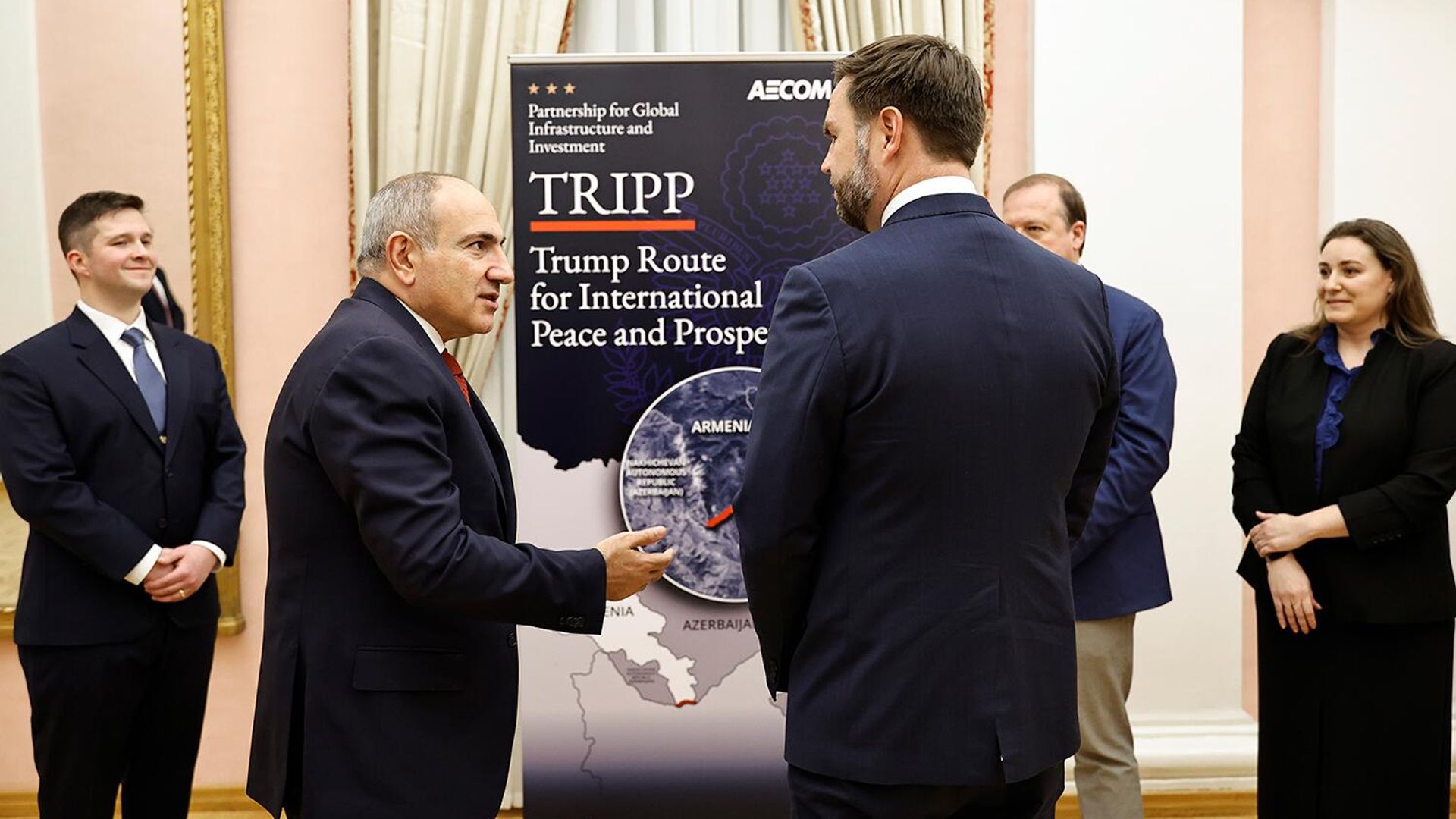
A year has passed since the Washington summit of August 8, 2025, which became one of the key milestones in the Armenian-Azerbaijani peace process. One year later, the United States, Armenia, and Azerbaijan once again reaffirmed their commitment to the agreements reached in Washington and to further advancing the peace process.
Yet behind the diplomatic statements lies a fundamental question: Is the South Caucasus truly moving toward institutionalized peace, or has it merely entered a period in which the likelihood of a new war has significantly decreased?
This question was at the center of a discussion hosted by APRI Armenia, featuring Senior Fellow Benjamin Poghosyan, Research Fellow Sergey Melkonyan, and moderator Armenak Minasyants.
The Main Outcome of Washington: A Lower Risk of War
According to Benjamin Poghosyan, the main geopolitical outcome of the August 2025 agreements was a sharp reduction in the likelihood of renewed military escalation.
In spring 2025, following the agreement on the text of the peace treaty, the situation remained tense. Baku regularly accused Armenia of violating the ceasefire and issued statements suggesting the possibility of retaliatory action.
After Washington, the situation changed. The risk of a major military escalation between Armenia and Azerbaijan declined significantly. At the same time, the expert stressed that it would be impossible to speak of absolute guarantees of peace.
This is where an important distinction must be made between a reduced risk of war and sustainable peace. Until the peace treaty is signed and ratified, it is premature to speak of the institutionalization of peace.
Therefore, the joint statement issued by the United States, Armenia, and Azerbaijan on the eve of the anniversary of the Washington agreements should be viewed as a reaffirmation of the political continuity of the process rather than evidence that the process has been completed.
TRIPP Is Primarily a Geopolitical Project
The central topic of the discussion was the Trump Route for International Peace and Prosperity (TRIPP).
Sergey Melkonyan presented APRI Armenia's approach, according to which TRIPP should be viewed through both economic and geopolitical lenses. The experts' main conclusion was that TRIPP is primarily a geopolitical project and only secondarily an economic one.
This distinction is particularly important when assessing its potential benefits for Armenia.
According to APRI Armenia's calculations, if only the 43-kilometer section of TRIPP running through Armenian territory is considered, its potential annual economic impact could amount to approximately $23 million. For Armenia's economy, this is a relatively modest figure.
The situation is entirely different in the case of comprehensive regional connectivity. Under such a scenario, the potential economic impact for Armenia could reach approximately $388 million per year.
This difference demonstrates why it is crucial for Yerevan not to limit its transportation strategy to TRIPP alone.
If only the route through Syunik is implemented while other regional connections remain closed, Armenia risks gaining not genuine regional connectivity but rather a new model of limited connectivity.
Azerbaijan, Turkiye, and the Question of Control
An important part of the discussion focused on the extent to which the current TRIPP framework corresponds to Azerbaijan's original expectations.
According to Benjamin Poghosyan, in 2021–2023 Baku effectively called for the unhindered movement of people and goods between Azerbaijan and Nakhichevan through Syunik, without full Armenian control over the route.
The current TRIPP model differs from those earlier demands. It envisages regulatory and control procedures, as well as the involvement of a private operator.
Nevertheless, Azerbaijani expert circles generally view the project positively because it would provide Baku with a strategically important transportation link to Nakhichevan.
For Armenia, this makes it essential to clearly distinguish between “unimpeded transit” and an “extraterritorial corridor”. The implementation of TRIPP should not entail Armenia relinquishing control over its own territory.
Turkiye is also interested in the project, as the route through Nakhichevan would significantly shorten the transportation distance between Turkiye and Azerbaijan.
At the same time, some Turkish experts have expressed concern about the long-term presence of the United States in the project. Thus, even among countries that stand to benefit from TRIPP, there are differing assessments of its long-term geopolitical implications.
Why Armenia Needs Comprehensive Regional Connectivity
APRI Armenia experts argue that the economic value of TRIPP lies not so much in the 43-kilometer section itself as in the possibility of integrating it into a broader regional transportation network.
For Armenia, three directions are particularly important: Turkiye, Iran, and the Black Sea.
Opening the Armenian-Turkish border and restoring the Gyumri–Kars railway connection would give Armenia access to Turkiye's transportation infrastructure and, ultimately, European markets.
Restoring a railway connection through Nakhichevan to Iran would provide Armenia with an additional north-south transportation route.
In this scenario, TRIPP could become not an isolated route but part of a multidirectional regional transportation network.
That should be Yerevan's strategic objective: not a single “corridor”, but several interconnected routes.
Iran: A Factor That Cannot Be Ignored
The most sensitive external factor remains Iran.
For Tehran, the Armenian-Iranian border is important not only economically but also strategically. Armenia provides Iran with an alternative route to the Black Sea and European markets, reducing its dependence on routes through Turkiye and Azerbaijan.
For this reason, the prospect of a long-term U.S. presence within the TRIPP framework is viewed in Iran primarily through the lens of national security.
It remains unclear how exactly the project will operate in practice, who will be responsible for individual elements of the infrastructure, and what the actual scale of U.S. involvement will be.
Consequently, successful implementation of TRIPP will require Yerevan to take into account not only the interests of the United States, Azerbaijan, and Turkiye, but also Iran's concerns.
Russia and the New EU–EAEU Dilemma
The Russian factor makes the situation even more complicated.
Moscow has not yet presented a final strategy regarding TRIPP, but Russia retains significant leverage over Armenia's transportation and economic infrastructure, particularly through its control of the country's railway system.
At the same time, APRI Armenia experts caution against automatically treating the Russian railway concession as an obstacle to regional connectivity.
Until concrete decisions are made regarding the opening of the Armenian-Turkish and Armenian-Nakhichevan borders, it is impossible to determine whether Russian management of the railway will become a practical barrier.
However, the transportation issue is gradually becoming intertwined with a broader geopolitical question: Armenia's relations with Russia and the European Union.
Moscow advocates holding a referendum in Armenia on the country's choice between the European Union and the Eurasian Economic Union. This approach implies that Armenia's future foreign economic orientation should be viewed as a choice between two competing integration frameworks.
For Yerevan, however, the issue looks different.
Armenia is simultaneously developing relations with the EU and the United States while maintaining significant economic ties with Russia. Its strategic objective, therefore, should be not so much to choose one center of power as to diversify its external relations.
In this context, TRIPP acquires additional significance. It could become part of Western and regional transportation infrastructure while also being integrated into a broader network of connections, including those involving Iran and existing Russian routes.
The “Vicious Circle” of Armenian-Azerbaijani Relations
One of the most important conclusions of the discussion was the concept of a “vicious circle” identified by APRI Armenia experts.
Azerbaijan links the full opening of the border with Turkiye to the signing of a peace treaty with Armenia. At the same time, the process of signing the peace treaty has been accompanied by additional demands from Baku.
Experts believe that without significant external involvement, this cycle will be difficult to break.
Washington Has a Limited Window of Opportunity
Another important conclusion concerns the timing of the process.
According to Benjamin Poghosyan, the United States has a limited window of opportunity to actively advance the peace process.
Following the U.S. midterm elections in November 2026, American policymakers will increasingly focus on domestic issues and preparations for the 2028 presidential election.
This means that the coming months could prove particularly important.
Washington can use its relations not only with Yerevan and Baku, but also with Ankara, to facilitate the opening of the Armenian-Turkish border.
At the same time, launching the construction or implementation of TRIPP by itself would not resolve the broader problem.
One could envision a scenario in which construction of the route begins, but the peace treaty remains unsigned, the Armenian-Turkish border stays closed, and other regional transportation links fail to become operational.
In such a case, TRIPP would become a functioning geopolitical project, but not a comprehensive regional connectivity initiative.
What the Washington Anniversary Means
The year since Washington has revealed the central contradiction of the current stage of the peace process.
On the one hand, the likelihood of a new war has declined significantly, the United States has maintained direct involvement, and TRIPP has created a new framework for regional connectivity.
On the other hand, key issues remain unresolved: the peace treaty still needs to be formally concluded and ratified, the Armenian-Turkish border remains closed, the future of other transportation routes is uncertain, and Iran and Russia retain their own interests and instruments of influence.
Therefore, the main question for Armenia is not whether TRIPP will be implemented.
The real question is what kind of regional order will emerge as a result of its implementation.
If TRIPP becomes one of several transportation routes, while Armenia simultaneously gains access to Turkiye, Iran, the Black Sea, and European markets, the country could transform its geographic position from a source of vulnerability into an economic asset.
If, however, only one route is implemented while other connections remain blocked, the economic impact will be limited, while the project's geopolitical significance will far exceed its economic value.
This is why, one year after Washington, Yerevan faces a question that goes beyond the simple choice between “peace and war”.
The more complex challenge is whether Armenia can turn the reduction in military risks into sustainable peace, comprehensive regional connectivity, and diversification of its external dependencies.
Against this backdrop, Russia's demand that Armenia choose between the EU and the EAEU makes the issue even more fundamental.
For Armenia, the most advantageous scenario would not be a new dependence on a single center of power, but rather a system of mutual interdependence in which no external actor has the ability to unilaterally determine the country's strategic direction.
Yerevan's Main Task Is Not to Choose Dependence, but to Create Interdependence
This is where all the strands of the APRI Armenia discussion converge.
For Armenia, the dangerous scenario is one in which one dependency is simply replaced by another: Russian dependence by American dependence, Western dependence by Turkish dependence, or transportation dependence by geopolitical dependence.
The optimal scenario is different: to transform Armenia's geographic position from a source of vulnerability into an instrument of interdependence.
If routes simultaneously connect Azerbaijan and Nakhichevan, Turkiye and the Caucasus, Iran and the Black Sea, and, in the longer term, the Persian Gulf and European markets, the cost of potential destabilization for all participants would increase substantially.
In that case, peace would be sustained not only by political commitments but also by economic interests.
This is the main strategic question after Washington: Can Armenia transform TRIPP from a standalone geopolitical project into an element of comprehensive regional connectivity while maintaining control over its own territory, diversifying its external relations, and preventing the emergence of a new one-sided dependency?
The answer to that question remains open.
Journalist
Marine KHARATYAN


 Latest news
Latest news
Latest newsGeorgia’s Constitutional Court Continues Case on Banning Opposition Parties: Political Pluralism at Stake
12.Oct.2026
Azerbaijan and Iran Step Up Security Contacts Amid Hijab Protests
12.Oct.2026
Personnel Shortages Complicate Ukrainian Forces’ Rotation: Ukraine Faces Long-Term Challenges on the Front Line
11.Oct.2026
Trump Eases Sanctions on Russian Fuel After Talks with Putin: Kyiv Fears Boost to Moscow’s War Revenues
10.Oct.2026
Putin Seeks to Strengthen Russia’s Influence in the Post-Soviet Space Through the CIS
10.Oct.2026
Russia and the South Caucasus: External Pressure, Political Competition and a Crisis of Trust
10.Oct.2026
Peaceful Settlement Between Armenia and Azerbaijan: Moving from Declarations to Implementation
10.Oct.2026
Moldova Ready to Accept as Many Ukrainians as Necessary if Situation Worsens This Winter
09.Oct.2026
Turkmenistan Turns Avaza into a Regional Diplomatic Hub as Caspian, Central Asian and CIS Agendas Converge
08.Oct.2026
Romania Scrambles Spanish F-18s After Aerial Targets Detected Near Ukrainian Border
07.Oct.2026
Berlin Deepens Defence Partnership with Kyiv: Germany to Provide Ukraine with €1 Billion in Military Aid
07.Oct.2026
European Parliament Against Georgian Dream: EU Prepares New Response to Tbilisi
06.Oct.2026
Bulgarian Foreign Minister to Discuss European Security and International Law in the Netherlands
05.Oct.2026
Rheinmetall in Bulgaria: Sofia Emerges as a New NATO Defence-Industrial Hub in the Balkans
05.Oct.2026
The Cost of a Long War: Moscow Expands Spending Plans Through 2029
05.Oct.2026