
 13 Oct 2026









Upper Lars: Why Border Queues Have Become a Political Signal for Georgia and Russia
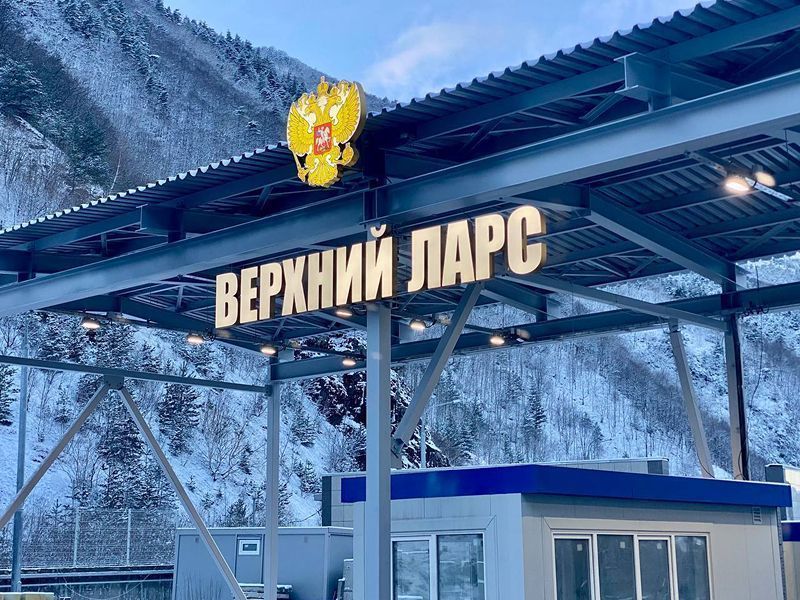
The situation at the Russian-Georgian border around the Upper Lars checkpoint has, within just a few days, evolved from a routine seasonal problem into a political story. The Russian Federal Customs Service reported “record” passenger traffic, prompting speculation in the information space about a new mass exodus of Russians amid rumors of possible mobilization. Georgian authorities, however, presented a significantly less dramatic picture.
The main conclusion of recent days is that the pressure on the border did increase, but the scale of the situation was considerably less extraordinary than the initial Russian reports might have suggested. At the same time, the reaction from society and the authorities shows that memories of the events of September 2022 have not disappeared.
The “record” was disputed
On August 18, the Russian customs service reported that more than 20,000 people traveling in passenger vehicles had crossed the Upper Lars checkpoint in a single day. On the previous day and on August 16, the figure reportedly exceeded 19,000. The description of the traffic as “record-breaking” quickly spread across the media and social networks.
The problem was that the statistics themselves did not allow for an unequivocal conclusion that there was a mass exodus of Russians into Georgia.
On August 19, Georgia’s Interior Ministry reported that during the previous 24 hours, 7,880 citizens of various countries had entered the country through the Georgian section of the border, while 8,406 had left. This put total traffic in both directions at 16,286 people. The Russian customs service later also adjusted its rhetoric: the word “record” disappeared, and the overall passenger flow was described as exceeding 16,000 people in both directions.
In other words, the initial Russian figure appears to have reflected a different method of counting, or was interpreted in a way that created the impression of an exclusively massive movement from Russia into Georgia. This is a crucial detail. If we look not at an individual figure but at the balance of movement, the picture becomes considerably calmer: during this period, the border was being used actively not only by people heading to Georgia, but also by those returning to Russia after their summer holidays.
Why did the queues emerge?
The queues themselves were real. August is traditionally one of the busiest periods at Upper Lars. In addition to the tourist season, weather-related restrictions also affected the situation. On August 13, traffic through the Georgian section was temporarily suspended following warnings about rising water levels and the threat of dangerous natural processes in the Darial Gorge. Such restrictions can quickly create a backlog of vehicles.
According to reports from specialized automotive chat groups, between August 15 and 19, crossing the border could take several hours. However, by August 20, the situation had begun to improve. This is significantly different from the situation in September 2022.
At that time, following Vladimir Putin’s announcement of partial mobilization, the queue on the Russian side stretched for approximately 20–30 kilometers, with several thousand vehicles waiting. Around 10,000 people crossed the border per day — a figure that became particularly significant because it represented a sharp increase compared with normal levels. In August 2026, there is currently no comparable situation.
Why, then, did everyone start talking about mobilization?
Because Upper Lars has long served as a kind of barometer of domestic tension in Russia. After mobilization was announced in September 2022, the checkpoint became one of the main routes used by Russians leaving the country. Georgia still remembers that period: the sharp increase in the number of Russians arriving triggered debates over security, migration and the possible introduction of a visa regime.
As a result, any noticeable increase in traffic in August 2026 is automatically viewed through the lens of 2022. This has been compounded by rumors of a possible new wave of mobilization in the autumn. There is currently no evidence that the present queues are directly connected to preparations for mobilization. However, the very emergence of this explanation demonstrates the level of public anxiety.
This creates a paradox: the objective scale of border traffic may remain within seasonal norms, while the informational impact is considerably greater than the statistics themselves.
For Tbilisi, the problem goes far beyond a traffic jam
The Georgian authorities face a difficult political dilemma. On the one hand, Russian tourists and other visitors from Russia are an important part of the country’s economy. Moscow remains one of the largest sources of tourist arrivals, while Russian citizens also have a significant presence in Georgia’s real-estate market. On the other hand, attitudes toward Russia within Georgian society remain extremely sensitive.
This is primarily connected to the August 2008 war and Russia’s continuing control over Abkhazia and the Tskhinvali region. According to data from the Caucasus Barometer cited in the publication, the share of Georgian citizens who perceive Russia as an enemy of the state increased from 35% in 2012 to 69% in 2024. As a result, the mass arrival of Russians is perceived by Georgian society in two completely different ways.
For part of society, it represents a potential demographic and political risk. This contradiction helps explain the nervous reaction to reports of “record” traffic.
Moscow is also interested in reducing tensions
Significantly, after reports of increased pressure at the border emerged, Moscow itself entered the discussion. Russian Foreign Ministry spokesperson Maria Zakharova called on the Georgian authorities to ensure the safety of Russian tourists and prevent manifestations of “Russophobia”. At the same time, she emphasized the economic importance of Russian tourists for Georgia. The border issue therefore quickly moved beyond the realm of transport statistics.
The economic factor: Russians remain in Georgia not only as tourists
The most important part of this story may not actually be taking place at the border. While short-term tourist traffic can be explained by the season, the real-estate market shows a more sustained trend. According to our data, in the first half of 2026, citizens of Russia, Ukraine and Belarus accounted for 18% of residential property purchases in Batumi, compared with 13% a year earlier.
Apartment sales in new developments increased by 35.1% year-on-year in the second quarter, while during the first half of the year they rose by almost 48%. The average price of an apartment in a new development in Batumi reached approximately $1,960 per square meter in June, an increase of 9.8% over the year. On the secondary market, the average price was around $1,497 per square meter.
This means that the Russian presence in Georgia cannot be reduced to tourism alone. Some people are not simply coming for a few weeks. They are buying property, investing, working remotely or considering Georgia as a long-term alternative to Russia. And this process could ultimately prove much more important than several days of queues at Upper Lars.
But the boom has its limits
At the same time, rising demand does not mean that Georgia’s real-estate market can benefit indefinitely from the influx of foreigners. Batumi is already facing the problem of oversupply: a large number of new projects are being built, while rental yields are gradually declining. In the second quarter of 2026, the average daily rental rate fell by 4.2%.
The picture is therefore mixed. Demand from foreign buyers is growing, but so is the supply of apartments. For developers, this means that continuing to build at the previous pace is becoming increasingly risky.
What does the Upper Lars story really mean?
The most accurate interpretation of the current situation is this: it is not a repeat of September 2022, but neither is it an entirely routine situation. Border traffic has indeed increased, but the available data do not support the picture of a mass flight of Russians into Georgia.
Seasonal tourism, returning holidaymakers, weather-related restrictions and differences in statistical counting can explain a significant part of the queues. But the political effect has been far greater than the physical flow of people.
Today, Upper Lars serves as an indicator of several processes at once: expectations within Russian society, relations between Moscow and Tbilisi, Georgia’s economic dependence on Russian tourism and real estate, and the continuing trauma associated with the 2008 war.
The main risk for Georgia
The problem for Tbilisi is not that several thousand additional people crossed the border at the same time. The key question is how long the country can continue balancing the economic benefits of Russian citizens’ presence against growing concerns among its own population about that presence.
For now, the Georgian government is clearly pursuing a pragmatic approach: maintaining economic ties with Russia while refusing political normalization until the issues surrounding Abkhazia and the Tskhinvali region are resolved.
Prime Minister Irakli Kobakhidze has explicitly stated that restoring diplomatic relations is impossible as long as Moscow continues to recognize these territories.
This is why the current Upper Lars story is not really a story about a traffic jam at the border. It is a story about the fragile balance between Georgia’s economic pragmatism, Russian influence and Georgian society’s fear of a new large-scale presence of Russian citizens. As long as this balance remains intact, any significant surge at Upper Lars will be perceived not simply as a transportation problem, but as a possible signal of much more serious political changes.
CCBS Research Desk


 Latest news
Latest news
Latest newsGeorgia’s Constitutional Court Continues Case on Banning Opposition Parties: Political Pluralism at Stake
12.Oct.2026
Azerbaijan and Iran Step Up Security Contacts Amid Hijab Protests
12.Oct.2026
Personnel Shortages Complicate Ukrainian Forces’ Rotation: Ukraine Faces Long-Term Challenges on the Front Line
11.Oct.2026
Trump Eases Sanctions on Russian Fuel After Talks with Putin: Kyiv Fears Boost to Moscow’s War Revenues
10.Oct.2026
Putin Seeks to Strengthen Russia’s Influence in the Post-Soviet Space Through the CIS
10.Oct.2026
Russia and the South Caucasus: External Pressure, Political Competition and a Crisis of Trust
10.Oct.2026
Peaceful Settlement Between Armenia and Azerbaijan: Moving from Declarations to Implementation
10.Oct.2026
Moldova Ready to Accept as Many Ukrainians as Necessary if Situation Worsens This Winter
09.Oct.2026
Turkmenistan Turns Avaza into a Regional Diplomatic Hub as Caspian, Central Asian and CIS Agendas Converge
08.Oct.2026
Romania Scrambles Spanish F-18s After Aerial Targets Detected Near Ukrainian Border
07.Oct.2026
Berlin Deepens Defence Partnership with Kyiv: Germany to Provide Ukraine with €1 Billion in Military Aid
07.Oct.2026
European Parliament Against Georgian Dream: EU Prepares New Response to Tbilisi
06.Oct.2026
Bulgarian Foreign Minister to Discuss European Security and International Law in the Netherlands
05.Oct.2026
Rheinmetall in Bulgaria: Sofia Emerges as a New NATO Defence-Industrial Hub in the Balkans
05.Oct.2026
The Cost of a Long War: Moscow Expands Spending Plans Through 2029
05.Oct.2026