
 13 Oct 2026









- Find
& Fix: Real-time sensor detection,
tracking and absolute geolocation of hostile electronic and mechanized assets.
- Track
& Target: Continuous threat monitoring
and the automated assignment of optimal kinetic or non-kinetic weapon
platforms.
- Engage
& Assess: High-precision strike
execution followed by instant Battle Damage Assessment (BDA) via organic ISR
assets.
- Adapt:
Immediate tactical and doctrinal realignment based on real-time operational
outcomes.
- France:
Defense cooperation with Paris has expanded into critical operational
capabilities, including the procurement of Bastion armored personnel carriers,
Ground Master 200 (GM200) radar systems, air defense components, and CAESAR
self-propelled artillery systems. The strategic relevance of this relationship
extends beyond hardware transfers. It
directly challenges Armenia's capability to absorb Western technological
platforms into its traditional force structure and C2 frameworks.
- The
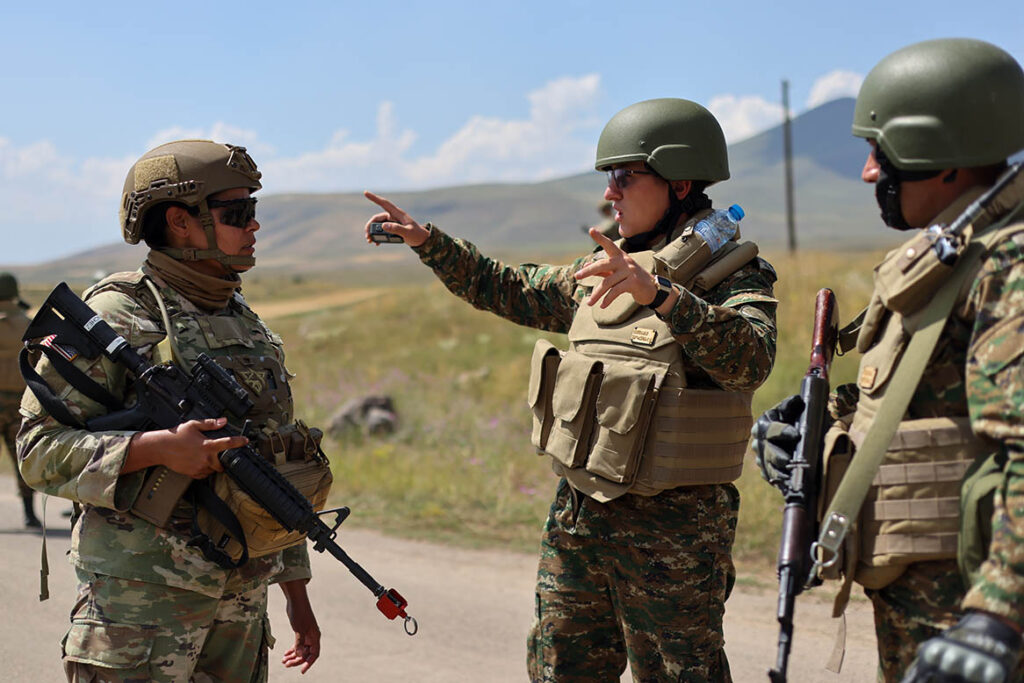
United States: Cooperation with Washington emphasizes
institutional and structural reform over hardware. The U.S. Department of State
has highlighted targeted advisory programs, military-to-military contacts,
Professional Military Education (PME) via the International Military Education
and Training (IMET) program, and the institutionalization of a regular defense
planning dialogue. This is further reinforced by the continuation of the State
Partnership Program with the Kansas National Guard and joint exercises such as
Eagle Partner, which serve as practical mechanisms for testing operational
interoperability.
- The
European Union: The EU has introduced a distinct geopolitical
and structural dimension to Armenia's resilience. In January 2026, the Council
of the European Union approved a second assistance measure under the European
Peace Facility (EPF) worth €20 million, bringing total EPF support to €30
million. This initiative is explicitly designed to enhance the logistical
capabilities, operational resilience, and tactical interoperability of the
Armenian Armed Forces.
- India:
Bilateral ties with New Delhi are rapidly transitioning from ad-hoc procurement
to deep institutional defense integration. During the visit of the Indian
Defense Secretary to Yerevan in August 2026, both states focused on joint
capacity building, specialized training, and defense research and development
(R&D). The exchange of a formal document to institutionalize Joint Services
Staff Talks signals a long-term
commitment to structured defense cooperation.
- Equipment: The physical acquisition of
technological systems. This layer is easily verifiable through open-source
intelligence but represents only the raw input of military power.
- Force
Structure: The structural optimization of military units to ensure
that newly acquired hardware is supported by the correct organizational
formations.
- Command
and Control (C2 Architecture): The technical and operational
architecture through which data flows. For instance, while a newly procured
radar can be visually confirmed, its strategic value depends on how rapidly it
transmits sensor data to decision-makers and strike assets (the ISR-to-fires
loop).
- Human
Capital (Professionalization): The intellectual and
technical capacity of the force. Genuine reform requires transforming
individual training into a continuous institutional cycle where field
experience updates doctrine, which subsequently refines large-scale exercises.
- Operational Integration (Functional Capability): The
highest layer of capability, where disparate systems, doctrines, and
multi-source logistics operate as a synchronized whole under realistic combat
conditions.
- Quantitative
growth in advanced hardware without a corresponding modernization of automated
C2 networks.
- The
parallel but operationally isolated deployment of Western, Indian, and legacy
Soviet-era hardware within the same tactical echelons.
- A
widening gap between the introduction of high-tech assets and the technical
proficiency of the conscript and professional NCO corps tasked with operating
them.
- Continued,
heavy reliance on foreign OEMs (Original Equipment Manufacturers) for routine
lifecycle maintenance and spare parts supply chains.
- Large-scale
military exercises that test isolated platform performance rather than joint,
multi-domain system interaction.
From Rearmament to Defence Transformation: Armenia’s Military Modernization and the Quest for an Integrated Defence Model
Introduction
Following
the 2020 Karabakh War, the central question for Armenia’s defence architecture
is no longer merely how quickly the state can replace its lost hardware.
Rather, the critical challenge lies in whether Armenia can transform
technologies, human capital, institutional structures, and diverse military
partnerships acquired from foreign sources into a unified, functional, and
resilient combat capability.
This
distinction is fundamental to modern strategic analysis. The efficacy of a
contemporary military force is not determined by the sheer volume or technical
specifications of isolated platforms. True operational capability materializes
only when intelligence, surveillance, command-and-control (C2) systems, strike
assets, logistics, and doctrine operate within a synchronized
system-of-systems. Consequently, acquiring advanced main battle tanks,
artillery pieces, or unmanned aerial vehicles (UAVs) provides raw military
resources but does not automatically yield enhanced combat effectiveness.
The
Army Transformation Concept introduced by the Ministry of Defence of the
Republic of Armenia in November 2024 demonstrates that Yerevan's official
agenda extends beyond simple procurement. However, the mere existence of a
conceptual document does not equate to completed systemic reform. While the
concept outlines the strategic vector, actual transformation must be rigorously
evaluated by the extent to which these directives materialize into tangible
organizational, operational, and technological capabilities. Armenia’s ongoing
process is best understood as a complex transition from reactive rearmament
toward comprehensive defence transformation, the ultimate success of which
hinges on systemic integration rather than acquisition.
The
core thesis of this analysis posits that the primary benchmark for Armenia’s
military modernization should not be the quantity of procured platforms or the
number of bilateral security partners, but rather the state's capacity to
synthesize these disparate inputs into a cohesive, interoperable military
capability.
The
2020 War: A Deficit of Matériel or a Systemic Failure?
The
2020 Karabakh War underscored critical dimensions of military effectiveness in
modern high-intensity conflicts. The extensive deployment of unmanned systems,
advanced electronic warfare (EW), precision-guided munitions, and integrated
reconnaissance networks proved that platform availability and operational
utility are distinct variables.
This
provides the primary operational lesson for Armenia. The wartime experience
cannot be reduced to a quantitative or technological deficit in hardware. The
deeper vulnerability lay in the breakdown of the force-generation and
target-engagement cycle:
If
a single link within this functional chain is compromised, the introduction of
isolated high-tech systems fails to generate a proportional increase in combat
power. Thus, the 2020 conflict serves as a stark assessment of Armenia's
military integration and institutional adaptability.
Moving
forward, Yerevan faces two divergent strategic pathways. The first approach
assumes that the war simply demonstrated a need for more advanced hardware,
leading to a conventional, procurement-heavy rearmament strategy. The second,
more holistic approach recognizes the necessity of fundamentally overhauling
the state's force generation, C2 structures, intelligence frameworks,
logistical models and operational doctrines. The institutional commitment to
this secondary path must serve as the primary metric for evaluating
contemporary Armenian military reforms.
Geopolitical
Shift: Partner Diversification and Functional Allocation
Evaluating
the restructuring of Armenia's defence architecture is impossible without
analyzing the Russian Federation's historical role. Traditionally, Armenia’s
security matrix was inextricably linked to Moscow across defense pacts,
hardware procurement, military education, and institutional doctrines.
In
the post-2020 landscape, this paradigm is undergoing a profound structural
shift. However, current dynamics are accurately characterized not as an
immediate or absolute replacement of Russian influence, but as a strategic
diversification and functional allocation of new security partnerships.
Reducing
reliance on a single external patron does not automatically guarantee strategic
autonomy. Absent meticulous planning, a state risks replacing unilateral
dependence with a fragmented web of multilateral dependencies, particularly
when dealing with disparate foreign technologies, operational standards, and
training doctrines. Therefore, the critical analytical inquiry is not how many
new international partners Armenia has secured, but rather what specific
operational function each partnership fulfills within the broader defense
apparatus and
how effectively these functions can be integrated. If one partner provides
professional military education, another supplies air defense frameworks, a
third delivers artillery systems, and a fourth assists in research and
development, overall military efficacy becomes entirely contingent on systemic
synthesis.
The
Material and Institutional Dimensions of Diversification
Armenia's
emerging defense architecture is defined by the expansion of military-technical
and institutional cooperation with several key sovereign actors:

Additionally,
ongoing defense consultations and experience-sharing formats with traditional
regional actors like Greece and Cyprus underscore a concerted effort to anchor
Armenia's military education and operational planning within a wider European
framework. This collective shift proves that diversification has surpassed mere
procurement; it now encompasses the entire spectrum of military readiness, from
foundational education to logistical synchronization.
From
Procurement to Capability: Frameworks of Systemic Integration
To
realistically assess whether Armenia is achieving genuine defense transformation
or remaining stagnant at the level of simple rearmament, its progress must be
measured across five interconnected conceptual layers. This analytical
framework progresses systematically from foundational equipment procurement
and the optimization of force
structures to the implementation of automated command and control networks,
the qualitative development of human
capital and, ultimately, full operational integration under realistic
combat conditions.
Open-source
data confirms that Armenia has successfully altered its partnership geography,
introduced the Army Transformation Concept and
expanded international PME and logistical support frameworks. However, open
sources remain insufficient to definitively prove that these multi-source
systems are seamlessly integrated into a unified C2 architecture, or that
long-term supply chain sustainability (sustainment) has been achieved. Analysts
must maintain a strict distinction between evidence of process (reforms
initiated) and evidence of outcome (combat capability achieved).
The
Sustainment Paradox: Logistics and Strategic Resilience
The
creation of a multi-source defense inventory introduces a critical structural
paradox. While diversification mitigates strategic vulnerability to a single
foreign supplier, it exponentially increases the internal complexity of defense
maintenance and logistics.
Managing
systems from vastly different manufacturing origins requires maintaining
separate supply chains for spare parts, specialized technical personnel,
distinct ammunition calibers, and proprietary software architectures. The EU’s
explicit focus on logistics within its 2026 EPF assistance package underscores
the critical nature of this vulnerability. A diversified military inventory is
only as effective as the state's sustainment architecture. If a military cannot
guarantee the long-term operational readiness of its hardware independent of immediate
foreign technical intervention, its strategic resilience remains compromised.
This
dynamic extends directly to domestic defense-industrial capabilities. Relying
entirely on foreign technical lifelines for repairs, modifications, and
upgrades severely limits a state's endurance in a prolonged crisis. True
strategic autonomy requires establishing a comprehensive domestic cycle that
encompasses research and
development (R&D), conceptual design, streamlined manufacturing,
operational testing,
and advanced system
integration, culminating in autonomous lifecycle maintenance.
Armenia's 2026 defense R&D initiatives with India mark a notable step in
this direction, yet its ultimate utility depends on whether this cooperation
yields reproducible domestic industrial capacity or remains confined to
external technology transfers.
Risk
Indicators: Where Transformation Stalls
To
maintain an objective analytical framework, it is vital to identify specific
systemic indicators that would signal a failure to progress beyond superficial
rearmament. Transformation can be considered stalled or fragmented if the
following anomalies emerge:
Regional
Security Implications and Trajectories
Armenia’s
defense trajectory will ultimately evolve along one of three paths: Limited
Rearmament (increased hardware procurement with stagnant institutional
structures), Managed Transformation (synchronized technological and
organizational reform), or a New Defense Model (comprehensive
integration of multi-partner assets, domestic industrial baseline, and advanced
C2).
The
realization of these models carries profound implications for the South
Caucasus security architecture. Armenia's reforms do not occur in a vacuum;
they interact directly with Azerbaijan’s evolving military capabilities,
Turkey’s expanding regional footprint, Iran’s strategic calculations, Russia’s
shifting posture, and the increasing institutional presence of the EU and the
United States.
Should
Armenia successfully transition to an integrated defense model, it will
fundamentally alter the regional strategic calculus. Deterrence will no longer
be measured purely through quantitative asset ratios or numerical balances.
Instead, the emergence of a highly integrated, doctrinally adaptable defense
framework in Yerevan will introduce a higher level of operational complexity
for external planners, shifting the regional paradigm from a primitive balance
of power to a complex balance of capabilities.
Conclusion
The
modernization of the Armenian Armed Forces has clearly breached the boundaries
of traditional, reactive rearmament. The trauma of the 2020 war exposed deep
institutional fissures, prompting a deliberate diversification of partners, an
overhaul of military education, and a concerted push toward logistical
sustainability.
Readiness and defense transformation are inherently non-linear processes. Acquiring advanced artillery is a procurement event; integrating that artillery into an automated, sensor-to-shooter reconnaissance network is a strategic transformation. At this juncture, the empirical evidence indicates that Armenia is actively moving toward comprehensive defense transformation, but treating this process as a finished result is premature. The final metric of Armenia's military viability will be determined not by the volume of its international purchases, but by the depth of its internal integration.
Political and Security Analyst
Tatia KHUNTUA


 Latest news
Latest news
Latest newsGeorgia’s Constitutional Court Continues Case on Banning Opposition Parties: Political Pluralism at Stake
12.Oct.2026
Azerbaijan and Iran Step Up Security Contacts Amid Hijab Protests
12.Oct.2026
Personnel Shortages Complicate Ukrainian Forces’ Rotation: Ukraine Faces Long-Term Challenges on the Front Line
11.Oct.2026
Trump Eases Sanctions on Russian Fuel After Talks with Putin: Kyiv Fears Boost to Moscow’s War Revenues
10.Oct.2026
Putin Seeks to Strengthen Russia’s Influence in the Post-Soviet Space Through the CIS
10.Oct.2026
Russia and the South Caucasus: External Pressure, Political Competition and a Crisis of Trust
10.Oct.2026
Peaceful Settlement Between Armenia and Azerbaijan: Moving from Declarations to Implementation
10.Oct.2026
Moldova Ready to Accept as Many Ukrainians as Necessary if Situation Worsens This Winter
09.Oct.2026
Turkmenistan Turns Avaza into a Regional Diplomatic Hub as Caspian, Central Asian and CIS Agendas Converge
08.Oct.2026
Romania Scrambles Spanish F-18s After Aerial Targets Detected Near Ukrainian Border
07.Oct.2026
Berlin Deepens Defence Partnership with Kyiv: Germany to Provide Ukraine with €1 Billion in Military Aid
07.Oct.2026
European Parliament Against Georgian Dream: EU Prepares New Response to Tbilisi
06.Oct.2026
Bulgarian Foreign Minister to Discuss European Security and International Law in the Netherlands
05.Oct.2026
Rheinmetall in Bulgaria: Sofia Emerges as a New NATO Defence-Industrial Hub in the Balkans
05.Oct.2026
The Cost of a Long War: Moscow Expands Spending Plans Through 2029
05.Oct.2026