
 13 Oct 2026









The United States Hail Azerbaijan's Anti-Terror Efforts, Urges For Respect Of Human Rights, Rule Of Law
Azerbaijan was among international partners that the U.S. State Department praised on Wednesday for "actively working" to deter, detect, and defeat terrorist efforts, as it released its annual terrorism report, however, diplomats in Washington also reminded that counterterrorism tools should be used against actual terrorist threats only, Turan's Washington correspondent reports.
The annual Country Reports on Terrorism, released by the State Department, notes that in 2019, there were no reported terrorist incidents in Azerbaijan.
It goes on to highlight that, law enforcement and security services "have demonstrated adequate capacity to detect, deter, and prevent acts of terrorism in Azerbaijan’s territory".
The report also points out that law enforcement and security agencies continued to exhibit wide discretion in determining what activities qualify as “terrorism” or “extremism,” leaving political opponents and religious activists vulnerable to prosecution, detention, and physical mistreatment.
"Such individuals have been especially vulnerable to physical abuse by the [Ministry of Internal Affairs'] organized crime unit," the authors noted referring to the State Department's recently issued Religious Report, which, in itself, reflects abuses in Azerbaijan.
The move comes just a month after Azerbaijan's opposition Popular Front Party leader's bodyguard Niyamaddin Ahmadov has been charged with "financing terrorism" after 30 days of administrative detention for "violating quarantine measures", amid Covid 19 lockdown.
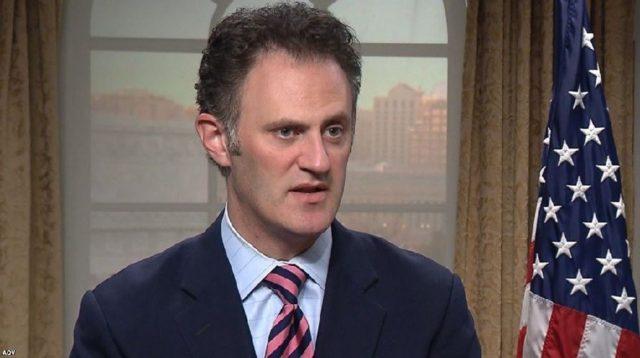
Asked whether the U.S. has any concern that the governments such as Azerbaijan and other, might be using terrorism as an excuse to purge their critics and opposition, Ambassador Nathan Sales, State Department's Coordinator for Counterterrorism, told TURAN's Washington correspondent that "in the United States, we pursue an approach to counterterrorism that is fully respectful of human rights and the rule of law."
"Unfortunately, there are too many countries around the world that use counterterrorism concerns as a pretext to suppress peaceful political protest, to marginalize or isolate religious or ethnic minority groups," he said during a virtual press briefing organized by the State Department's Foreign Press Center.
"Perhaps the most shameful example of this", he continued explaining, "is what the Chinese Communist Party is doing right now in Xinjiang, where it has rounded up at least a million Muslims – Uyghurs, ethnic Kazakhs, and other Muslim minorities – rounded them up and thrown them into internment camps. That’s not counterterrorism. That’s just repression, plain and simple."
"And so the United States has been clear that counterterrorism tools should be used against actual terrorist threats, but should never be abused to justify religious suppression," Ambassador Sales added.
Overall, the State Department's latest annual Reports on Terrorism, details key developments in 2019 in the global fight against ISIS, al-Qa’ida, Iranian proxies, and other international terrorist groups.
Along with the Global Coalition to Defeat ISIS, the United States completed the destruction of the so-called caliphate in Iraq and Syria in March. In October, ISIS leader Abu Bakr al Baghdadi died following a U.S. military raid on his compound in Syria.
"... We’re undaunted in our pursuit of bringing terrorists to justice." Secretary of State Mike Pompeo told reporters during the press briefing, calling Iran the “foremost state sponsor of terrorism”
According to the report, Tehran has had its hand in attempted assassination and bombings across Europe, leading to icier relations with a number of countries where the plots were to be carried out.
“Albania, Denmark, and France all reduced diplomatic relations in response to Iran-backed plots to conduct assassinations or bombings in those countries,” the report reads. “These plots in the heart of Europe illustrate the global reach of Tehran’s terrorist capabilities.”
Separately, the State Department on Wednesday increased its reward offer – now up to $10 million – for information about the location of the new leader of ISIS known as Amir Muhammad Sa’id Abdal-Rahman al-Mawla.
"We urge anyone with information on the whereabouts of al-Mawla to contact the Rewards for Justice Program via the RFJ website at www.rewardsforjustice.net or via email at info@rewardsforjustice.net. Individuals outside the United States may also contact the nearest U.S. embassy or consulate. All information submitted to us will be kept strictly confidential," State Department's Principal Deputy Assistant Secretary for Diplomatic Security Todd Brown told reporters.
TURAN's correspondent also asked Ambassador Nathan Sales if there was any concern in Washington that the pandemic might be putting pressure on nations to pledge to a common goal of defeating ISIS?
"The world," he said in response, "is facing a really historically unprecedented challenge in the COVID pandemic, and it’s putting enormous strain on civilian populations around the world. As we focus on this, it’s important that we also keep our eye on the ball when it comes to terrorism."
"We can’t allow our terrorist adversaries to think that just because the world is grappling with a public health crisis that they now have a safe space to operate. They don’t have a safe space to operate. We’re going to continue to bring pressure to bear on them notwithstanding COVID-19. Whether it’s military pressure or law enforcement pressure, or counter-messaging, we’re still very much in the business of counterterrorism in this environment," he concluded.


 Latest news
Latest news
Latest newsGeorgia’s Constitutional Court Continues Case on Banning Opposition Parties: Political Pluralism at Stake
12.Oct.2026
Azerbaijan and Iran Step Up Security Contacts Amid Hijab Protests
12.Oct.2026
Personnel Shortages Complicate Ukrainian Forces’ Rotation: Ukraine Faces Long-Term Challenges on the Front Line
11.Oct.2026
Trump Eases Sanctions on Russian Fuel After Talks with Putin: Kyiv Fears Boost to Moscow’s War Revenues
10.Oct.2026
Putin Seeks to Strengthen Russia’s Influence in the Post-Soviet Space Through the CIS
10.Oct.2026
Russia and the South Caucasus: External Pressure, Political Competition and a Crisis of Trust
10.Oct.2026
Peaceful Settlement Between Armenia and Azerbaijan: Moving from Declarations to Implementation
10.Oct.2026
Moldova Ready to Accept as Many Ukrainians as Necessary if Situation Worsens This Winter
09.Oct.2026
Turkmenistan Turns Avaza into a Regional Diplomatic Hub as Caspian, Central Asian and CIS Agendas Converge
08.Oct.2026
Romania Scrambles Spanish F-18s After Aerial Targets Detected Near Ukrainian Border
07.Oct.2026
Berlin Deepens Defence Partnership with Kyiv: Germany to Provide Ukraine with €1 Billion in Military Aid
07.Oct.2026
European Parliament Against Georgian Dream: EU Prepares New Response to Tbilisi
06.Oct.2026
Bulgarian Foreign Minister to Discuss European Security and International Law in the Netherlands
05.Oct.2026
Rheinmetall in Bulgaria: Sofia Emerges as a New NATO Defence-Industrial Hub in the Balkans
05.Oct.2026
The Cost of a Long War: Moscow Expands Spending Plans Through 2029
05.Oct.2026