
 14 Jul 2026









Erdoğan visits Balkans
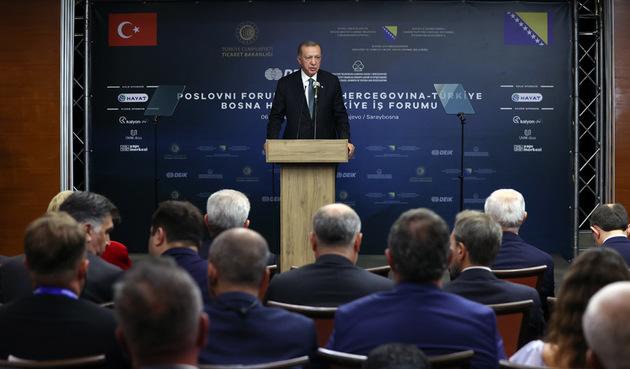
Strengthening bilateral ties and revving up economic cooperation are topping the agenda of the Turkish president’s three-nation swing through the Balkans.
Yesterday, according to Daily Sabah, Accompanied by a large delegation, President Recep Tayyip Erdoğan arrived in Bosnia-Herzegovina’s capital Sarajevo on Tuesday, before he held one-on-one and inter-delegation meetings with the three-member Presidential Council of Bosnia-Herzegovina, which includes Bosniak member Sefik Dzaferovic, Croat member Zeljko Komsic and Serb member Milorad Dodik. Erdoğan dubbed relations with Bosnia-Herzegovina as “exceptional,” stressing support for the country’s territorial integrity and stability. Dzaferovic said Türkiye and Bosnia-Herzegovina enjoy friendly relations, and their historical and cultural ties are strong, adding they want to further enhance ties. He also said plans were in place to expand bilateral trade to $1 billion, voiced Bosnia-Herzegovina’s will to commence passport-free travel with Türkiye.
The Balkans is a priority for Türkiye not only for political, economic and geographical reasons but also due to its historical, cultural and human ties with the region. Today, he will also visit the grave of Alija Izetbegovic, the first Bosniak president of the country who died in 2003.
In recent years, the Balkans region has become an attractive market for Turkish investors with its qualified workforce, business-friendly investment environment, and tax and financial incentives. The region – which has deep historical and cultural ties with Türkiye – is often described as Türkiye’s gateway to the EU thanks to its geographical location.
Zdravko Marinkovic, head of Bosnia-Herzegovina’s Chamber of Foreign Trade, said Erdoğan’s Balkan tour is important for the region: “Türkiye invested $265 million in Bosnia-Herzegovina last year. Türkiye is one of the most important investment powers in Bosnia-Herzegovina. The trade volume increased to approximately $600 million last year”.
After Bosnia-Herzegovina, the Turkish leader will head to Serbia and Croatia. All three nations are aiming to improve their economic relations with Türkiye, according to their officials.
Marija Sepi, head of the Center for Europe at Serbia’s Chamber of Commerce, said economic relations with Türkiye were at the highest level: “The economic relations between Türkiye and Serbia have made great progress in recent years. The foreign trade volume reached $1.73 billion in 2021. Imports from Türkiye increased by 43%. We have come a long way in terms of foreign trade volume and investment, but we are below the real potential. Thanks to good political relations, the economic relations of the two countries are at their highest level. Sepi added that there are 699 Turkish companies registered in Serbia and these companies employ approximately 10,000 people”.
Silva Stipic, director of the International Employment Center at Croatia’s Chamber of Economy, said the bilateral trade volume reached $845 million in 2021 and $501 million in the first five months of this year.
Erdoğan is also expected to attend business forums in Belgrade and Zagreb, organized by the Foreign Economic Relations Board of Türkiye (DEİK).


 Latest news
Latest news
Latest newsUS Ready to Lift Sanctions on Turkiye and Restore Its Participation in the F-35 Program
09.Jul.2026
Trump Announces Transfer of License to Ukraine for Patriot Interceptor Missile Production
09.Jul.2026
The NATO Summit in Ankara Marked a New Stage in the Alliance's Transformation
08.Jul.2026
The war in Ukraine - the “liberation of Novorossiya” is a mission impossible
07.Jul.2026
Ursula von der Leyen's Visits to Baku and Yerevan Signal Brussels' New Strategy
07.Jul.2026
Putin's Approval Ratings Decline as Russians Grow Increasingly Concerned About the Economy and the War
06.Jul.2026
Erdogan and Radev Discuss Black Sea Security and Defense Cooperation
06.Jul.2026
OPEC+ Accelerates Output Recovery as Kazakhstan Increases Oil Production from August
05.Jul.2026
Georgia and Uzbekistan Elevate Relations to Strategic Partnership
05.Jul.2026
Iran Turns Khamenei Funeral into a Show of Strength as Week-Long National Mourning Begins
04.Jul.2026