
 29 May 2026









Armenia and Russia: Redefining Dependence in a Time of Regional Upheaval
A Relationship Under Strain
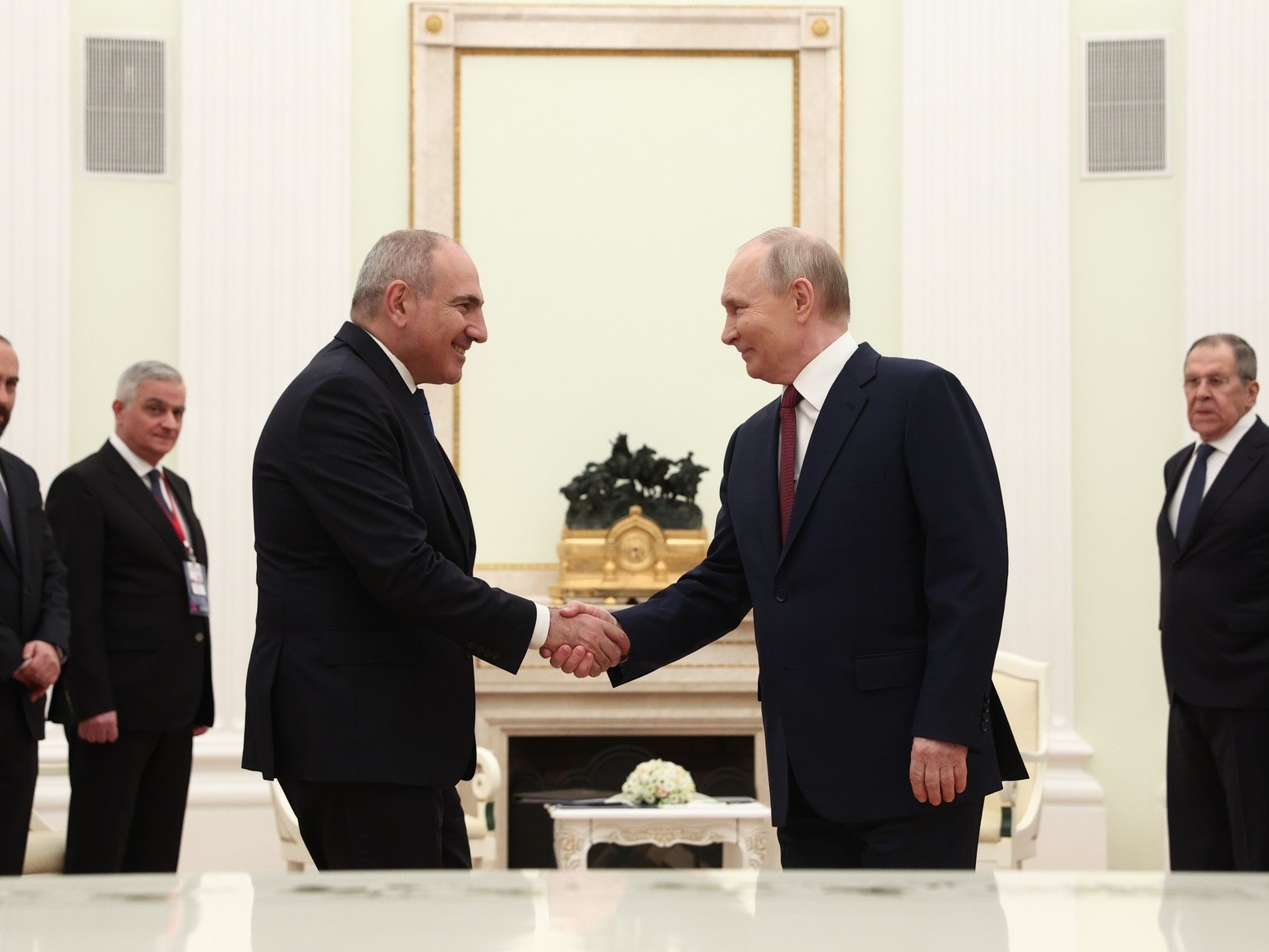
Armenia’s relationship with Russia is no longer defined by quiet dependence, but by visible tension, renegotiation, and strategic doubt. The recent Kremlin meeting between Nikol Pashinyan and Vladimir Putin did little to dispel the growing sense that Armenian–Russian relations are entering a period of structural transformation. Instead, it sharpened the contours of an increasingly transactional and, at times, adversarial relationship.
Putin’s remarks were telling. By underscoring the economic benefits Armenia derives from membership in the Eurasian Economic Union — notably access to markets and subsidized gas — he reaffirmed Moscow’s long-standing narrative: integration with Russia-led structures guarantees stability and prosperity. Yet his simultaneous warning about the incompatibility of the EAEU with potential EU accession signaled a hardening red line.
More striking still was his explicit call for pro-Russian forces within Armenia to operate without restriction. In the context of Armenia’s increasingly polarized domestic environment ahead of the June 7, 2026 parliamentary elections, such remarks blur the line between geopolitical messaging and perceived political interference.
Economic Leverage as Strategic Pressure
If the Kremlin meeting set the tone, subsequent comments by Alexei Overchuk amplified it. His warning that Russia may be “forced” to recalibrate economic relations — and even suspend air links should Armenia pivot toward the European Union — amounts to a clear articulation of economic coercion as policy.
This rhetoric was met with an unusually direct response from Alen Simonyan, who suggested that Armenia could reconsider its own participation in both the Collective Security Treaty Organization and the EAEU if Moscow revises key economic terms such as gas pricing.
What emerges is a relationship no longer anchored in mutual strategic alignment, but rather negotiated through leverage, counter-leverage, and implicit threats.
From Security Patron to Questioned Ally
For decades, Armenia’s partnership with Russia rested primarily on security. Russian military presence, defense cooperation, and Moscow’s role as a guarantor shaped the bilateral framework. However, the conflicts and crises of recent years have eroded Armenian confidence in that model.
The perceived insufficiency — or inconsistency — of Russian security guarantees has triggered a profound reassessment in Yerevan. The shift is not merely tactical; it is conceptual. Armenia is no longer willing to define its foreign policy through a single axis.
Instead, it is exploring political and security cooperation with Western actors, including the European Union, while attempting to preserve economic ties with Russia. This balancing act reflects both necessity and ambition—but also exposes Armenia to heightened geopolitical risk.
The Economy as the New Arena
As security cooperation loses its centrality, the economy has become the primary domain through which Armenian–Russian relations are being renegotiated and increasingly contested.
The scale of Armenia’s economic dependence on Russia remains significant. Russia continues to be Armenia’s largest trading partner, accounting for a substantial share of exports and imports, particularly in energy, foodstuffs, and raw materials. Armenian exports to Russia have surged in recent years, partly due to re-export dynamics that intensified after Western sanctions on Moscow. This created short-term growth but also deepened structural dependence on Russian markets and financial systems.
Energy is the most sensitive lever. Armenia relies heavily on subsidized Russian natural gas supplied through Gazprom, which not only controls pricing but also owns critical segments of Armenia’s gas distribution infrastructure. Preferential pricing has long been one of the key economic benefits of Armenia’s membership in the Eurasian Economic Union—and, as highlighted by Vladimir Putin, a central argument for maintaining alignment with Moscow. Any revision of these terms would have immediate macroeconomic and social consequences in Armenia, from inflationary pressures to industrial competitiveness.
Financial flows further reinforce this interdependence. Remittances from Armenians working in Russia remain a crucial source of household income and foreign currency inflows, making Armenia vulnerable to fluctuations in the Russian economy and policy decisions affecting migrant labor. Additionally, the Russian ruble’s volatility has had spillover effects on Armenia’s financial stability in recent years.
Yet, alongside this dependence, a gradual diversification strategy is taking shape. Armenia has expanded trade with the European Union under frameworks such as the Comprehensive and Enhanced Partnership Agreement (CEPA), while also deepening economic ties with regional actors including Iran and exploring new logistics routes through Georgia to access Black Sea ports.
The government has also sought to position Armenia as a technology and services hub, attracting investment and talent, including an influx of Russian IT professionals since 2022. This has boosted sectors such as fintech and digital services, slightly reducing reliance on traditional industries tied to Russian supply chains. However, this shift remains uneven and insufficient to offset broader structural dependencies.
Infrastructure control has become another focal point of economic sovereignty. Beyond the railway system, Russian companies maintain stakes in key sectors including energy and telecommunications. Efforts by Yerevan to renegotiate or reclaim control over such assets reflect a broader attempt to rebalance the relationship, but also risk provoking retaliatory economic measures from Moscow.
At the same time, Armenia’s geographic constraints complicate diversification. Closed borders with Turkey and Azerbaijan limit trade routes, increasing reliance on transit through Georgia and Iran. This structural reality makes a rapid economic reorientation away from Russia both costly and logistically challenging.
In this context, the economy is not merely a sphere of cooperation — it is the central battleground where sovereignty, resilience, and geopolitical alignment intersect. Armenia’s ability to gradually diversify without triggering economic destabilization will likely determine the success or failure of its broader foreign policy transformation.
Railways and Sovereignty: A Test Case
Perhaps the most illustrative example of this evolving dynamic is Armenia’s intention to assume management of its railway system, currently operated by Russian entities. Announced by Pashinyan on February 13, the move carries both economic and symbolic weight.
Unsurprisingly, the proposal drew criticism from Sergey Shoigu and Maria Zakharova, who framed it as a destabilizing step.
At its core, the railway issue is about sovereignty. Control over critical infrastructure is a hallmark of state autonomy, and Yerevan’s move signals a desire to reclaim strategic assets.
Yet the feasibility of replacing Russian management with a third-country operator remains uncertain. Potential candidates — whether European or regional—would face significant political, financial, and logistical hurdles. Moreover, any transition risks retaliation from Moscow, potentially affecting other sectors.
Thus, while symbolically powerful, the railway initiative may prove difficult to implement without broader structural shifts in Armenia’s external relations.
Competing Integration Projects
As Armenia approaches its parliamentary elections, the question of geopolitical orientation is becoming increasingly salient. The choice is not framed as binary, but the constraints imposed by competing integration projects make it difficult to avoid trade-offs.
On one side stands the EAEU, offering economic continuity but limiting political maneuverability. On the other lies the prospect of deeper engagement with the European Union, promising reform and diversification but carrying economic and geopolitical costs.
Putin’s assertion that these paths are incompatible reflects not just institutional realities, but strategic intent. Moscow is signaling that Armenia cannot indefinitely pursue a “both-and” approach.
For Armenian voters, this raises fundamental questions: What balance between sovereignty and security is acceptable? How much economic risk is worth taking for political autonomy? And can Armenia realistically navigate between competing blocs without being forced to choose?
A Shifting Regional Landscape
These developments must also be understood within the broader transformation of the South Caucasus—one increasingly defined by fluid alliances, diminished certainties, and the growing assertiveness of regional and extra-regional actors.
The aftermath of the 2020 Nagorno-Karabakh War fundamentally altered the balance of power. Azerbaijan emerged with strengthened military and political leverage, while Turkey consolidated its role as a decisive strategic partner to Baku, projecting influence deeper into the South Caucasus than at any point in the post-Soviet period. This has effectively created a new regional axis that constrains Armenia’s room for maneuver.
At the same time, Russia’s traditional dominance has been diluted—not necessarily by withdrawal, but by overextension and shifting priorities. Moscow’s role as a security arbiter has been called into question, particularly after its peacekeeping presence failed to prevent subsequent escalations and the eventual depopulation of Nagorno-Karabakh. This erosion of credibility has had ripple effects across the region, prompting states to hedge their bets.
Into this space, new actors have stepped more assertively. The European Union has expanded its diplomatic footprint, including civilian monitoring missions along Armenia’s borders, signaling a willingness to engage in security-adjacent roles. Meanwhile, the United States has intensified political engagement, positioning itself as a mediator and supporter of regional connectivity initiatives.
Simultaneously, regional transport and energy corridors—such as the so-called “Middle Corridor” linking China to Europe via Central Asia and the South Caucasus—are gaining strategic importance. These projects elevate the significance of countries like Azerbaijan and Georgia as transit hubs, while leaving Armenia relatively sidelined due to unresolved conflicts and closed borders.
Iran, for its part, has also become more vocal and active, particularly in opposing any changes to regional borders or transit arrangements that could undermine its access to Armenia. Tehran’s position adds another layer of complexity, as it seeks to counterbalance both Turkish-Azerbaijani alignment and Western influence.
In this evolving environment, Armenia’s strategic recalibration is not occurring in isolation — it is unfolding within a competitive and rapidly changing geopolitical marketplace. The country’s challenge is not only to diversify its partnerships, but to do so in a way that integrates it into emerging regional frameworks rather than leaving it further marginalized.
The South Caucasus, in short, is no longer a space dominated by a single power center. It is becoming a contested arena where influence is negotiated, not assumed — and where Armenia must navigate with greater precision than ever before.
Conclusion: Between Strategy and Constraint
Armenia today finds itself at a strategic crossroads. Its relationship with Russia is neither collapsing nor stable; it is being renegotiated in real time, across multiple domains.
Economic ties may provide a temporary bridge, but they cannot fully compensate for the erosion of trust in the security sphere. Meanwhile, diversification efforts, while necessary, carry their own risks and limitations.
The coming months — shaped by electoral dynamics and external pressures — will be critical. Whether Armenia can transform its foreign policy without triggering severe economic or security repercussions remains an open question.
What is clear, however, is that the era of unquestioned dependence is over. What replaces it is still being written.
Political journalist and researcher
Anna Vardanyan


 Latest news
Latest news
Latest newsAstana Between Moscow and the West: Why Putin Needs the Visit to Kazakhstan
26.May.2026
Starlink at War: How SpaceX Secured Higher Prices from the Pentagon During the Iran Campaign
26.May.2026
Strike Back 2026: NATO Expands Its Military Presence in the Balkans and the Black Sea Region
25.May.2026
Military Parade as a Manifesto: What Armenia Wants to Tell the World on May 28
25.May.2026
The War in Ukraine: The Russian Army is Already Running Out of Steam
25.May.2026
Railway Breakthrough: Armenia Integrates into the Akhalkalaki–Kars Route
24.May.2026
Tbilisi on the Eve of May 26: Independence Day Turns Into a Day of Political Struggle
24.May.2026
The US and Iran Continue Negotiations on a Possible Agreement and Extension of the Ceasefire
23.May.2026
The United States Suspends Participation in Ukraine Negotiations
22.May.2026
Azerbaijan and Georgia Strengthen Strategic Partnership with New Package of Agreements Signed
21.May.2026