
 13 Oct 2026









Georgia’s Central Election Commission: ISFED’s data on imbalance in summaries of election results incorrect
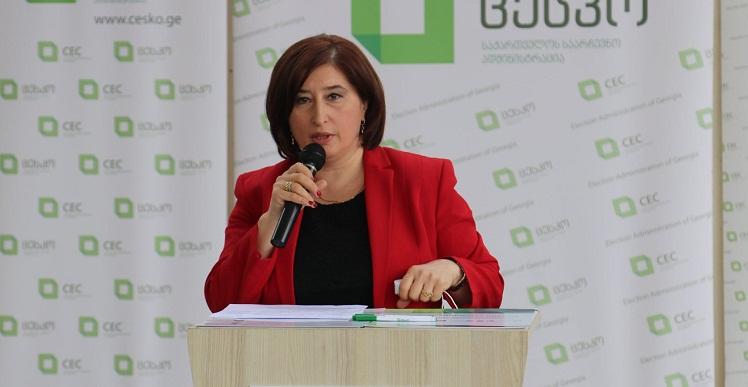
The Georgian Central Election Commission (CEC) says that the data of the International Society for Fair Elections and Democracy (ISFED) NGO which shows an imbalance between ballots cast and signatures of registered votes in eight per cent of election districts, is incorrect.
The CEC says that the imbalance was detected in only 19 summaries of election results of 3,657 polling stations which makes for 0.52 per cent of election districts.
The CEC states that ‘it is unclear’ why ISFED says in its November 1 and December 11 documents on the parallel vote count that there was an imbalance between ballots cast and signatures of registered votes in eight per cent of election districts.
The data released by ISFED is absolutely different from official statistics. It is possible that ISFED did not take corrected summaries of election results into account which are an integral part of summaries of election results,” CEC said, adding that they are ready to cooperate with ISFED and all interested parties regarding the issue.
Earlier this week the ruling Georgian Dream party asked ISFED to present the list of the eight per cent of election districts where, per the NGO, the ballots cast outnumber the signatures of registered voters.
 The ruling party says that ISFED's data is incorrect. Photo: Georgian Dream press office.
ISFED admitted to a mistake in its data of the parallel vote count last weekend, while the data has been used so far by opposition parties ‘as evidence that the ‘elections were fabricated’.
Following an internal audit ISFED adjusted the figures and said that the Georgian Dream ruling party received 47.6 per cent of votes instead of the the initially reported 45.8 per cent in the parallel vote count, while the United National Movement/Strength in Unity election bloc received 27. 4 per cent of votes instead of 26.4 per cent.
However, the NGO repeated that there was an imbalance in the eight per cent of summaries of election results.
The ruling party says that like the initial data of the parallel vote count, ISFED’s statement on the imbalance between ballot papers and registered voters, is also incorrect.


 Latest news
Latest news
Latest newsInflation in Romania Accelerates to 6.61%: Rising Prices Increase Pressure on Households and the Economy
13.Oct.2026
Can Europe Protect the International Criminal Court from Trump’s Sanctions?
13.Oct.2026
Georgia’s Constitutional Court Continues Case on Banning Opposition Parties: Political Pluralism at Stake
12.Oct.2026
Azerbaijan and Iran Step Up Security Contacts Amid Hijab Protests
12.Oct.2026
Personnel Shortages Complicate Ukrainian Forces’ Rotation: Ukraine Faces Long-Term Challenges on the Front Line
11.Oct.2026
Trump Eases Sanctions on Russian Fuel After Talks with Putin: Kyiv Fears Boost to Moscow’s War Revenues
10.Oct.2026
Putin Seeks to Strengthen Russia’s Influence in the Post-Soviet Space Through the CIS
10.Oct.2026
Russia and the South Caucasus: External Pressure, Political Competition and a Crisis of Trust
10.Oct.2026
Peaceful Settlement Between Armenia and Azerbaijan: Moving from Declarations to Implementation
10.Oct.2026
Moldova Ready to Accept as Many Ukrainians as Necessary if Situation Worsens This Winter
09.Oct.2026
Turkmenistan Turns Avaza into a Regional Diplomatic Hub as Caspian, Central Asian and CIS Agendas Converge
08.Oct.2026
Romania Scrambles Spanish F-18s After Aerial Targets Detected Near Ukrainian Border
07.Oct.2026
Berlin Deepens Defence Partnership with Kyiv: Germany to Provide Ukraine with €1 Billion in Military Aid
07.Oct.2026
European Parliament Against Georgian Dream: EU Prepares New Response to Tbilisi
06.Oct.2026
Bulgarian Foreign Minister to Discuss European Security and International Law in the Netherlands
05.Oct.2026