
 29 Aug 2026









Reduction of Military Service Term in Armenia: Political, Military, and Regional Aspects
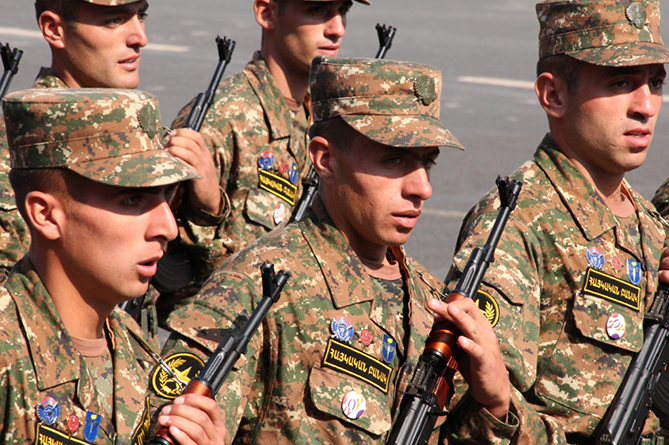
A few days ago, Prime Minister
Nikol Pashinyan announced a six-month reduction in the duration of mandatory
military service in Armenia – to 1 year and 6 months. This decision will take
effect on January 1, 2026, six months earlier than originally planned under the
Ministry of Defense’s legislative initiative. Prior to this, in September, the
government reduced next year’s defense budget by more than 15%, to $1.5
billion. The official explanation was a preliminary agreement signed with
Azerbaijan in Washington in August, which, according to the authorities, marked
the beginning of a “new era of peace” in the South Caucasus.
The
overarching narrative of the authorities is to convince both domestic and
international audiences that peace is now an irreversible reality and that
armed conflicts are a thing of the past.
However,
the reduction in the size of the army and defense spending indicates a much
deeper shift in state policy regarding the armed forces. According to data from
the Bonn International Center for Conflict Studies (BICC), in 2020 Armenia
ranked second in the world in terms of militarization (after Israel) and first
in Europe – with defense spending accounting for about 6.5% of GDP. There had
long been a broad public consensus that the army was the true guarantor of
peace.
Now the situation is changing. Despite recent large-scale arms purchases and the expansion of military cooperation with various power centers, an analysis of the government’s actions to reform the army shows that Armenia is moving toward demilitarization and a reduction in the army’s role in the country’s socio-political life. The following examines the political, military, and regional aspects of this process, as well as its causes, risks, and possible consequences.
Political aspect
For thirty years, Armenian
society endured significant hardships under the belief that all possible
resources were being directed toward national defense and border security. It
was widely believed that, despite Azerbaijan’s military superiority, the
Armenian army – through its training and dedication – would be able to ensure a
worthy defense. However, the war lasted only 44 days, and the army was
completely unprepared for the scale and nature of Azerbaijan’s military
operations.
The
high military command – generals who for years had enjoyed the privileges of
service and publicly declared their readiness to “crush the enemy” –
demonstrated complete incompetence, failing to manage the combat situation.
Much of the purchased weaponry proved largely useless. This happened in a
highly militarized state that had spent enormous resources and had three
decades to prepare. As a result, many members of the military elite were
arrested after the war and are currently under investigation on various charges.
The
fiasco of the 44-day war forced Armenia’s political leadership to reconsider
the army’s role in ensuring national security, assigning it a less central
place. Prime Minister Pashinyan even stated that too much responsibility for
state security had been placed on the shoulders of soldiers.
Thus,
even if the decision to shorten military service appears to be a temporary
measure or an electoral maneuver ahead of parliamentary elections, at a deeper
level it reflects the government’s view of the regional balance of power. The
significance of this moment lies in the fact that through this step, the ruling
team seeks to psychologically persuade Armenian society of the reality of peace
with Azerbaijan – even though most citizens still view this with skepticism.
Military aspect
From a military perspective,
the reduction in service time appears premature and inconsistent with Armenia’s
defense needs. A peace treaty with Azerbaijan has not yet been signed; there is
only a preliminary agreement, and the timing of border demarcation and
delimitation remains unclear, with numerous disputed sections still unresolved.
It is
not yet clear how the resulting personnel gaps will be compensated. Given the
reduction in the defense budget, a large-scale recruitment of contract soldiers
is unlikely to fully make up for the shortfall. The General Staff will likely
rely increasingly on reserve training cycles to fill the shortage of personnel
on the front lines.
Regional
aspect
By announcing a reduction in
defense spending and service duration immediately after the preliminary signing
of the Washington documents, Armenia is sending a clear signal to regional
power centers – primarily Azerbaijan and Turkey – about its peaceful
intentions.
Throughout
the three-decade-long conflict over Nagorno-Karabakh, Armenia, as the guarantor
of Artsakh’s security, relied on military force to defend the population’s
right to self-determination. Through demilitarization, the current Armenian
leadership is effectively declaring that it no longer pursues revanchist or
offensive goals toward its former adversary.
Notably,
Azerbaijan does not share this agenda. Despite economic challenges, it
continues to maintain a high level of defense spending – over $5 billion
annually – and plans only a modest reduction (8.6%) for 2026-2030. Given that
Azerbaijan has already achieved its main strategic objective, such a budget
reflects broader hegemonic ambitions in the South Caucasus.
The South Caucasus remains a complex region where the interests of competing power centers intersect. It will continue to be a zone of tension and conflict, and Armenia cannot remain on the sidelines. In this context, a modern and professional army remains one of the key instruments for protecting national interests and values. The Armenian Armed Forces are currently undergoing both conceptual and organizational transformation.
Specialist in politico-military and security affairs,
Hovhannes Vardanyan


 Latest news
Russia Intensifies Strikes on Ukraine’s Infrastructure, Targeting Warehouses and Logistics Hubs
28.Aug.2026
A New Economic Framework for Central Asia and the Caucasus: The Role of Azerbaijan and Uzbekistan
28.Aug.2026
Moscow Warns London: Russia Considers Strikes on British Military Targets
27.Aug.2026
Kazakhstan Launches a New Economic Strategy: GDP Growth, Investment and Pension Reform
27.Aug.2026
CIA Director Visits Moscow: Trump Hopes for Results
26.Aug.2026
Former Ukrainian Defense Minister Warns of Risk of Gradual Defeat in War with Russia
25.Aug.2026
Putin Authorizes Temporary State Management of Critical Infrastructure Vulnerable to Drone Attacks
24.Aug.2026
The United States Rapidly Expands Missile Production: Pentagon Accelerates Output of Tomahawks and Other Critical Weapons
24.Aug.2026
Record Supplies: Armenia Boosts Fish Exports to Georgia
23.Aug.2026
Political Battle During Wartime: Zelensky Opposes Elections
23.Aug.2026
Romania Approves Construction of One of the Largest Solar Power Plants in Europe
23.Aug.2026
Ex-Ukrainian Defence Minister Fails in Bid to Pressure Zelenskiy
22.Aug.2026
Upper Lars: Why Border Queues Have Become a Political Signal for Georgia and Russia
22.Aug.2026
Russia-Ukraine War: No Decisive Breakthrough on the Front and Intensifying Ukrainian Deep Strikes on Russia
21.Aug.2026
TRIPP, Peace, and a New Geopolitical Crossroads: How Armenia Has Changed One Year After Washington
20.Aug.2026