
 22 Sep 2026









Baku ready to open communications between Azerbaijan and Armenia, says Aliyev
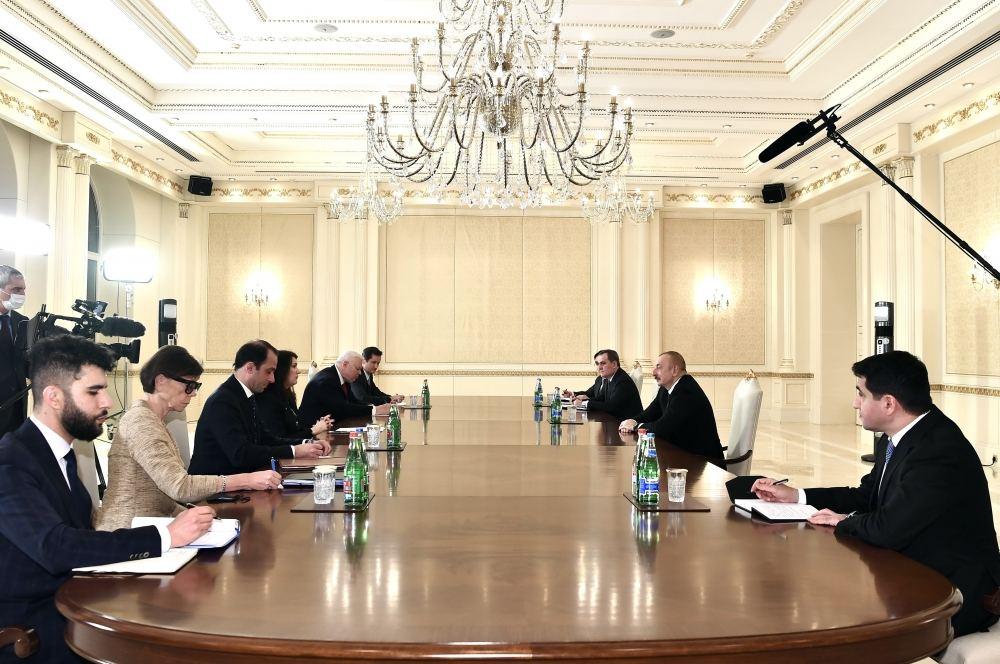
According to the Azerbaijani leader, opening of communications will be in the interests of the entire region, giving a fresh impetus to cooperation and opening new possibilities
Baku is ready to open communications with Yerevan, which will be a starting point for putting an end to the conflict in Nagorno-Karabakh, Azerbaijani President Ilham Aliyev said on Sunday at a meeting with visiting OSCE Chairperson-in-Office and Swedish Foreign Minister Ann Linde.
"We already started the process of negotiations on the opening of communications between Armenia and Azerbaijan. That was part of the statement which was signed on November 10. Negotiations already had several rounds, different levels and I think that this particular issue can be a starting point for completely turning the page of war and leaving it to the history," he was quoted as saying on the presidential website.
According to the Azerbaijani leader, opening of communications will be in the interests of the entire region, giving a fresh impetus to cooperation and opening new possibilities. "And it can bring after many other areas of potential cooperation. I already publicly spoke that Azerbaijan is ready for that," he stressed, adding that the four months that have elapsed after the war "already demonstrate the will of both sides to turn the page and to concentrate on the future."
Linde, in turn, said that the OSCE "would see if there is anything we can do to contribute to resolving conflict in the OSCE area" and stressed that in this context international law, human rights, humanitarian law, peace and security are of top priority for the OSCE.
On November 9, Russian President Vladimir Putin, Azerbaijani President Ilham Aliyev and Armenian Prime Minister Nikol Pashinyan signed a joint statement on a complete ceasefire in Nagorno-Karabakh starting from November 10. Under the document, the Azerbaijani and Armenian sides stopped at the positions that they had held and Russian peacekeepers were deployed along the engagement line in Nagorno-Karabakh and along the Lachinsky corridor that connects Armenia with the enclave to exercise control of the ceasefire observance. Apart from that, a number of districts came over to Baku’s control.
On January 11, 2021, the three leaders met in Moscow to sign a joint statement, which, among other things, provided for the establishment of a working group at the level of deputy prime ministers to unblock all economic and transport ties in the region.
15.03.2021 08:21


 Latest news
Latest news
Latest newsDuma Elections Reinforce Kremlin Dominance Amid the War
21.Sep.2026
Zelenskyy Approves New Long-Range Ukrainian Operations Amid Russian Attacks
20.Sep.2026
US Sanctions Target Russias Main Pillar as Moscow Faces New Pressure on Oil Revenues
19.Sep.2026
Russia Begins State Duma Elections Amid War in Ukraine
18.Sep.2026
Bulgaria Strengthens Protection of Strategic Infrastructure Against Drones and Other Threats
18.Sep.2026
Georgia and Enka: How the Namakhvani Dispute Could Affect the Investment Climate
17.Sep.2026
Una Aleksandra Bērziņa-Čerenkova: After Russia’s Invasion, Latvia Began Banning Russian-Language Media
17.Sep.2026
Rainer Saks: Russia сould lose its influence in Armenia, just as it did in the Baltics
16.Sep.2026
Russian Drones Violated Moldovan Airspace Twice During Zelenskys Trips
16.Sep.2026
Operation Vivaldi: Ukraine Reports Advances Near Lyman as Fighting Intensifies
16.Sep.2026
Kazakhstan and South Korea Elevate Ties to Comprehensive Strategic Partnership
16.Sep.2026
Armenia Energy Diversification: Testing the Limits of Dependence on Russian Gas
15.Sep.2026
Tbilisi Distances Itself from Brussels as Kobakhidze Intensifies Criticism of European Policy
14.Sep.2026
Russia Fuel Crisis Gives the US a New Diplomatic Leverage Tool
14.Sep.2026
Trump Calls on Zelenskyy to Stop Strikes on Russian Oil Infrastructure
13.Sep.2026