
 23 Nov 2026









Sofia and Washington Discuss Black Sea Security and the Future of Europe's Security Architecture
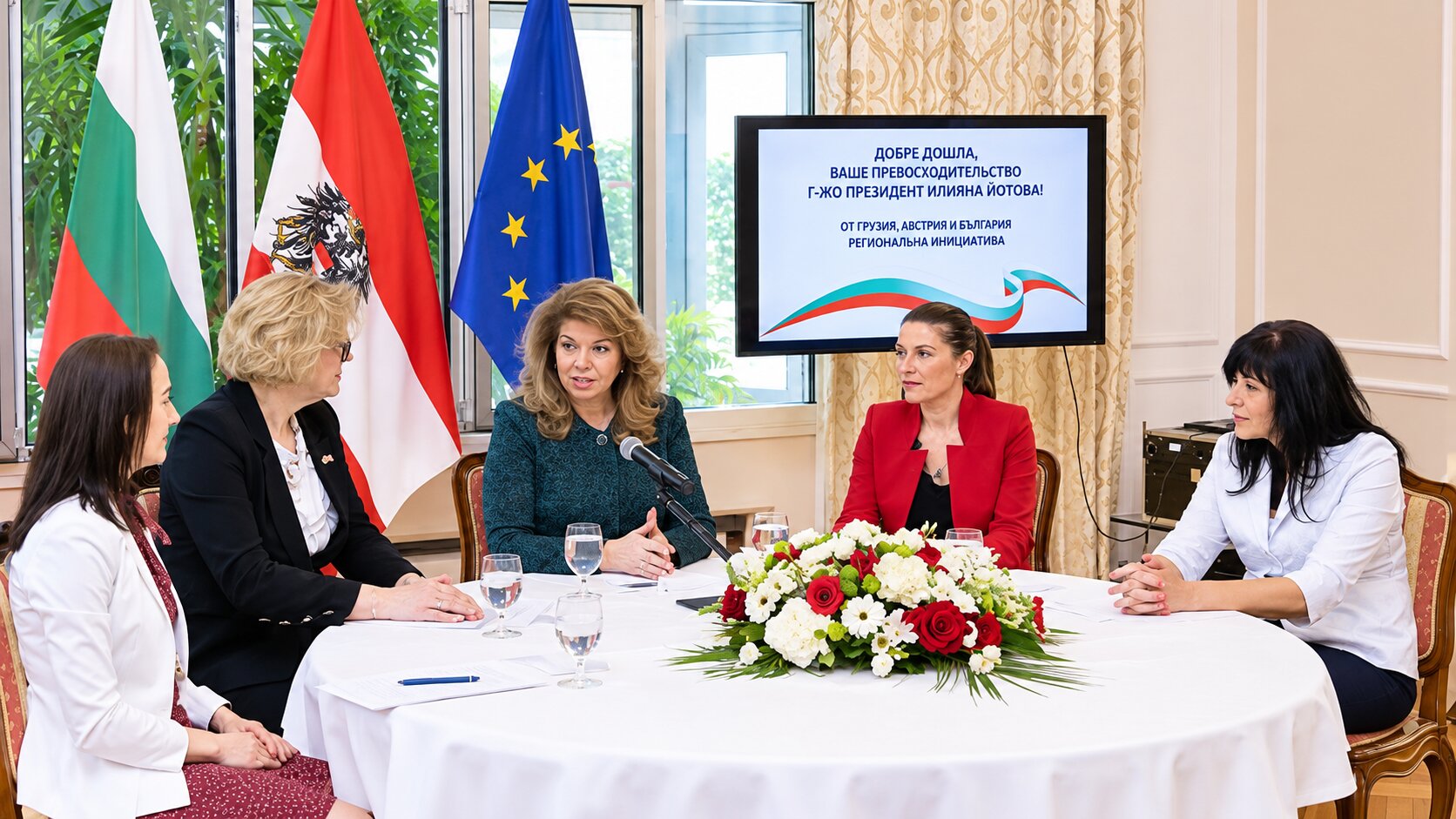
Bulgaria is seeking to strengthen international security cooperation amid the widening repercussions of the Russia-Ukraine war and growing threats to maritime infrastructure in the Black Sea. On 6 November, President Iliana Iotova met with representatives of the US National Defense University who were visiting Bulgaria as part of the Capstone programme. Discussions focused on the security situation in the Black Sea, prospects for a peaceful settlement of the war in Ukraine, the role of the European Union and the further development of the strategic partnership between Sofia and Washington.
The meeting took place at the presidential residence on Dondukov Boulevard in Sofia as part of the American delegation's visit to Bulgaria. Participants in the Capstone programme discussed key international security challenges with the Bulgarian head of state, including the consequences of the ongoing war in Ukraine and the changing military and political environment in Europe.
Iliana Iotova drew attention to the scale of contemporary armed conflicts, noting that more than 60 armed conflicts were recorded in 2025, the highest number since the Second World War, according to her assessment. The President described the current situation as a serious challenge for individual states and the international community.
Particular attention was paid to the Russia-Ukraine war. Iotova emphasised that the conflict had already extended beyond Ukraine's borders and that continuing a war of attrition could not be regarded as a viable solution. In her view, an end to the confrontation can be achieved through diplomacy and peace negotiations, in which Europe should play an active role.
The Bulgarian President stated that sustainable peace cannot be achieved without the participation of European countries. She called on the European Union to put forward concrete proposals for resolving the conflict in Ukraine and developing a security architecture capable of ensuring stability and predictability across the European continent. Iotova described the negotiations scheduled to take place in Abu Dhabi in the coming days as a positive step towards a diplomatic settlement.
Black Sea security was one of the central topics of the meeting. According to Iotova, attacks on vessels create not only immediate military risks but also serious economic and financial consequences. Particular concerns include threats to European energy security and to food security in Asian and African countries that depend on stable maritime trade routes.
In this context, the President outlined the measures Bulgaria is taking to strengthen regional security. In particular, the Consultative Council for National Security was convened to discuss the necessary response measures. Sofia has also held a series of consultations with its partners in the European Union and NATO, as well as with neighbouring Romania and Turkiye, to strengthen coordination on Black Sea security.
Of particular interest is Iotova's proposal to organise an international forum on Black Sea security involving the six coastal states: Bulgaria, Romania, Turkiye, Georgia, Ukraine and Russia. According to the President, one of the objectives of such a format could be to reach an agreement on a moratorium on military operations in the Black Sea basin. The initiative reflects Sofia's intention to expand diplomatic mechanisms for regional security. However, its practical implementation would require reconciling the positions of countries with substantially different interests and approaches to the ongoing conflict.
Iotova also emphasised Bulgaria's growing importance in European and regional affairs. She identified the development of infrastructure, energy and digital corridors as key factors enhancing the country's strategic role. These areas are important not only for the economic integration of Southeast Europe but also for ensuring the resilience of cross-border connections amid geopolitical instability.
Another issue discussed was the strengthening of the strategic partnership between Bulgaria and the United States, as well as the expansion of cooperation in security and defence. Against the backdrop of NATO's increased focus on its eastern flank, cooperation between Sofia and Washington has acquired additional significance for security in the Black Sea region.
Notably, Bulgarian Prime Minister Rumen Radev also met with the same American delegation on 6 November. During the talks, he reaffirmed the strategic importance of relations with the United States and expressed Sofia's interest in further developing defence cooperation, including the development and modernisation of critical military capabilities. The Prime Minister also stressed the importance of timely planning, coordination and preparedness to respond to contemporary threats. The modernisation of the armed forces and the development of national defence capabilities were identified as government priorities.
The meetings between representatives of the US National Defense University and Bulgaria's President and Prime Minister highlighted the broad range of issues shaping the agenda of US-Bulgarian cooperation. At the same time, Bulgaria is seeking to maintain a diplomatic role in discussions on the future of the Black Sea and Europe's security architecture.


 Latest news
EU Allocates Another €1 Billion to Ukraine: European Military Support Takes on a Long-Term Dimension
22.Nov.2026
Europe Prepares a Military Mission for Ukraine: 2800 Troops Rehearse Post-War Deployment Scenarios
21.Nov.2026
Russian Missiles and a Drone Fall on Polish Territory: NATO Faces New Threats on Its Eastern Flank
21.Nov.2026
Russia Strikes Kyiv Bridges Following Ukraine’s Attack on the Crimean Bridge: Transport Infrastructure Becomes a New Front in the Escalation
20.Nov.2026
The "Coalition of the Willing" Discusses Security Guarantees and Continued Support for Kyiv
19.Nov.2026
Tanker Sinks off Bulgaria After Being Hit Four Times: All 19 Crew Members Rescued
18.Nov.2026
Europe Accelerates Defence Integration: EU Identifies 8 Priorities for Joint Weapons Development
17.Nov.2026
Bulgaria and North Macedonia Plan to Begin Construction of New Border Crossing in October 2027
17.Nov.2026
Central Asia Accelerates Digitalisation of the Trans-Caspian Transport Corridor
16.Nov.2026
Bulgaria, Romania and Turkiye Deploy Naval Assets in BETUL 8 Rescue Operation
16.Nov.2026
Armenia Becomes the EU’s Leading Partner in the South Caucasus: Georgia Loses Influence in Europe’s Regional Strategy
15.Nov.2026
Ukraine Expands Its Campaign Against Russia’s Strategic Infrastructure
15.Nov.2026
Defence Partnerships without a Common Strategy? Turkiye Expands Military Ties with Qatar, Saudi Arabia and Pakistan
14.Nov.2026
Kobakhidze Says Georgia is Ready to Restore Political Dialogue with the European Union
14.Nov.2026
European Leaders Warn of Growing Russian Pressure on Armenia and Pledge Support to Yerevan
14.Nov.2026