
 23 Nov 2026









Russian Gerbera-2 Drone Discovered and Destroyed on Bulgaria’s Black Sea Coast
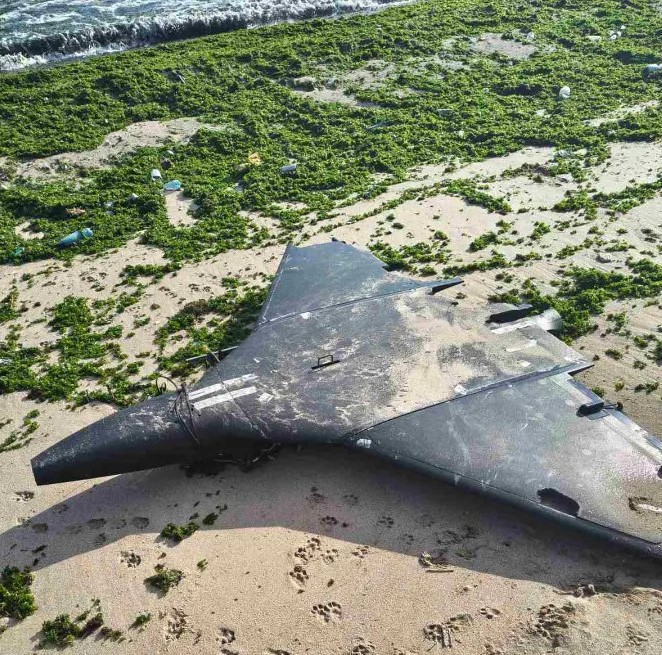
The discovery of a Russian
Gerbera-2 unmanned aerial vehicle (UAV) on Bulgaria’s Black Sea coast marks
another incident highlighting the spillover effects of the Russian-Ukrainian
war into the Black Sea region. Bulgaria’s Ministry of Defence confirmed that
the drone was found on a beach near Cape Shabla, apparently after falling into
the sea and being washed ashore by the waves. Bulgarian Navy personnel examined
the aircraft and destroyed it at the site. No explosives were found on board.
At approximately 10:00 a.m. on
6 November 2026, the duty officer of Bulgaria’s Ministry of Interior received a
report that an unmanned aerial vehicle had been discovered on a beach north of
the Cape Shabla lighthouse, on the country’s northeastern coast. The object was
located approximately 800 metres from the lighthouse. Following the report and
a decision by the Chief of Defence, a specialised team from the Varna Naval
Base was deployed on the orders of the Deputy Commander of the Bulgarian Navy.
Military personnel examined
the site and determined that the drone had most likely fallen into the sea
before being washed ashore by the waves. Following the inspection, specialists
identified the aircraft as a Russian Gerbera-2 drone. The Ministry of Defence
noted that no identification markings or inscriptions were visible on its body.
The inspection established
that the aircraft contained no explosive material. Bulgarian Navy personnel
subsequently neutralised the drone at the site, observing all necessary safety
precautions.
Initial reports by Bulgarian
media suggested that the discovered aircraft might have belonged to the Shahed
family of drones. However, the official identification provided by the Ministry
of Defence ruled out this possibility: the object was identified as a Russian
Gerbera-2.
 The Gerbera-2 is a Russian
unmanned aerial platform used for various purposes, including reconnaissance,
surveillance and serving as a decoy to complicate air defence operations. Such
systems form part of the broader range of unmanned technologies employed in the
Russian-Ukrainian war.
The incident occurred amid
heightened tensions in the western Black Sea. In recent weeks, reports of drone
attacks on commercial vessels near the coasts of Bulgaria and Romania have
raised concerns. These developments have heightened the focus of Black Sea
littoral states on the security of maritime transport routes, the protection of
port infrastructure, and the monitoring of the air and maritime environment.
Although Bulgaria’s Ministry
of Defence has not reported any direct threat to the country’s territory or any
deliberate violation of its airspace, the appearance of a Russian drone on the
Bulgarian coast highlights the extent to which the consequences of military
operations in the region can affect states that are not directly involved in
the conflict. As Russia’s war against Ukraine continues, ensuring security in
the Black Sea is becoming an increasingly important priority for Bulgaria,
Romania and their NATO allies.


 Latest news
EU Allocates Another €1 Billion to Ukraine: European Military Support Takes on a Long-Term Dimension
22.Nov.2026
Europe Prepares a Military Mission for Ukraine: 2800 Troops Rehearse Post-War Deployment Scenarios
21.Nov.2026
Russian Missiles and a Drone Fall on Polish Territory: NATO Faces New Threats on Its Eastern Flank
21.Nov.2026
Russia Strikes Kyiv Bridges Following Ukraine’s Attack on the Crimean Bridge: Transport Infrastructure Becomes a New Front in the Escalation
20.Nov.2026
The "Coalition of the Willing" Discusses Security Guarantees and Continued Support for Kyiv
19.Nov.2026
Tanker Sinks off Bulgaria After Being Hit Four Times: All 19 Crew Members Rescued
18.Nov.2026
Europe Accelerates Defence Integration: EU Identifies 8 Priorities for Joint Weapons Development
17.Nov.2026
Bulgaria and North Macedonia Plan to Begin Construction of New Border Crossing in October 2027
17.Nov.2026
Central Asia Accelerates Digitalisation of the Trans-Caspian Transport Corridor
16.Nov.2026
Bulgaria, Romania and Turkiye Deploy Naval Assets in BETUL 8 Rescue Operation
16.Nov.2026
Armenia Becomes the EU’s Leading Partner in the South Caucasus: Georgia Loses Influence in Europe’s Regional Strategy
15.Nov.2026
Ukraine Expands Its Campaign Against Russia’s Strategic Infrastructure
15.Nov.2026
Defence Partnerships without a Common Strategy? Turkiye Expands Military Ties with Qatar, Saudi Arabia and Pakistan
14.Nov.2026
Kobakhidze Says Georgia is Ready to Restore Political Dialogue with the European Union
14.Nov.2026
European Leaders Warn of Growing Russian Pressure on Armenia and Pledge Support to Yerevan
14.Nov.2026