
 24 Jun 2026









BRICS Is Not A Rival: U.S. Says, Countries Are Able To Choose 'Whatever Groupings They Associate'
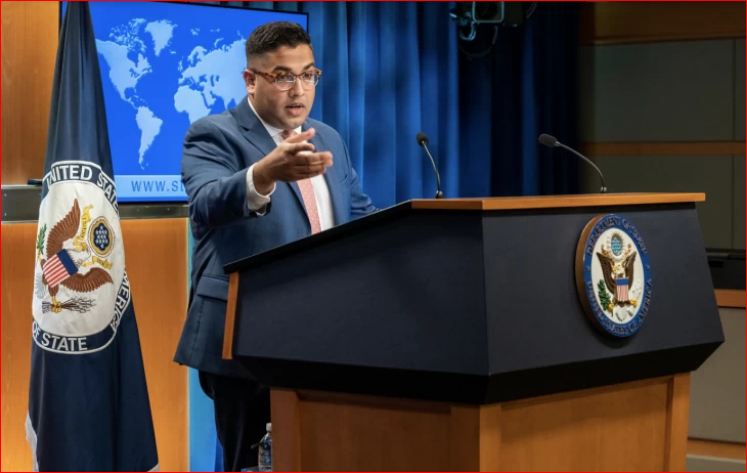
The United States said Tuesday it will continue to engage with countries that are attending today's Kazan summit, making it clear that it's not looking at BRICS as evolving into some kind of geopolitical rival, TURAN's Washington correspondent reports.
"We believe that countries are able to chart their own foreign policy and choose whatever countries and groupings in which they associate," State Department's Principal Deputy Spokesperson Vedant Patel told a daily briefing when responding to TURAN's questions.
"What the United States is focused on and the approach that we bring to all of the foreign policy and the diplomacy that we conduct is that we are focused on working with partners around the world to build the broadest and deepest coalitions possible to help achieve our shared goals," Patel aded.
His comments came as Russia is rolling out the red carpet to its geopolitical allies while hosting the latest BRICS summit in Kazan, pushing its agenda to create a “new world order” that challenges the West.
Patel said, Washington wants to enhance "the value proposition of what the United States can bring to the table, and we want to work with countries through investments in the kinds of things that we know these kinds of countries are looking for, and we are looking to sharpen and deepen and broaden our partnerships in that way."
"And of course, the multilateral institutions, whether it be the UN, G20, groups – groupings like APEC or ASEAN, are, of course, important and vital avenues for us to do that, and that’s why you have seen the Secretary place an emphasis on continuing to engage with those countries," he said. "As it relates to the specific makeup of BRICS, we’re going to continue to work and have a strong, positive relationship with Brazil, with South Africa, with India. We work bilaterally with those countries in a number of key areas, a number of key areas that we frankly think are going to continue to define the 21st century."
When it comes to China, Patel added, "our goal and our intent is to continue to manage that relationship and manage that relationship responsibly, manage our competition with China responsibly. That is what we know that the rest of the world expects of superpowers."
As it relates to Russia, he said, "we will continue to push back on Russian aggression and make clear to any country on the planet that it can no longer be business as usual with the Russian Federation."
TURAN also asked Patel about NATO ally Türlkiye's BRICS membership bid. "This is an issue for our Turkish partners to speak to," he said in response. "Türkiye is an important and vital NATO Ally," he added.
BRICS, which stands for Brazil, Russia, India, China and South Africa, is an intergovernmental body that was established in 2009 to counter Western influence and bolster economic partnerships. The bloc has expanded to include another five nations, Egypt, Ethiopia, Iran, Saudi Arabia and the UAE. Azerbaijan has also recently applied for membership.
Among today's participants at the Summit is also the UN Secretary-General António Guterres, who was criticised by Ukraine for accepting an invitation to meet with Russia's Vladimir Putin.
When asked by TURAN for Washington's reaction, Patel said he would "let the secretary-general and his team speak to whatever scheduling decisions they have or have not made."
"I just want to be clear, though, Secretary-General Guterres has – the UN system in itself has been an incredible partner when we are talking about holding the Russian Federation accountable and – in almost as unison as one can be in the UN system - making it clear that there is a strong collection of countries that are standing up against Russian aggression, Russians’ infringement on Ukrainian territorial integrity, its infringement on Ukrainian sovereignty," Patel concluded.
23.10.2024 08:38


 Latest news
Latest news
Latest newsUkraine’s Battlefield Experience Opens New Opportunities in Asia’s Drone Market
19.Jun.2026
Azerbaijan’s Oil Trap: Why the Economy Is Standing Still
18.Jun.2026
Motorcycle Noise Seen as Obstacle to Air Defense Operations in Crimea
17.Jun.2026
Rising Wages and Euro Integration: Bulgaria Enters a New Economic Era
17.Jun.2026
Armenia After June 7: Pashinyan Remains in Power, Moscow Unhappy
17.Jun.2026
$300 Billion Deal: Iran Poised to Receive the Largest Investment Package in Modern Middle Eastern History
16.Jun.2026
Infrastructure Pressure: Putin Acknowledges the Economic Impact of Ukrainian Attacks
15.Jun.2026
Kyiv and Moscow Trade Blame After Damage Reported at Kyiv Pechersk Lavra
15.Jun.2026
IMF Raises Georgia’s Economic Growth Forecast to 6.5% for 2026
15.Jun.2026
EU Opens the Door to Ukraine and Moldova as First Membership Talks Begin
14.Jun.2026