
 24 Jun 2026









Putin Announces Creation of a National AI Task Force: A Bid for Technological Autonomy
Russian
President Vladimir Putin has unveiled an initiative to establish a national
task force on artificial intelligence — a structure intended to coordinate the
efforts of the state and private sector in the AI domain. The announcement,
made at the AI Journey conference in Moscow, reflects the Kremlin’s intention
to strengthen its technological position amid ongoing international isolation.
Putin emphasized that reliance on foreign language models
may pose risks to information security, particularly for states with limited
access to global IT ecosystems. According to him, the development of a
“sovereign” AI infrastructure would allow Russia to avoid dependence on
external solutions that may be seen as politically or ideologically vulnerable.
Such concerns appear reasonable against the backdrop of a
global debate over who controls data and algorithms — although in Europe,
similar issues are usually addressed through regulation rather than isolation.
One of the key tasks of the new AI task force will be the
development of national data-processing infrastructure. Plans include expanding
the network of data centers and securing stable energy sources for them. Among
the options being considered are small modular nuclear reactors — a solution
Russia presents as part of its long-term energy strategy.
However, European experts note that such projects will
require time, funding, and access to technological equipment — factors
complicated by existing sanctions.
Despite these technological constraints, Russia already has
several domestic language models on the market, including GigaChat and Yandex
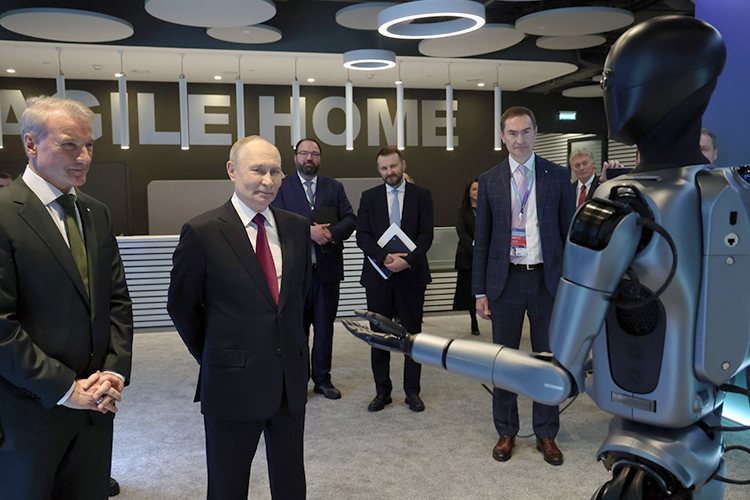
GPT. At the AI Journey conference, new AI-based products were showcased,
ranging from service robots to medical terminals.
Nevertheless, according to analysts, Russia still
significantly lags behind the United States, the EU, and China in computing
capacity and research capabilities.
Putin stated that the contribution of artificial
intelligence to the national economy could exceed 11 trillion rubles by 2030.
Moscow expects accelerated adoption of AI across industry, transport,
healthcare, and the financial sector.
In Europe, such forecasts are viewed more as indicators of
political priorities than as guaranteed scenarios; experts highlight that the
feasibility of these plans depends on technological availability and an open
innovation environment.
Sanctions have severely limited Russia’s access to modern
microchips and high-performance GPUs — key components for training large
models. This makes the goal of strengthening technological sovereignty
particularly challenging.
European analysts believe that Russia is forced
to develop its own solutions under conditions of increasing isolation, while
the global AI industry is moving toward integration and cooperation. Putin
noted that AI regulation should not “slow down development.” However, he
simultaneously called for restrictions on the use of foreign models in
strategically important sectors. This approach illustrates a distinctly Russian
combination of interest in innovation and a consistent emphasis on state
control.


 Latest news
Latest news
Latest newsUkraine’s Battlefield Experience Opens New Opportunities in Asia’s Drone Market
19.Jun.2026
Azerbaijan’s Oil Trap: Why the Economy Is Standing Still
18.Jun.2026
Motorcycle Noise Seen as Obstacle to Air Defense Operations in Crimea
17.Jun.2026
Rising Wages and Euro Integration: Bulgaria Enters a New Economic Era
17.Jun.2026
Armenia After June 7: Pashinyan Remains in Power, Moscow Unhappy
17.Jun.2026
$300 Billion Deal: Iran Poised to Receive the Largest Investment Package in Modern Middle Eastern History
16.Jun.2026
Infrastructure Pressure: Putin Acknowledges the Economic Impact of Ukrainian Attacks
15.Jun.2026
Kyiv and Moscow Trade Blame After Damage Reported at Kyiv Pechersk Lavra
15.Jun.2026
IMF Raises Georgia’s Economic Growth Forecast to 6.5% for 2026
15.Jun.2026
EU Opens the Door to Ukraine and Moldova as First Membership Talks Begin
14.Jun.2026