
 24 Jun 2026









- Scalability. Civilians can be quickly trained to operate interceptors, allowing Ukraine to rapidly close air-defense gaps.
- Economic sustainability. Cheap defense against cheap attacks is the only viable model in 21st-century warfare.
- Societal integration. Unlike mobilization, volunteer participation is a psychological resource. Citizens turn from passive observers into active defenders of their communities.
- A response to technological evolution. Russia uses autonomous UAVs, swarm attacks, decoy drones, and strike UAVs with modified routes and low signatures. A people’s air-defense system is flexible enough to adapt faster than the regular army.
- Lack of infrastructure. Ukraine is still building its network of alerts, navigation support, target distribution, and communication between volunteers and regular air-defense units.
- Technical risks. Civilians — even trained ones — must operate under high stress and heavy operational load.
- Dependence on production. Mass production of interceptors is critical. If Russia begins using even cheaper UAVs, the arms race may accelerate.
Ukraine Builds a “People’s Air Defense”
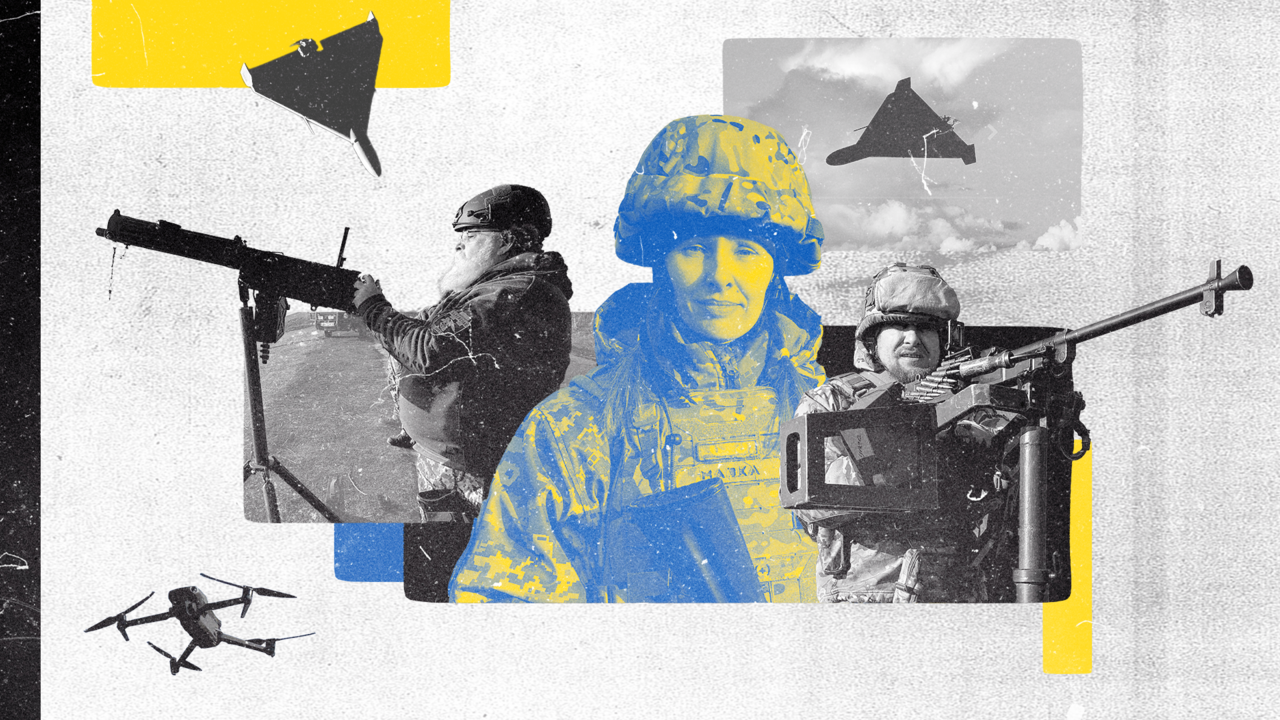
Massive night strikes on Ukrainian cities are increasingly accompanied not only by the work of regular air-defense forces, but also by the efforts of civilian volunteers. As Russia deploys hundreds of drones and cruise missiles in a single attack, Ukraine has begun forming a multi-layered counter-drone defense system unparalleled anywhere in the world — and ordinary citizens are starting to play a key role in it.
This decision goes far beyond military tactics. It reshapes Ukraine’s defense structure, strengthens societal resilience, and creates a new model of “hybrid air defense”, where the regular army and civil society operate as a unified organism.
On November 19, a Russian Kh-101 missile strike on an apartment building in Ternopil served as a painful reminder that even western regions of Ukraine, long considered the deep rear, are no longer safe. According to Ukraine’s air-defense forces, Russia launched more than 48 missiles and 470 drones that night, most of them targeting western regions and Kharkiv.
Classic air-defense systems — Patriot, NASAMS, IRIS-T — effectively intercept missiles, but using them against swarms of cheap, small, low-visibility drones is economically unsustainable. A missile worth a million dollars fired at a drone costing $20–30 thousand is not a viable model of warfare. Ukraine was forced to seek alternatives.
In 2024–2025, the Ministry of Defense of Ukraine began integrating civilian volunteers into the Territorial Defense Forces (DFTG) as part of a nationwide counter-drone network. These are not mobilized soldiers, but ordinary residents — engineers, IT specialists, entrepreneurs, teachers. Their tasks include supporting air-defense operators, guiding interceptors, and helping operate low-cost “interceptor drones”.
“We understand: a drone is flying toward our neighborhoods, toward our homes. And we want to meet it first”, says a 43-year-old volunteer known by the callsign “Strela”, one of the members of the formation.
“Strela” already has over 200 hours of training flights. She recalls how her group shot down three Shaheds in one night, when a Russian attack passed directly over their positions.
Ukraine is actively developing its own interceptor drones — small, maneuverable devices designed to detonate upon contact with the target. The cost of such drones is €2000–5000, which is tens of times cheaper than most Western air-defense missiles.
Technically, they can climb to altitudes of up to 4 km, reach speeds of 300 km/h, and intercept drones such as the Shahed, which flies at around 240 km/h.
The main difficulty is the need for a large number of operators. This is why Ukraine is engaging civilians in training: a single district may require dozens of crews, and according to military estimates, protecting three north-south defensive lines requires up to 700 crews, plus another 100 just for Kyiv.
Engaging civilians creates a unique defense model unseen in any other country:
Despite its potential, the model also has weaknesses:
Ukraine is betting on mass participation, decentralization, and technology: the country is gradually building a defense model in which every community becomes a mini air-defense hub, and every district becomes part of a national counter-drone network. This approach may become a prototype for future air-defense doctrines worldwide, especially for countries facing threats from mass-produced kamikaze drones.
The “people’s air defense” is not a temporary measure but a strategic shift. Ukraine is transforming its civil society into a powerful component of national defense, capable of compensating for shortages of trained personnel and equipment. This approach may reshape the very nature of modern warfare, where states will be forced to build counter-drone systems based not only on their armies, but also on the participation of trained, organized civilians connected to a unified national network.


 Latest news
Latest news
Latest newsUkraine’s Battlefield Experience Opens New Opportunities in Asia’s Drone Market
19.Jun.2026
Azerbaijan’s Oil Trap: Why the Economy Is Standing Still
18.Jun.2026
Motorcycle Noise Seen as Obstacle to Air Defense Operations in Crimea
17.Jun.2026
Rising Wages and Euro Integration: Bulgaria Enters a New Economic Era
17.Jun.2026
Armenia After June 7: Pashinyan Remains in Power, Moscow Unhappy
17.Jun.2026
$300 Billion Deal: Iran Poised to Receive the Largest Investment Package in Modern Middle Eastern History
16.Jun.2026
Infrastructure Pressure: Putin Acknowledges the Economic Impact of Ukrainian Attacks
15.Jun.2026
Kyiv and Moscow Trade Blame After Damage Reported at Kyiv Pechersk Lavra
15.Jun.2026
IMF Raises Georgia’s Economic Growth Forecast to 6.5% for 2026
15.Jun.2026
EU Opens the Door to Ukraine and Moldova as First Membership Talks Begin
14.Jun.2026