
 13 Oct 2026









Armenia Delivers Protest Note to Russian Ambassador over Vladimir Solovyov’s Statements
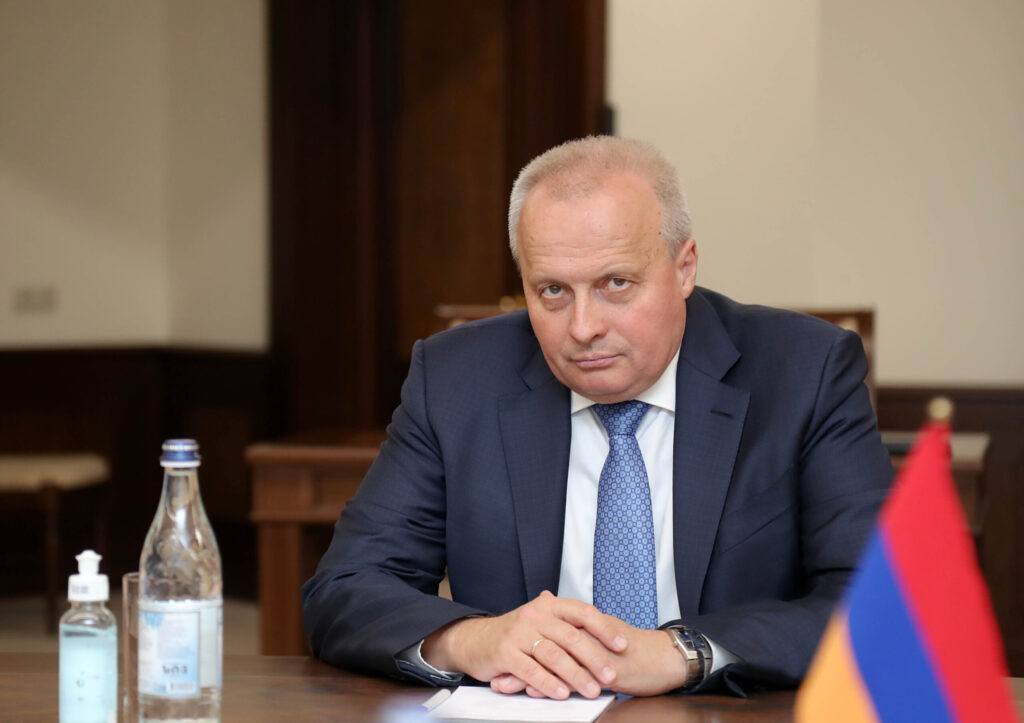
The
Ambassador of the Russian Federation to Yerevan, Sergey Kopyrkin, was summoned
to the Ministry of Foreign Affairs of Armenia, where he was handed an official
note of protest in connection with statements made by Russian television host
Vladimir Solovyov. This was reported by the press secretary of the Armenian
Ministry of Foreign Affairs, Ani Badalyan.
The note expresses deep indignation over the content of
remarks voiced on a program broadcast by a media outlet that is part of
Russia’s state-owned media holding. As Badalyan emphasized, the Armenian side
regards these statements as an unacceptable encroachment on the country’s
sovereignty.
“It was emphasized that these statements constitute an unacceptable infringement on the sovereignty of the Republic of Armenia, carry a hostile character, and grossly violate the fundamental principles of friendly relations between Armenia and the Russian Federation”, Ani Badalyan stated.
Particular attention in Yerevan was drawn to the fact that
such rhetoric was aired on a state television channel, and therefore cannot be
viewed merely as the private opinion of a media figure.
The diplomatic response was triggered by remarks made by
Vladimir Solovyov on January 11, in which he allowed for the possibility of
conducting forceful operations in regions he referred to as Russia’s so-called
“zone of influence.” Commenting on relations with Yerevan, he spoke of the
“loss of Armenia”, describing it as, in his words, a “giant problem”.
The statements provoked a broad public reaction in Armenia.
Narеk Karapetyan, coordinator of the “Po-nashemu” (“Our Way”) movement,
responded by stressing that Armenia has always been and will remain a sovereign
state.
“We respect our friends and neighbors, but we respect ourselves more”, Karapetyan said.
The Armenian Ministry of Foreign Affairs underscored that
the summoning of the ambassador and the delivery of the protest note are part
of standard diplomatic practice and reflect Yerevan’s firm stance on
safeguarding sovereignty and national dignity.
The move should be seen as a deliberate and carefully
calibrated diplomatic step aimed not at escalation, but at clearly delineating
“red lines”. Armenia has made it clear that it does not intend to ignore
statements that could be interpreted as signals legitimizing the use of force
or interference in its internal affairs.
Crucially, Yerevan’s response remains fully within the
framework of international diplomatic norms and demonstrates Armenia’s
commitment to defending state sovereignty through political and legal means.
Amid ongoing transformations in the regional security architecture, Armenia is
increasingly asserting its right to an independent position and resisting
attempts to use the information space as an instrument of political pressure.
Thus, the incident can
be viewed as another marker of Armenia’s evolving foreign policy posture — a
shift from restrained reactions to a more explicit and articulated defense of
national interests. Yerevan is sending a clear message: the language of threats,
even when disguised as television rhetoric, will not go without an official and
public response.


 Latest news
Latest news
Latest newsGeorgia’s Constitutional Court Continues Case on Banning Opposition Parties: Political Pluralism at Stake
12.Oct.2026
Azerbaijan and Iran Step Up Security Contacts Amid Hijab Protests
12.Oct.2026
Personnel Shortages Complicate Ukrainian Forces’ Rotation: Ukraine Faces Long-Term Challenges on the Front Line
11.Oct.2026
Trump Eases Sanctions on Russian Fuel After Talks with Putin: Kyiv Fears Boost to Moscow’s War Revenues
10.Oct.2026
Putin Seeks to Strengthen Russia’s Influence in the Post-Soviet Space Through the CIS
10.Oct.2026
Russia and the South Caucasus: External Pressure, Political Competition and a Crisis of Trust
10.Oct.2026
Peaceful Settlement Between Armenia and Azerbaijan: Moving from Declarations to Implementation
10.Oct.2026
Moldova Ready to Accept as Many Ukrainians as Necessary if Situation Worsens This Winter
09.Oct.2026
Turkmenistan Turns Avaza into a Regional Diplomatic Hub as Caspian, Central Asian and CIS Agendas Converge
08.Oct.2026
Romania Scrambles Spanish F-18s After Aerial Targets Detected Near Ukrainian Border
07.Oct.2026
Berlin Deepens Defence Partnership with Kyiv: Germany to Provide Ukraine with €1 Billion in Military Aid
07.Oct.2026
European Parliament Against Georgian Dream: EU Prepares New Response to Tbilisi
06.Oct.2026
Bulgarian Foreign Minister to Discuss European Security and International Law in the Netherlands
05.Oct.2026
Rheinmetall in Bulgaria: Sofia Emerges as a New NATO Defence-Industrial Hub in the Balkans
05.Oct.2026
The Cost of a Long War: Moscow Expands Spending Plans Through 2029
05.Oct.2026