
 22 Nov 2026









Kazakhstan Advances Green Electricity Export Project across the Caspian Sea to Europe
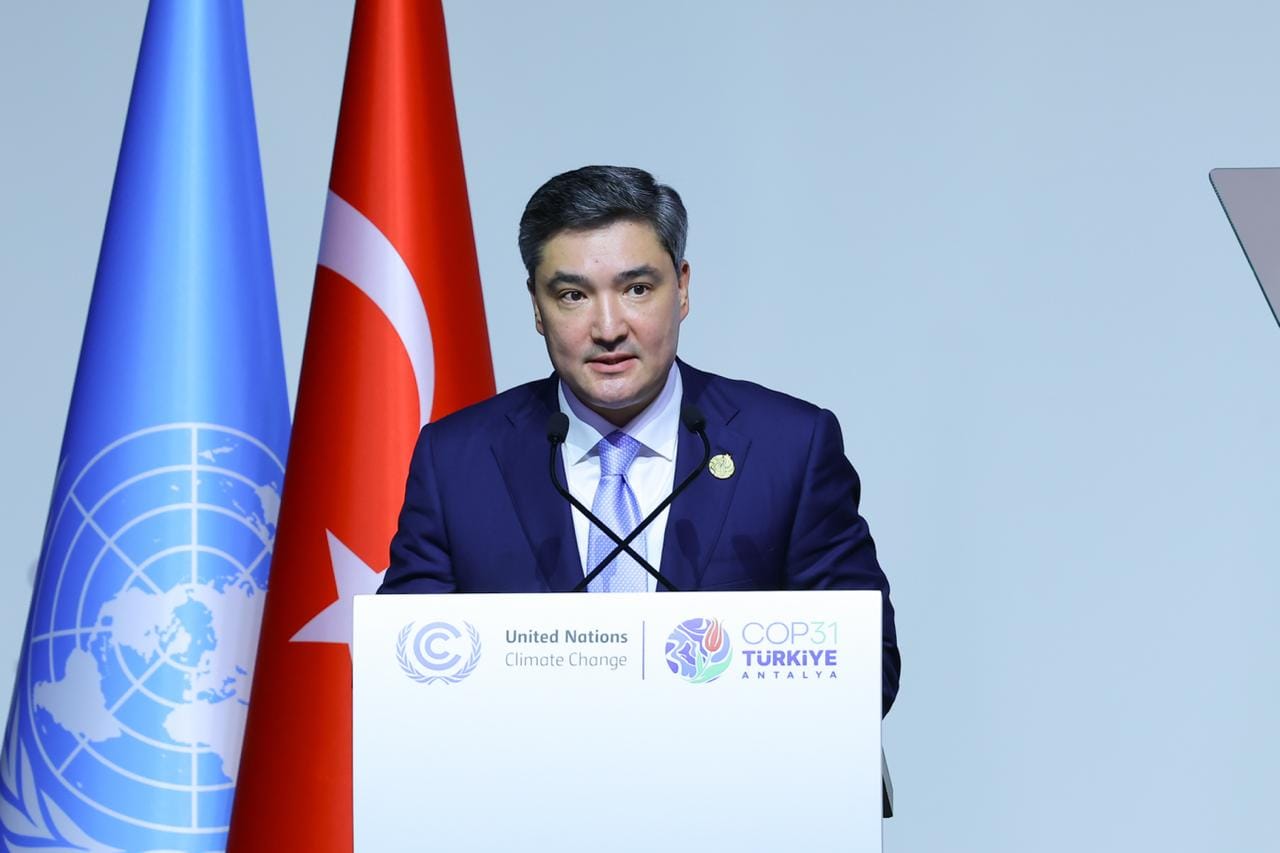
Kazakhstan,
Azerbaijan and Uzbekistan are continuing efforts to establish a transboundary
Green Energy Corridor that would enable electricity generated from renewable
sources in Central Asia to be supplied to European markets via the Caspian Sea.
The project was once again presented by Kazakhstan’s Prime Minister Olzhas
Bektenov at the 31st United Nations Climate Change Conference (COP31), held in
Antalya, Turkiye.
According to the Government of
Kazakhstan, Olzhas Bektenov participated in the climate summit on the
instructions of President Kassym-Jomart Tokayev. In his address, the head of
the Kazakh government emphasised the importance of regional energy cooperation
and highlighted the prospects of the joint initiative involving Kazakhstan,
Azerbaijan and Uzbekistan to develop infrastructure for exporting clean
electricity.
The project envisages the
creation of an energy system that will connect Central Asia’s renewable energy
potential with European markets. One of the key components of the initiative
will be the construction of a high-voltage direct-current (HVDC) submarine
cable along the seabed of the Caspian Sea. It is expected to enable electricity
generated in Kazakhstan and Uzbekistan to be transmitted to Azerbaijan, with
subsequent integration into energy transmission routes leading to Europe.
The legal foundation for
trilateral cooperation was established through an agreement on strategic
partnership in the field of green energy production and transmission, signed by
Kazakhstan, Azerbaijan and Uzbekistan in November 2024 on the sidelines of COP29
in Baku. In 2026, the document underwent ratification procedures in Kazakhstan.
Preparations for a feasibility study are currently underway to determine the
project's technical parameters, financial model and practical implementation
requirements.
Speaking at COP31, Bektenov also provided an update on the development of renewable energy in Kazakhstan. According to him, over the past six years, the share of renewable energy sources in the country's energy mix has increased fourfold, reaching 8% in 2026. Kazakhstan aims to raise this figure to 15% by 2030. At the same time, the country is advancing projects in wind and solar power, nuclear energy and green hydrogen production.
The advancement of the Caspian
energy route is taking place against the backdrop of expanding cooperation
between the countries of the South Caucasus and Europe. On 10 November, on the
sidelines of COP31, Azerbaijan, Georgia, Turkiye and Bulgaria signed an
intergovernmental agreement on strategic partnership in the field of clean energy.
The document provides for the development of infrastructure to transmit
electricity generated from renewable sources along the
Azerbaijan–Georgia–Turkiye–Bulgaria route, connecting the region to European
markets.
Thus,
interconnected directions of energy integration are taking shape: a Central
Asian route crossing the Caspian Sea to Azerbaijan and a South Caucasus route
extending through Georgia and Turkiye towards Europe. Their implementation
could expand the export capacities of the countries involved, contribute to the
diversification of Europe's electricity supply sources and strengthen the role
of the Caspian basin in the development of a new Eurasian energy
infrastructure.


 Latest news
Europe Prepares a Military Mission for Ukraine: 2800 Troops Rehearse Post-War Deployment Scenarios
22.Nov.2026
Russian Missiles and a Drone Fall on Polish Territory: NATO Faces New Threats on Its Eastern Flank
21.Nov.2026
Russia Strikes Kyiv Bridges Following Ukraine’s Attack on the Crimean Bridge: Transport Infrastructure Becomes a New Front in the Escalation
20.Nov.2026
The "Coalition of the Willing" Discusses Security Guarantees and Continued Support for Kyiv
19.Nov.2026
Tanker Sinks off Bulgaria After Being Hit Four Times: All 19 Crew Members Rescued
18.Nov.2026
Europe Accelerates Defence Integration: EU Identifies 8 Priorities for Joint Weapons Development
17.Nov.2026
Bulgaria and North Macedonia Plan to Begin Construction of New Border Crossing in October 2027
17.Nov.2026
Central Asia Accelerates Digitalisation of the Trans-Caspian Transport Corridor
16.Nov.2026
Bulgaria, Romania and Turkiye Deploy Naval Assets in BETUL 8 Rescue Operation
16.Nov.2026
Armenia Becomes the EU’s Leading Partner in the South Caucasus: Georgia Loses Influence in Europe’s Regional Strategy
15.Nov.2026
Ukraine Expands Its Campaign Against Russia’s Strategic Infrastructure
15.Nov.2026
Defence Partnerships without a Common Strategy? Turkiye Expands Military Ties with Qatar, Saudi Arabia and Pakistan
14.Nov.2026
Kobakhidze Says Georgia is Ready to Restore Political Dialogue with the European Union
14.Nov.2026
European Leaders Warn of Growing Russian Pressure on Armenia and Pledge Support to Yerevan
14.Nov.2026
Beyond Washington and Moscow: Europe Seeks a Seat at the Ukraine Negotiating Table
13.Nov.2026