
 13 Oct 2026









Washington panel: Is Georgia still safe for Azerbaijani dissidents?
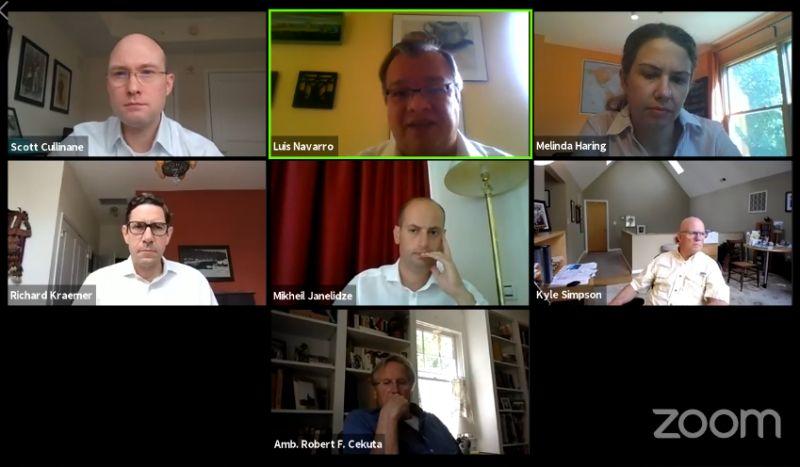
Georgia and Azerbaijan share "common interests in solving any issue" between two countries and steering the regional economy towards betterment, Mikheil Janelidze, Georgia's former foreign minister, said on Friday at a panel organized by Washington-based US-Europe Alliance.
"Our countries have strategic interests... If Azerbaijan wants to be a hub for energy, trade, or data connection, etc, it can't do it without Georgia," he said. More particularly, he was talking about recent challenges between the two countries in terms of Azerbaijan's increasing interest in moving fiber-optic cable through Georgia in order to boost the country’s digital independence from Russia.
For Luis Navarro, a Eurasian program fellow at the Foreign Policy Research Institute, cooperation between Baku and Tbilisi on this issue will indicate whether they are truly aligning themselves with the West.
In the meantime, he added, "it's also important for the West to shift its view of Georgia from being a country that has its parameters to the Caucasus, and expand it to Black Sea".
For Janelidze, cooperation on fiber-optic cable between Baku and Tbilisi will be beneficial for not only both sides, but also for the U.S. interests in the region.
Asked by TURAN's Washington correspondent whether if Georgia still was safe for Azerbaijani independent voices living abroad, particularly those are critical of government, Navarro said, journalist Afgan Mukhtarli's case "raises the question of to what extent is there a transactional relationship between the Georgian government and its neighbours around dissidents."
"it's hard to imagine how the abduction of an Azeri journalist in Tbilisi in 2018] would have been possible without prior knowledge of the Georgian security services," he said. Similar narrative could be seen around Turks who are living in Georgia and are opposed to Erdogan, he added.
The question here, he said, is about what the Georgian governments' approach is in terms of human rights considerations in the region.
"Much depends on Georgian people in terms of moving towards Western direction and how Georgia can help itself continue being a source of economic investments which depend on democratic reforms," he argued.
For Mikheil Janelidze, Georgia's former FM, Tbilisi has to "do its best" to show that it continues democratic path while at the same time, it can be a reliable bridge for Black Sea-Caspian connection.


 Latest news
Latest news
Latest newsGeorgia’s Constitutional Court Continues Case on Banning Opposition Parties: Political Pluralism at Stake
12.Oct.2026
Azerbaijan and Iran Step Up Security Contacts Amid Hijab Protests
12.Oct.2026
Personnel Shortages Complicate Ukrainian Forces’ Rotation: Ukraine Faces Long-Term Challenges on the Front Line
11.Oct.2026
Trump Eases Sanctions on Russian Fuel After Talks with Putin: Kyiv Fears Boost to Moscow’s War Revenues
10.Oct.2026
Putin Seeks to Strengthen Russia’s Influence in the Post-Soviet Space Through the CIS
10.Oct.2026
Russia and the South Caucasus: External Pressure, Political Competition and a Crisis of Trust
10.Oct.2026
Peaceful Settlement Between Armenia and Azerbaijan: Moving from Declarations to Implementation
10.Oct.2026
Moldova Ready to Accept as Many Ukrainians as Necessary if Situation Worsens This Winter
09.Oct.2026
Turkmenistan Turns Avaza into a Regional Diplomatic Hub as Caspian, Central Asian and CIS Agendas Converge
08.Oct.2026
Romania Scrambles Spanish F-18s After Aerial Targets Detected Near Ukrainian Border
07.Oct.2026
Berlin Deepens Defence Partnership with Kyiv: Germany to Provide Ukraine with €1 Billion in Military Aid
07.Oct.2026
European Parliament Against Georgian Dream: EU Prepares New Response to Tbilisi
06.Oct.2026
Bulgarian Foreign Minister to Discuss European Security and International Law in the Netherlands
05.Oct.2026
Rheinmetall in Bulgaria: Sofia Emerges as a New NATO Defence-Industrial Hub in the Balkans
05.Oct.2026
The Cost of a Long War: Moscow Expands Spending Plans Through 2029
05.Oct.2026