
 21 Sep 2026









Explainer: What Is Russia’s Role in Recent Armenian Unrest?
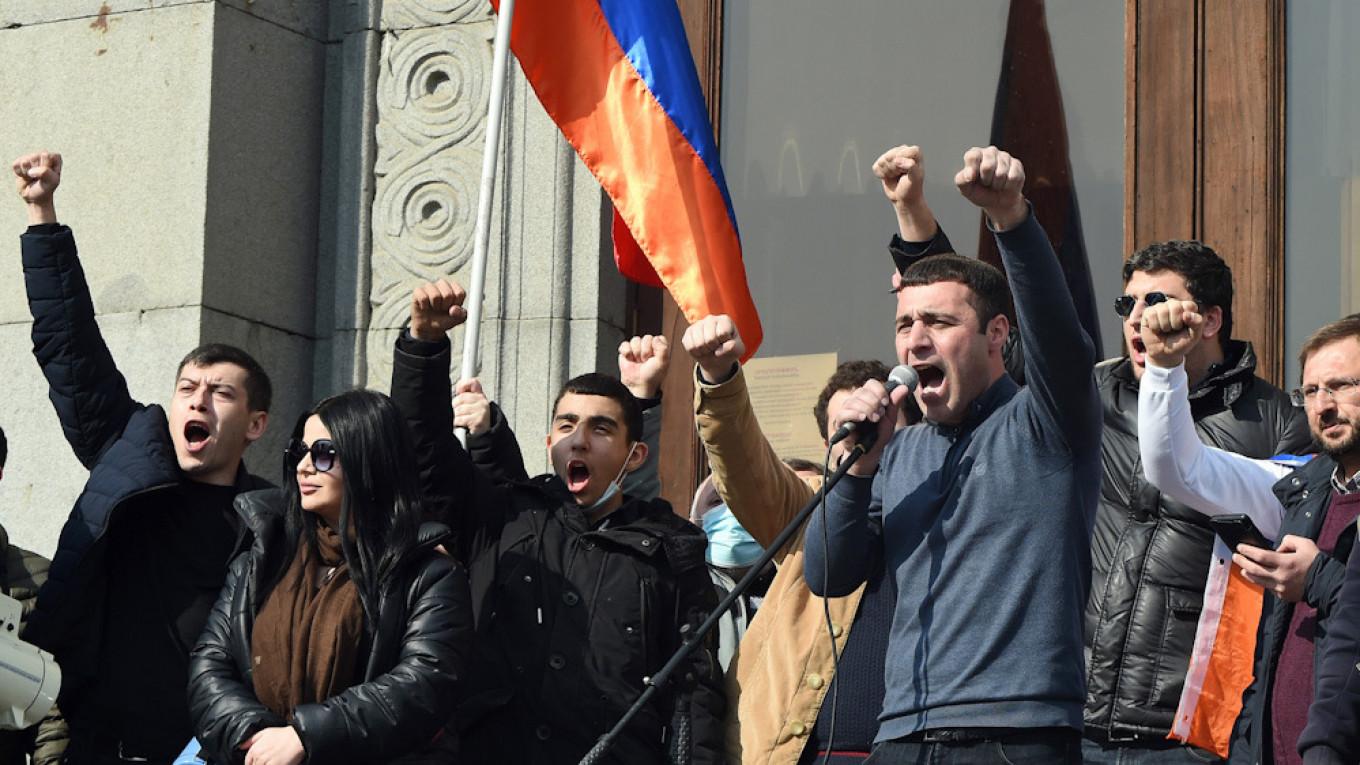
Armenia has faced days of political crisis after its prime minister’s remarks on a Russian missile system that Yerevan used during last fall’s war against Azerbaijan sparked demands for his resignation.
Prime Minister Nikol Pashinyan clashed with the general staff of Armenia’s armed forces after he claimed that Iskander missiles supplied by Russia — Armenia's main military ally — had been ineffective during the war over the disputed Nagorno-Karabakh region.
Tens of thousands of Pashinyan’s supporters and members of the opposition have protested in Yerevan in the days since, with the prime minister accusing the military of an “attempted coup” and defying growing calls to resign.
Here’s a look at what has happened — and what the events mean for Russia’s relationship with Armenia:
What did Pashinyan say?
In a Feb. 23 interview with local television, Pashinyan said that the Russian-made Iskander missiles “didn’t explode, or maybe 10% of them exploded” during the fighting over Nagorno-Karabakh. When asked by the interviewer if that was really true, Pashinyan replied “I don’t know... maybe they were weapons from the ‘80s.”
The comments came after Pashinyan’s predecessor Serzh Sargsyan criticized him for waiting to deploy the Iskander missiles, one of the most sophisticated weapons in Armenia’s arsenal, until the war was essentially over.
Why did a top military official get fired?
On Wednesday, Pashinyan advised the president to fire Tigran Khachatryan, the deputy chief of the general staff, after he ridiculed Pashinyan's comments.
The next day, the military’s general staff, who have traditionally been uninvolved in politics, called on Pashinyan to resign. Pashinyan fired back with an accusation that they were mounting an "attempted military coup."
Pashinyan’s criticism of the Russian missile system provoked “an added element of military defiance [among] those who were seeking Russian support and sensed an opportunity in the potential conflict between the prime minister and Moscow,” Richard Giragosian, director of the Regional Studies Center in Yerevan, told The Moscow Times.
What has Pashinyan said since?
Pashinyan on Monday walked back his criticism of the Russian missile system, saying he had been “misinformed” of its effectiveness. The statement came shortly after a phone call with Russian President Vladimir Putin.
“Pashinyan’s recent correction regarding the missile system is a welcome move after the prime minister’s previous comment which reflected his military inexperience,” Giragosian said.
How has Russia responded?
While Russian lawmakers took umbrage at Pashinyan’s remarks, the Kremlin issued a carefully worded statement in response to the political crisis unfolding in Armenia and extended its support to Pashinyan.
“Vladimir Putin spoke in favor of maintaining order and tranquility in Armenia, resolving the situation within the framework of the law. The head of the Russian state called on all sides for restraint,” a Kremlin readout of Putin and Pashinyan’s call said.
Moscow’s response to the Armenian unrest was so restrained “because the Kremlin is mainly interested in fulfilling the agreement that was signed in order to preserve at least some semblance of peace in the region,” said Vadim Mukhanov, senior researcher at the Moscow State Institute of International Relations (MGIMO).
Why is Russia in Nagorno-Karabakh?
Russia, an ally of both Armenia and Azerbaijan, sought to quell the fighting between the two after the latest clashes broke out in September. Moscow brokered a peace agreement in November that ended the war, with some 2,000 Russian military peacekeepers deployed to Nagorno-Karabakh to enforce it.
“The Russian factor is quite influential, both in domestic and foreign policy, especially after the defeat in Karabakh, which can be assessed as the largest geopolitical crisis in Armenia in post-Soviet history,” said MGIMO’s Mukhanov.
What do the latest events mean for Russia in the region?
The six-week Nagorno-Karabakh war ended in a devastating defeat for Armenia, with a Russia-enforced peace agreement that saw Azerbaijan regain control of districts that Armenia had controlled since the 1990s as well as the strategic city of Shusha. But for Russia, the end of the war presented an opportunity to expand its influence in the region.
“Russia is clearly a winner after years of limited leverage because it was the only conflict in post-Soviet space with no Russian military presence which ended on Moscow’s terms,” Giragosian said.
While the Russia-brokered peace agreement granted regional power-broker status to Moscow, analysts said the outcome of the conflict left Armenians deeply dissatisfied.
“It is clear that these agreements did not satisfy Armenian society and thus ignited protests against Pashinyan, who became the symbol of these agreements,” said Mukhanov.
AFP contributed reporting.


 Latest news
Latest news
Latest newsUS Sanctions Target Russias Main Pillar as Moscow Faces New Pressure on Oil Revenues
19.Sep.2026
Russia Begins State Duma Elections Amid War in Ukraine
18.Sep.2026
Bulgaria Strengthens Protection of Strategic Infrastructure Against Drones and Other Threats
18.Sep.2026
Georgia and Enka: How the Namakhvani Dispute Could Affect the Investment Climate
17.Sep.2026
Una Aleksandra Bērziņa-Čerenkova: After Russia’s Invasion, Latvia Began Banning Russian-Language Media
17.Sep.2026
Rainer Saks: Russia сould lose its influence in Armenia, just as it did in the Baltics
16.Sep.2026
Russian Drones Violated Moldovan Airspace Twice During Zelenskys Trips
16.Sep.2026
Operation Vivaldi: Ukraine Reports Advances Near Lyman as Fighting Intensifies
16.Sep.2026
Kazakhstan and South Korea Elevate Ties to Comprehensive Strategic Partnership
16.Sep.2026
Armenia Energy Diversification: Testing the Limits of Dependence on Russian Gas
15.Sep.2026
Tbilisi Distances Itself from Brussels as Kobakhidze Intensifies Criticism of European Policy
14.Sep.2026
Russia Fuel Crisis Gives the US a New Diplomatic Leverage Tool
14.Sep.2026
Trump Calls on Zelenskyy to Stop Strikes on Russian Oil Infrastructure
13.Sep.2026
Ukraine Expands Pressure on Russia’s Shadow Fleet: Moscow’s Oil Logistics Under Threat
13.Sep.2026
The Riga Conference: Europe Prepares for Long-Term Confrontation with Russia and Reshapes Its Security Architecture
12.Sep.2026