
 28 Aug 2026









Preserving Stability While Claiming Change: An Analytical Look at Kazakhstan’s Constitutional Draft
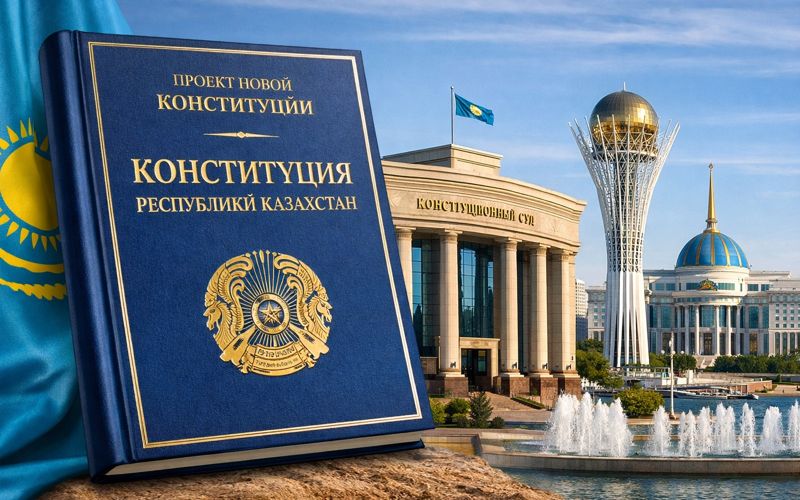
The
publication of the new Constitution of the Republic of Kazakhstan on January
31, 2026, stands out as one of the most notable political and legal events in
recent years, as it is not merely an adjustment of certain provisions, but an
attempt to rethink the very model of the state amid a growing public demand for
participation, fairness, and managed reforms. The draft was developed by the
Constitutional Reform Commission based on a broad public dialogue: more than
2,000 proposals from citizens, political parties, civil society organizations,
and experts were taken into account and discussed during public hearings,
reflecting an effort to incorporate the realities and expectations of a wide
range of social groups. The authorities present the document as the result of a
“mature public consensus” and a logical continuation of the course toward
political modernization. However, behind the scale of the reform — reworking
over 80% of the current Constitution — lies a fundamental question: does this
represent a real redistribution of power and responsibility, or a subtler
adaptation of the existing system to new societal expectations and external
contexts?
It is symbolic that, even at the level of fundamental
provisions, the draft seeks to strike a balance between modernization and the
preservation of the status quo. On one hand, there is a strengthened rhetoric
of popular sovereignty, citizen participation, and a “people-centered state”.
On the other hand, the key pillars of the current political structure,
including the dominant role of the executive, remain intact. In this sense, the
new constitutional draft does not represent a break with the past, but an
institutionally calibrated revision of it.
A particularly indicative element of this balance is the preservation of Russian as an
official language alongside the state language, Kazakh. In a
context where language issues are often used in the post-Soviet space as tools
of political mobilization or identity pressure, the decision to maintain the
existing model can be seen as a deliberate stabilizing measure. It signals a
desire to avoid sharp symbolic shifts that could provoke social or regional
tensions, and confirms the authorities’ pragmatic approach to the country’s multinational
structure. At the same time, the Constitution again limits itself to fixing the
status quo, without offering a long-term vision of language policy as a tool
for integration and the formation of a shared civic identity.
The declared enhancement of the role of the people is to be
realized through the reform of state institutions and the introduction of new
forms of representation, including the People’s Council. Formally, it is intended to serve as a
platform for expressing public interests and facilitating feedback between the
state and society. However, its advisory nature and the absence of clearly
defined mechanisms for influencing decision-making create the risk that the
body will function primarily symbolically, enhancing the legitimacy of power
without changing the actual distribution of authority.
Overall, the constitutional draft demonstrates the
authorities’ desire to speak a new language — the language of participation,
justice, and dialogue — while avoiding radical institutional shifts. Even the
expanded chapter on rights and freedoms, brought closer to international
standards, runs up against a longstanding problem of Kazakhstan’s political and
legal system: the gap between the norm and its implementation. Without
strengthened judicial independence and effective constitutional oversight,
these new guarantees risk remaining largely declarative.
Ultimately, the new constitutional draft gives the impression of a carefully constructed compromise. It reflects the evolution of political discourse and an attempt to respond to public demand for renewal without jeopardizing the manageability of the system. The preservation of Russian as an official language, alongside cautious institutional reforms, underscores the overall character of the document: it is neither a revolution nor a break from the previous model, but a managed modernization, the success of which will be determined not by the text of the Constitution, but by how consistently and sincerely it is implemented in practice.


 Latest news
Latest news
Latest newsRussia Intensifies Strikes on Ukraine’s Infrastructure, Targeting Warehouses and Logistics Hubs
28.Aug.2026
A New Economic Framework for Central Asia and the Caucasus: The Role of Azerbaijan and Uzbekistan
28.Aug.2026
Moscow Warns London: Russia Considers Strikes on British Military Targets
27.Aug.2026
Kazakhstan Launches a New Economic Strategy: GDP Growth, Investment and Pension Reform
27.Aug.2026
CIA Director Visits Moscow: Trump Hopes for Results
26.Aug.2026
Former Ukrainian Defense Minister Warns of Risk of Gradual Defeat in War with Russia
25.Aug.2026
Putin Authorizes Temporary State Management of Critical Infrastructure Vulnerable to Drone Attacks
24.Aug.2026
The United States Rapidly Expands Missile Production: Pentagon Accelerates Output of Tomahawks and Other Critical Weapons
24.Aug.2026
Record Supplies: Armenia Boosts Fish Exports to Georgia
23.Aug.2026
Political Battle During Wartime: Zelensky Opposes Elections
23.Aug.2026
Romania Approves Construction of One of the Largest Solar Power Plants in Europe
23.Aug.2026
Ex-Ukrainian Defence Minister Fails in Bid to Pressure Zelenskiy
22.Aug.2026
Upper Lars: Why Border Queues Have Become a Political Signal for Georgia and Russia
22.Aug.2026
Russia-Ukraine War: No Decisive Breakthrough on the Front and Intensifying Ukrainian Deep Strikes on Russia
21.Aug.2026
TRIPP, Peace, and a New Geopolitical Crossroads: How Armenia Has Changed One Year After Washington
20.Aug.2026