
 14 Jul 2026









TRIPP and Uranium: Washington vs. the Moscow–Paris Nexus
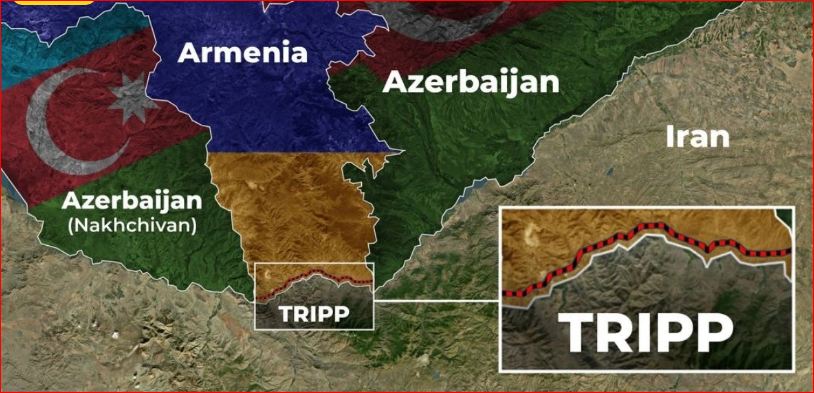
The Vice President of the United States has begun a tour of the South Caucasus, with Armenia as the first stop, followed by Azerbaijan. The official agenda of the visit by J.D. Vance and his accompanying spouse has not been disclosed. Nevertheless, the sequence of the trip and the broader diplomatic context suggest that Washington’s primary focus is precisely on Armenia — as a key element of the new American infrastructure and geo-economic initiative TRIPP (Trump Route Infrastructure and Partnership Project).
The project envisages the creation of a transport route that would provide direct connectivity between mainland Azerbaijan, its exclave Nakhchivan, and Turkey through southern Armenia. To implement the project, the establishment of a separate operating company is planned: approximately 74% of the shares are expected to be held by the American side, with the remaining 26% allocated to Armenia. Formally, sovereignty over the territory would remain with Yerevan; however, operational management and the adoption of key strategic decisions would shift under U.S. control. In the longer term, a revision of the ownership structure cannot be ruled out, further reinforcing the project’s asymmetry.
Logistics, however, represent only the visible tip of the TRIPP iceberg. As noted by Armenian and international experts, behind the infrastructure façade lies a broader geo-economic calculation. According to Dr. Vahé Davtyan, Doctor of Political Science and specialist in energy security, U.S. interest in Armenia’s Syunik region is partly linked to access to the region’s uranium resources. Based on a map of uranium-bearing zones compiled by Academician Petros Aloyan — one of Armenia’s leading experts in subsoil resource management — Syunik constitutes one of the country’s most promising uranium regions.
 Uranium Mine
Within this logic, the TRIPP project fits into the global competition for nuclear resources. Davtyan emphasizes that Washington’s geo-economic objective is to reduce the gap with Russia and China, where the development of nuclear energy — including fast-neutron reactors and thorium technologies — is progressing at an accelerated pace.
An additional factor is the U.S. desire to prevent the diversification of uranium supplies to France amid Paris’s weakening positions in Africa, particularly in Niger and Gabon. The European market, according to Davtyan, continues to be viewed by the Trump administration as a space for economic pressure and redistribution of influence. In this sense, TRIPP becomes not only a regional but also a transatlantic instrument.
The French Factor: The South Caucasus as a New Arena of Competition with the United States
The TRIPP project fits into a broader context of U.S.–French contradictions. The conflict between Washington and Paris under the Trump administration was not limited to trade tariffs or the U.S. withdrawal from the Paris Climate Agreement. At its core lay a deeper divergence of strategic approaches: the “America First” doctrine versus France’s concept of European strategic autonomy, disagreements over NATO’s role, support for Ukraine, and rivalry for influence in the Arctic and the Global South.
 French parliament
Today, this conflict is gradually shifting to the South Caucasus. A telling signal was a resolution adopted by the French parliament on the eve of Vice President Vance’s visit to the region and on the very day of the meeting between Armenian Prime Minister Nikol Pashinyan and Azerbaijani President Ilham Aliyev in Abu Dhabi. The document demanded the release of individuals detained in Baku and employed the term “Artsakh”, returning the discourse to the plane of separatist rhetoric.
The symbolism of the date lent the resolution the character of a political demarche against the backdrop of attempts to build direct Azerbaijani-Armenian dialogue without intermediaries. Already the next day, life sentences were handed down in Baku to a number of figures associated with former separatist structures, which appeared as a demonstrative response to external pressure. At the same time, Yerevan’s official position in recent months has been noticeably more pragmatic and does not fully coincide with Paris’s hard line.
Notably, several weeks earlier, within the framework of informal agreements, Azerbaijan had transferred four prisoners to Armenia who had ended up in Baku’s custody during the hostilities of 2020–2023. Following the French resolution, Baku conveyed through diplomatic channels that such steps are perceived as a “double game” and could complicate the parameters of a future peace treaty. Given that the concept of a “Real Armenia” is a cornerstone of Pashinyan’s electoral campaign, the confrontational line pursued by Paris regarding the Armenian-Azerbaijani settlement is causing growing irritation within Armenian government circles as well. According to CCBS sources, after the August summit in Washington, Pashinyan personally asked Macron to “rein in his horses”. In this light, the latest resolution of the French Senate may be a sign that Paris did not heed this request.
The Uranium Knot: When Moscow and Paris Look in the Same Direction
It is uranium that once again brings the Russian factor into play. Russia remains the largest supplier of enriched uranium to both the United States and Europe. On February 3, Emmanuel Bonne, adviser to French President Emmanuel Macron, arrived in Moscow and met with Putin aide Yuri Ushakov. Officially, the topic was Ukraine, but according to sources, uranium also featured in the discussions. As practice shows, France continues to actively purchase Russian enriched uranium and natural uranium from Central Asia transiting through Russia.
France remains one of the EU countries most actively opposing a complete ban on imports of Russian nuclear materials. A Greenpeace report published at the end of January confirms that uranium trade between Paris and Moscow continues under conditions of limited transparency. France imports both enriched uranium from Russia and natural uranium from Kazakhstan and Uzbekistan, a significant portion of which transits Russian territory. According to French customs data, re-enriched uranium of Russian origin accounted for approximately 18% of the relevant imports as of September 2025.
In this context, contacts between the Élysée Palace and the Kremlin may reflect a convergence of Moscow’s and Paris’s interests in containing U.S. influence within the framework of TRIPP. Russia, gradually losing its positions in the Armenian-Azerbaijani settlement, is objectively interested in preserving leverage over Armenia. France, in turn, seeks to prevent the definitive monopolization of the region by the United States.
Thus, Armenia is increasingly clearly turning into an object of intersecting interests of several external power centers. The strengthening of the American presence through TRIPP, the growing divergence between the priorities of Yerevan and Paris, and the potential tactical rapprochement between France and Russia on an anti-U.S. basis are forming a new, unstable configuration in the South Caucasus — with long-term consequences for both regional security and global energy policy.
CCBS Expert Group


 Latest news
Latest news
Latest newsUS Ready to Lift Sanctions on Turkiye and Restore Its Participation in the F-35 Program
09.Jul.2026
Trump Announces Transfer of License to Ukraine for Patriot Interceptor Missile Production
09.Jul.2026
The NATO Summit in Ankara Marked a New Stage in the Alliance's Transformation
08.Jul.2026
The war in Ukraine - the “liberation of Novorossiya” is a mission impossible
07.Jul.2026
Ursula von der Leyen's Visits to Baku and Yerevan Signal Brussels' New Strategy
07.Jul.2026
Putin's Approval Ratings Decline as Russians Grow Increasingly Concerned About the Economy and the War
06.Jul.2026
Erdogan and Radev Discuss Black Sea Security and Defense Cooperation
06.Jul.2026
OPEC+ Accelerates Output Recovery as Kazakhstan Increases Oil Production from August
05.Jul.2026
Georgia and Uzbekistan Elevate Relations to Strategic Partnership
05.Jul.2026
Iran Turns Khamenei Funeral into a Show of Strength as Week-Long National Mourning Begins
04.Jul.2026