
 14 Jul 2026









- A geopolitical counterbalance to the China–Pakistan axis;
- An alternative connectivity route to Europe and West Asia via the International North–South Transport Corridor (INSTC), potentially reducing transit time by over 40%;
- A practical platform for defense exports and limited operational exposure without formal alliance commitments.
- Managing competition with China, particularly in the Indo-Pacific and along contested border areas;
- Limiting Pakistan’s regional maneuverability, especially in the context of connectivity initiatives;
- Expanding influence across the Global South through development, climate, and financial diplomacy.
- A supplementary route complementing maritime trade corridors;
- A geopolitical space where Turkish and Chinese influence is expanding;
- A potential stabilizing link within the INSTC framework.
- China, through Belt and Road investments;
- Turkiye, via expanding military cooperation with Azerbaijan;
- Russia, maintaining a security presence in Armenia despite reduced regional leverage;
- The EU and the United States, increasing political and humanitarian engagement.
- Deepened Engagement — Expanded infrastructure investment and advanced defense cooperation.
- Managed Pragmatism (Most Likely) — Continued defense exports and moderate INSTC development without alliance commitments.
- Strategic Retrenchment — Reduced regional involvement if Indo-Pacific tensions intensify.
- Armenia’s diversification of security partnerships;
- The gradual development of INSTC connectivity;
- Expanded diplomatic presence without bloc alignment.
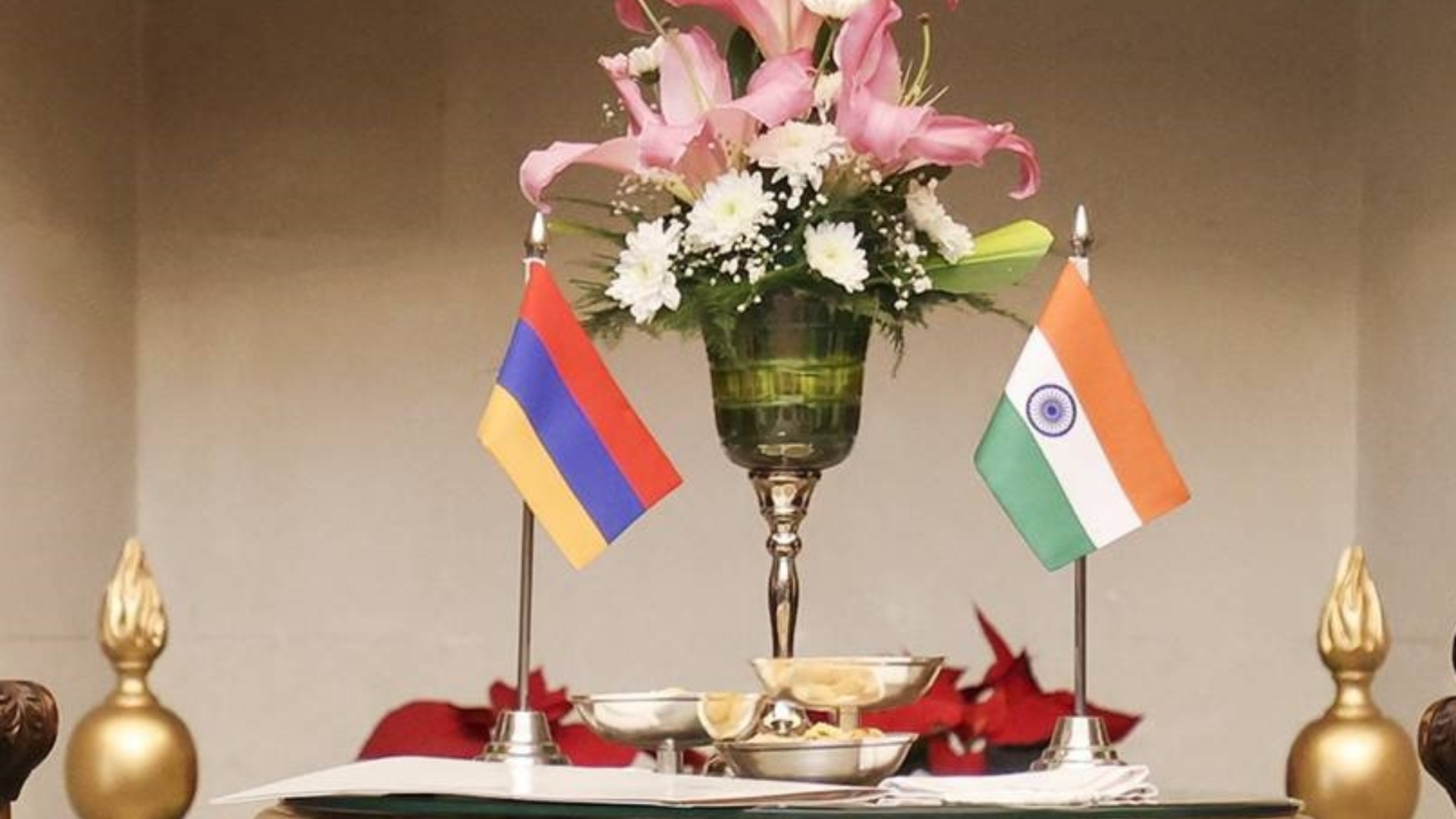
India’s Long-Term Strategy in the South Caucasus: Armenia’s Role as a Key Partner
Introduction
Despite its relatively small geographic size, the South Caucasus holds significant geopolitical importance as a crossroads of major power interests, energy flows, and transport corridors. The region plays a growing role in global stability and Europe’s energy security. Following the signing of the India–EU trade agreement in early 2026, the transport relevance of the South Caucasus has further increased, offering shorter and potentially more secure routes connecting India to European markets.
For India — which has evolved from a regional power into an emerging global actor (becoming the world’s third-largest economy by purchasing power parity in 2025, with GDP reaching approximately $4.5 trillion in nominal terms) — the South Caucasus represents an additional arena for strengthening strategic autonomy in a multipolar international system.
According to the 2025 report of the Observer Research Foundation (ORF), the region serves not only as a logistical gateway toward Europe and Central Asia but also as a geopolitical balancing space vis-à-vis China and Pakistan, particularly through expanding India–Armenia defense cooperation.
Following the 2020 Nagorno-Karabakh war and Azerbaijan’s reassertion of control over the region in 2023, accompanied by the displacement of the Armenian population, the geopolitical landscape of the South Caucasus shifted considerably. These developments encouraged New Delhi to pay increased attention to Armenia as a potential strategic partner within the region.
In early 2026, bilateral relations deepened further with the visit of India’s Chief of Defence Staff, General Anil Chauhan, and the public presentation of Indian defense systems already delivered to Armenia. The total value of bilateral defense contracts has exceeded $2 billion, positioning Armenia among the notable importers of Indian military equipment.
India’s engagement in the South Caucasus can be understood through three main dimensions:
This assessment is grounded in India’s long-term strategic culture, which emphasizes calibrated engagement, risk management, and avoidance of rigid bloc politics.
India’s Strategic Identity in a Multipolar Order
Between 2025 and 2026, India’s strategic identity continues to be shaped by its transition from Cold War-era non-alignment to a model of “multi-alignment.” This approach allows India to maintain parallel partnerships with the United States, Russia, the European Union, and Iran without entering binding alliance structures.
India’s foreign policy priorities — as identified in ORF analyses — center on economic growth, national security, and leadership in the Global South. With a defense budget of approximately $75 billion in 2025 and expanding participation in multilateral platforms such as the G20 and BRICS, India has strengthened its confidence as a middle-to-major power.
Three core strategic priorities define India’s external posture:
India’s strategic culture is marked by caution, gradualism, and long-term calculation. Its simultaneous engagement with Russia, the United States, and Iran reflects a deliberate effort to preserve strategic flexibility.
For Armenia, this approach offers opportunities for diversification, particularly in the defense sphere, without obligating Yerevan to rigid geopolitical alignments.
The South Caucasus in India’s Strategic Perception
India increasingly views the South Caucasus as a strategic transit zone linking Europe, Central Asia, and West Asia. The region offers logistical potential while also functioning as a geopolitical interface among Russia, Turkiye, Iran, the European Union, and China.
From New Delhi’s perspective, the South Caucasus represents:
India’s policy therefore remains selective: strengthening ties with Armenia while maintaining functional economic relations with Azerbaijan and Georgia.
India–Armenia Relations: Strategic Depth Without Formal Alliance
India–Armenia relations have evolved into a structured defense partnership, though not a formal alliance. Bilateral trade remains modest, yet defense cooperation has expanded significantly.
Armenia has procured Indian air defense systems, artillery, radar technologies, and other military equipment. This cooperation enhances Armenia’s defense diversification while also serving India’s broader objective of expanding defense exports.
The partnership is supported by political dialogue, educational exchanges, and emerging technological cooperation. Armenia also plays a potential role within the INSTC transit architecture linking India to Europe via Iran.
Functional Relations with Azerbaijan and Georgia
India’s relations with Azerbaijan are primarily energy-focused, with oil imports forming the core of economic interaction. Political engagement remains cautious due to Azerbaijan’s close ties with Pakistan and Turkiye.
With Georgia, India’s engagement is centered on logistics and connectivity. However, NATO–Russia competition and domestic political dynamics limit deeper strategic involvement.
In both cases, India prioritizes economic pragmatism while avoiding security commitments.
The Iranian Dimension
India’s engagement with Iran remains central to the INSTC. Investments in Chabahar Port and associated infrastructure projects aim to provide India with diversified access to Eurasian markets.
Sanctions constraints have required financial adaptation, including local-currency arrangements and indirect trade mechanisms. Armenia’s geographic position strengthens the resilience of this corridor, offering additional transit reliability.
Competitive Environment
India operates alongside multiple influential actors:
India’s approach remains deliberately low-profile, seeking incremental influence rather than overt strategic dominance.
Scenarios of Future Development
Three plausible trajectories can be identified:
The second scenario appears most consistent with India’s broader global priorities.
Conclusion
India’s presence in the South Caucasus is best described as calibrated and low-disruption. New Delhi does not seek to reshape the regional order but rather to secure selective strategic advantages.
Its engagement contributes to:
However, India does not aim to fundamentally alter the structural causes of regional conflicts or displace established powers.
In the long term, India’s role will depend on whether the South Caucasus evolves into a competitive yet open multipolar space or shifts toward rigid geopolitical polarization. In either case, India is likely to remain a cautious but increasingly relevant actor.
Research Fellow,
Araik Mkrtumyan


 Latest news
Latest news
Latest newsUS Ready to Lift Sanctions on Turkiye and Restore Its Participation in the F-35 Program
09.Jul.2026
Trump Announces Transfer of License to Ukraine for Patriot Interceptor Missile Production
09.Jul.2026
The NATO Summit in Ankara Marked a New Stage in the Alliance's Transformation
08.Jul.2026
The war in Ukraine - the “liberation of Novorossiya” is a mission impossible
07.Jul.2026
Ursula von der Leyen's Visits to Baku and Yerevan Signal Brussels' New Strategy
07.Jul.2026
Putin's Approval Ratings Decline as Russians Grow Increasingly Concerned About the Economy and the War
06.Jul.2026
Erdogan and Radev Discuss Black Sea Security and Defense Cooperation
06.Jul.2026
OPEC+ Accelerates Output Recovery as Kazakhstan Increases Oil Production from August
05.Jul.2026
Georgia and Uzbekistan Elevate Relations to Strategic Partnership
05.Jul.2026
Iran Turns Khamenei Funeral into a Show of Strength as Week-Long National Mourning Begins
04.Jul.2026