
 20 Sep 2026









Armenia’s Pashinyan spills water on his desk, clothes to explain what he is doing in Tavush Province
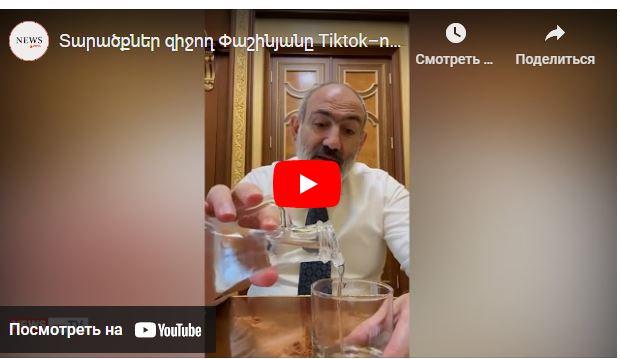
Armenian Prime Minister Nikol Pashinyan dedicated his conversation Tuesday about the state to law, jurisdiction, sovereignty, and territorial integrity.
"These are parts of the trinity because the most important attribute of sovereignty in the conditions of a democratic state is that the people decide the scope of their rights and responsibilities; that is, not others decide what rights and responsibilities the people have, but the people decide," Pashinyan said, noting that it is also important to have an idea of what area these rights and duties operate on.
"This is called jurisdiction in combination with territorial integrity, which essentially makes rights and duties practical and applicable. Sovereignty, law, even statehood without the concretization of the territory are blurred and become scarcely applicable, non-applicable, and even non-viable. That is, the applicability of rights and responsibilities is directly related to the concreteness and territorial integrity of the territory," he said.
To more graphically show what he said, Pashinyan took a vial filled with water, poured the water into a glass, and said: "Imagine that the rights and responsibilities are in a vial. If they are placed in a concrete form, they are applicable and viable, and we can use it to meet our vital needs.
As Pashinyan said this, he took a sip from the water, demonstrating the "use" of rights and responsibilities.
Then, Pashinyan proposed to imagine what would happen if the rights and responsibilities are not enclosed in the form, and poured the water from the vial on his desk.
The water from the desk spilled on Pashinyan's clothes, and he said they become non-vital, blur, and create problems and a feeling of discomfort.
"What we are doing also in the Tavush Province, also in the process of border delimitation and demarcation, also in the peace agenda [with Azerbaijan], has exactly this objective. Within its framework, the range of rights and responsibilities of citizens will be significantly strengthened, this four unity will guarantee the development and existence of our state," said the Armenian PM.
As reported earlier, on April 19, the Armenian and Azerbaijani border delimitation commissions agreed to start border delimitation from Tavush Province of Armenia. The description of the given sections of the border line will be drawn up taking into account the clarification of the coordinates made as a result of geodetic measurements on the site, and this will be worded in a corresponding protocol-description, which must be agreed upon and signed by the two parties before May 15.
The office of the Prime Minister of Armenia had announced that as a result of all this, Azerbaijan will receive 2.5 villages, and Armenia will get a reduction of security risks related to border delimitation. A few hundred meters of the motorway will be changed in the Kirants village section, whereas Voskepar village will not have a motorway problem. After the border delimitation, the armed forces of Armenia and Azerbaijan will withdraw in the area of the four villages, and they will be replaced by the border guards of the two countries.
Residents of Tavush’s border villages have been protesting on the Armenia-Georgia interstate motorway since April 19. They are against the aforesaid version of border delimitation agreed between Armenia and Azerbaijan.


 Latest news
Latest news
Latest newsUS Sanctions Target Russias Main Pillar as Moscow Faces New Pressure on Oil Revenues
19.Sep.2026
Russia Begins State Duma Elections Amid War in Ukraine
18.Sep.2026
Bulgaria Strengthens Protection of Strategic Infrastructure Against Drones and Other Threats
18.Sep.2026
Georgia and Enka: How the Namakhvani Dispute Could Affect the Investment Climate
17.Sep.2026
Una Aleksandra Bērziņa-Čerenkova: After Russia’s Invasion, Latvia Began Banning Russian-Language Media
17.Sep.2026
Rainer Saks: Russia сould lose its influence in Armenia, just as it did in the Baltics
16.Sep.2026
Russian Drones Violated Moldovan Airspace Twice During Zelenskys Trips
16.Sep.2026
Operation Vivaldi: Ukraine Reports Advances Near Lyman as Fighting Intensifies
16.Sep.2026
Kazakhstan and South Korea Elevate Ties to Comprehensive Strategic Partnership
16.Sep.2026
Armenia Energy Diversification: Testing the Limits of Dependence on Russian Gas
15.Sep.2026
Tbilisi Distances Itself from Brussels as Kobakhidze Intensifies Criticism of European Policy
14.Sep.2026
Russia Fuel Crisis Gives the US a New Diplomatic Leverage Tool
14.Sep.2026
Trump Calls on Zelenskyy to Stop Strikes on Russian Oil Infrastructure
13.Sep.2026
Ukraine Expands Pressure on Russia’s Shadow Fleet: Moscow’s Oil Logistics Under Threat
13.Sep.2026
The Riga Conference: Europe Prepares for Long-Term Confrontation with Russia and Reshapes Its Security Architecture
12.Sep.2026