
 07 Nov 2026









Russian Gerbera-2 Drone Discovered and Destroyed on Bulgaria’s Black Sea Coast
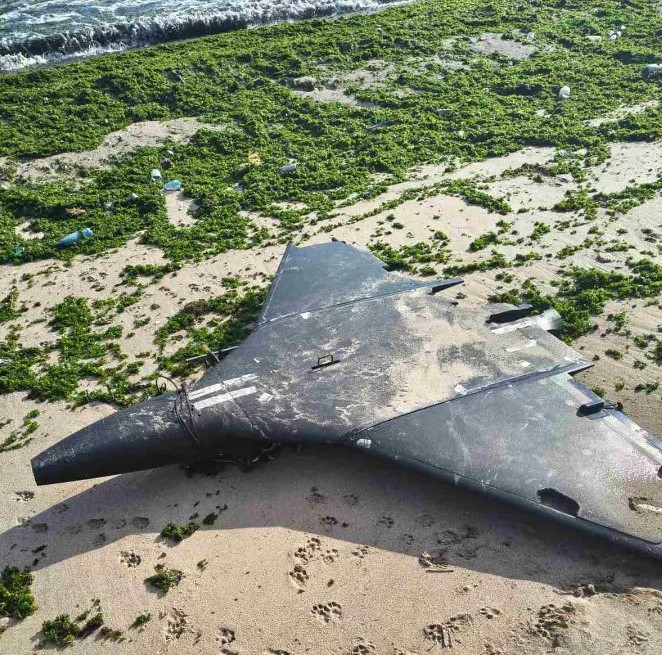
The discovery of a Russian
Gerbera-2 unmanned aerial vehicle (UAV) on Bulgaria’s Black Sea coast marks
another incident highlighting the spillover effects of the Russian-Ukrainian
war into the Black Sea region. Bulgaria’s Ministry of Defence confirmed that
the drone was found on a beach near Cape Shabla, apparently after falling into
the sea and being washed ashore by the waves. Bulgarian Navy personnel examined
the aircraft and destroyed it at the site. No explosives were found on board.
At approximately 10:00 a.m. on
6 November 2026, the duty officer of Bulgaria’s Ministry of Interior received a
report that an unmanned aerial vehicle had been discovered on a beach north of
the Cape Shabla lighthouse, on the country’s northeastern coast. The object was
located approximately 800 metres from the lighthouse. Following the report and
a decision by the Chief of Defence, a specialised team from the Varna Naval
Base was deployed on the orders of the Deputy Commander of the Bulgarian Navy.
Military personnel examined
the site and determined that the drone had most likely fallen into the sea
before being washed ashore by the waves. Following the inspection, specialists
identified the aircraft as a Russian Gerbera-2 drone. The Ministry of Defence
noted that no identification markings or inscriptions were visible on its body.
The inspection established
that the aircraft contained no explosive material. Bulgarian Navy personnel
subsequently neutralised the drone at the site, observing all necessary safety
precautions.
Initial reports by Bulgarian
media suggested that the discovered aircraft might have belonged to the Shahed
family of drones. However, the official identification provided by the Ministry
of Defence ruled out this possibility: the object was identified as a Russian
Gerbera-2.
 The Gerbera-2 is a Russian
unmanned aerial platform used for various purposes, including reconnaissance,
surveillance and serving as a decoy to complicate air defence operations. Such
systems form part of the broader range of unmanned technologies employed in the
Russian-Ukrainian war.
The incident occurred amid
heightened tensions in the western Black Sea. In recent weeks, reports of drone
attacks on commercial vessels near the coasts of Bulgaria and Romania have
raised concerns. These developments have heightened the focus of Black Sea
littoral states on the security of maritime transport routes, the protection of
port infrastructure, and the monitoring of the air and maritime environment.
Although Bulgaria’s Ministry
of Defence has not reported any direct threat to the country’s territory or any
deliberate violation of its airspace, the appearance of a Russian drone on the
Bulgarian coast highlights the extent to which the consequences of military
operations in the region can affect states that are not directly involved in
the conflict. As Russia’s war against Ukraine continues, ensuring security in
the Black Sea is becoming an increasingly important priority for Bulgaria,
Romania and their NATO allies.


 Latest news
Bulgaria Presents Draft 2027 State Budget: Increased Pensions and Investment in Development
07.Nov.2026
Russian Gerbera-2 Drone Discovered and Destroyed on Bulgaria’s Black Sea Coast
07.Nov.2026
Sofia and Washington Discuss Black Sea Security and the Future of Europe's Security Architecture
07.Nov.2026
Green Energy Corridor: a Strategic Opportunity or an Overly Costly Project?
07.Nov.2026
Kremlin Calls for European Involvement in Security Talks without Offering a Concrete Framework
06.Nov.2026
The Caspian Bridge between Azerbaijan and Kazakhstan: Ambitious Plans without Guarantees of Implementation
05.Nov.2026
Armenia Outlines Prospects for Applying for EU Membership in 2027–2028
04.Nov.2026
Moscow Seeks to Maintain Its Influence in the South Caucasus through the “3+3” Format
03.Nov.2026
Kazakhstan Resumes Oil Transit through Russia after Drone Attack
03.Nov.2026
Iliana Yotova's Victory Strengthens Political Stability and Bulgaria's Position in the Black Sea Region
02.Nov.2026
France Expands Military Surveillance Activities in the Black Sea: Romania Gains Strategic Importance
01.Nov.2026
Georgia Brings Black Sea Security to the UN Security Council Agenda
01.Nov.2026
Ukrainian Drone Attacks on Russian Oil Refineries: Russia’s Energy Infrastructure Faces Growing Risks
31.Oct.2026
Who will Pay to Protect Nature? A Council of Europe Expert’s Perspective
31.Oct.2026
OTS Expands Its Defence Agenda: Ankara’s Initiative Raises Questions About the Militarisation of the Organisation
31.Oct.2026