
 07 Nov 2026









Green Energy Corridor: a Strategic Opportunity or an Overly Costly Project?
Azerbaijan, Georgia, Romania
and Hungary are preparing for the next stage of a large-scale project aimed at
exporting electricity from the Caspian region to Europe. A ministerial meeting
involving the countries participating in the Caspian-Black Sea-European Green
Energy Corridor is scheduled to take place in Bucharest in late November 2026.
The total investment required is estimated at €22.1 billion. The project
envisages the development of high-voltage electricity transmission
infrastructure across the South Caucasus and a subsea cable connection across
the Black Sea, potentially opening up a new route for supplying renewable
energy to the European market.
Preparations for the Bucharest
meeting were among the key issues discussed at the latest board meeting of
Green Energy Corridor Power Company (GECO), which is responsible for advancing
the project. According to the company, participants reviewed the outcomes of
the investment forum held in Baku on 22 October, which brought together
potential investors, international financial institutions and representatives
of relevant organisations.
During the upcoming ministerial
meeting, Azerbaijan, Georgia, Romania and Hungary are expected to assess the
progress made and agree on the next steps towards implementing the initiative.
Particular attention will be paid to attracting investment, engaging with
financial institutions and preparing the project for a final investment
decision.
According to GECO's investment
presentation, the total cost of the Caspian-Black Sea-European Green Energy
Corridor is estimated at €22.1 billion. Of this amount, approximately €14.3
billion is expected to be allocated to electricity transmission infrastructure,
while a further €7.8 billion will be directed towards developing renewable
energy generation capacity. Thus, the bulk of the investment will be required
not only for electricity generation but also for establishing complex
cross-border infrastructure to deliver electricity to European consumers.
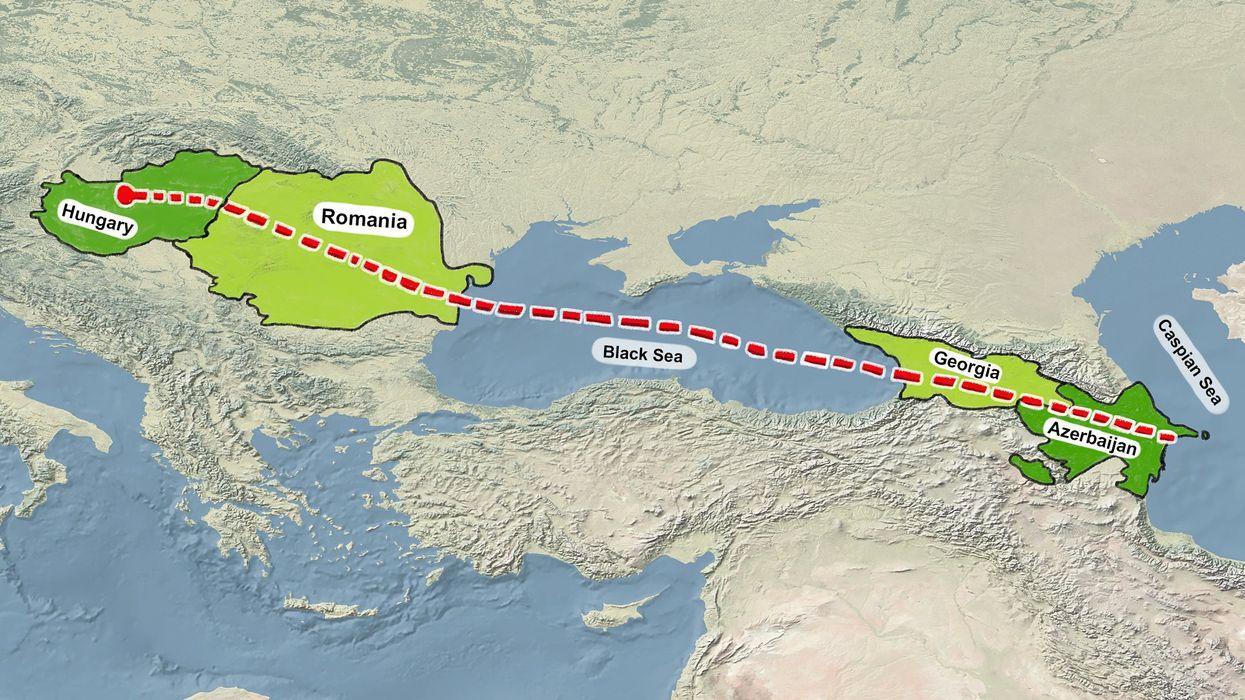
The project envisages the
construction of three independent high-voltage direct current (HVDC)
transmission lines, each with a capacity of 1.3 GW. Their combined transmission
capacity is expected to reach 3.9 GW by 2040. The route will originate in
Azerbaijan, pass through Georgia, cross the Black Sea and connect to the
European electricity grid in Romania and Hungary.
The project is scheduled to be
implemented in three phases. The first line, following the
Baku–Ksani–Anaklia–Constanța–Albertișa route, is expected to become operational
in 2032. The second line, connecting Baku, Tskaltubo, Poti and the Bucharest
area, is scheduled for commissioning in 2036. The third phase envisages the
construction of an additional connection between Baku, Georgian energy hubs and
Romania's Constanța by 2040.
One of the most technically
challenging components of the initiative will be laying the subsea electricity
cable across the Black Sea. The offshore section of each line is expected to be
approximately 1,120 kilometres long, with a maximum installation depth of
around 2,200 metres. This will require specialised technologies, substantial
engineering resources and international cooperation in the construction and
operation of energy infrastructure.
Azerbaijan's renewable energy
potential is expected to serve as the main source of electricity for the new
corridor. In particular, the project envisages developing offshore wind power
in the Caspian Sea, where the potential is estimated at approximately 25 GW.
Additional sources of electricity will include solar and onshore wind power
plants. According to the feasibility study, exports of renewable electricity to
the European Union could reach approximately 8 billion kWh annually following
the launch of the first line in 2032 and increase to 20 billion kWh by 2040.
The project's economic
benefits are also expected to be substantial. According to estimates by the
Italian consulting company CESI, the annual economic benefits could amount to
approximately €860 million following the commissioning of the first line, rise
to €1.8 billion after the second phase and exceed €3 billion upon completion of
the third phase in 2040. Another expected benefit is a reduction in carbon
dioxide emissions of approximately 3.6 million tonnes annually by 2040.
The project's financing model
envisages a combination of public and private investment, long-term loans from
international financial institutions, commercial bank financing and potential
support from the European Union. In particular, the possibility of securing
grants under the Connecting Europe Facility (CEF) is being considered. However,
the potential involvement of European financial instruments does not mean that
the relevant funding has already been allocated or formally approved.
For Azerbaijan, the project
could complement its existing role as a supplier of hydrocarbons to European
markets and create new opportunities to integrate its national energy sector
into European infrastructure. For Georgia, the initiative offers prospects for
strengthening its transit role and attracting investment in its electricity
networks. Romania and Hungary, in turn, could gain an additional source of electricity
and new opportunities to diversify their energy supplies.
At the same time, the scale of
the required investment, the technical complexity of laying subsea cables and
the need to coordinate tariff and commercial arrangements among the four
countries remain significant challenges. Another essential condition for the
project's implementation will be the availability of sufficient electricity
generation capacity and long-term supply agreements.
The forthcoming meeting in Bucharest will mark an important stage in the transition from technical and economic planning towards identifying concrete financial and organisational mechanisms for implementing the project. If successfully implemented, the initiative could strengthen energy connectivity between the Caspian region, the South Caucasus and the European Union.
CCBS Research Desk


 Latest news
Bulgaria Presents Draft 2027 State Budget: Increased Pensions and Investment in Development
07.Nov.2026
Russian Gerbera-2 Drone Discovered and Destroyed on Bulgaria’s Black Sea Coast
07.Nov.2026
Sofia and Washington Discuss Black Sea Security and the Future of Europe's Security Architecture
07.Nov.2026
Green Energy Corridor: a Strategic Opportunity or an Overly Costly Project?
07.Nov.2026
Kremlin Calls for European Involvement in Security Talks without Offering a Concrete Framework
06.Nov.2026
The Caspian Bridge between Azerbaijan and Kazakhstan: Ambitious Plans without Guarantees of Implementation
05.Nov.2026
Armenia Outlines Prospects for Applying for EU Membership in 2027–2028
04.Nov.2026
Moscow Seeks to Maintain Its Influence in the South Caucasus through the “3+3” Format
03.Nov.2026
Kazakhstan Resumes Oil Transit through Russia after Drone Attack
03.Nov.2026
Iliana Yotova's Victory Strengthens Political Stability and Bulgaria's Position in the Black Sea Region
02.Nov.2026
France Expands Military Surveillance Activities in the Black Sea: Romania Gains Strategic Importance
01.Nov.2026
Georgia Brings Black Sea Security to the UN Security Council Agenda
01.Nov.2026
Ukrainian Drone Attacks on Russian Oil Refineries: Russia’s Energy Infrastructure Faces Growing Risks
31.Oct.2026
Who will Pay to Protect Nature? A Council of Europe Expert’s Perspective
31.Oct.2026
OTS Expands Its Defence Agenda: Ankara’s Initiative Raises Questions About the Militarisation of the Organisation
31.Oct.2026